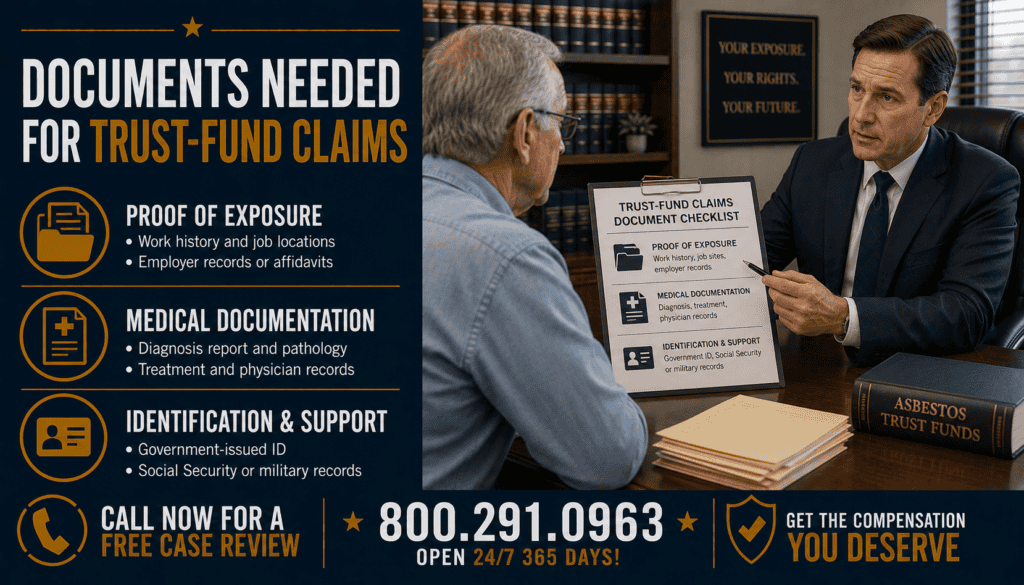
Documents Needed for Trust-Fund Claims
Asbestos bankruptcy trusts hold more than $32 billion to compensate victims diagnosed with mesothelioma, lung cancer, asbestosis, and other asbestos-related illnesses. But unlike lawsuits, which allow live testimony and depositions, trust-fund claims rely almost entirely on documents.
The right paperwork proves the diagnosis, confirms exposure, and links the victim to specific asbestos-containing products. Missing or incomplete documents can delay payment — or prevent approval altogether.
Knowing which documents trusts require helps families prepare strong claims without confusion or unnecessary delays.
If you need help gathering the required documents for your trust-fund claims, call 800.291.0963 for immediate assistance.
📘 Step 1: Why Documentation Is Essential for Trust-Fund Claims
Asbestos trusts were created when companies filed for bankruptcy and were required by the courts to compensate victims.
Because these companies no longer operate normally, trusts rely on written evidence, not in-person testimony.
✔ Trust Funds Require Documents To:
-
Confirm a valid asbestos-related diagnosis
-
Prove exposure to asbestos products
-
Link exposure to the bankrupt company
-
Verify work history
-
Confirm eligibility for payment
-
Ensure consistent information across all claims
Even if exposure occurred decades ago, attorneys can help reconstruct the documentation needed.
🩺 Step 2: Medical Records Required for Trust-Fund Claims
A confirmed medical diagnosis is the foundation of every trust-fund submission.
Without medical proof, trusts cannot legally approve compensation.
🩻 Required Medical Documents Include:
-
Pathology reports
-
Biopsy confirmation of mesothelioma or cancer
-
CT scans, X-rays, or PET scans
-
Imaging reports showing pleural thickening or effusion
-
Pulmonologist or oncologist records
-
Hospital admission and discharge summaries
-
VA medical records (for veterans)
❗Important
If the victim has passed away, trusts still accept medical records from when they were alive.
✔ Optional Supporting Medical Documentation:
-
Cytology reports
-
Tumor board summaries
-
Treatment notes
-
Radiation or chemotherapy records
-
Hospice or palliative care records
More documentation can strengthen your claim, especially when filing with multiple trusts.
📂 Step 3: Employment Records Needed to Prove Work History
Trusts must confirm the victim’s work locations and dates, especially if exposure occurred at multiple job sites.
🧾 Accepted Employment Documents:
-
Social Security “Earnings Summary” (most used)
-
Pay stubs
-
Employment letters
-
Company job timelines
-
Union records
-
Pension records
-
W-2 forms
-
Personnel files
✔ Why Social Security Records Matter
They show:
-
Exact employers
-
Dates worked
-
Earnings by year
This helps attorneys identify which companies’ products were used at your job sites.
🧱 Step 4: Documents That Prove Asbestos Exposure
Trusts require evidence showing the victim was exposed to asbestos-containing products connected to the bankrupt company.
📄 Accepted Exposure Documents:
-
Job-site records
-
Plant or refinery documentation
-
Navy ship logs
-
Maintenance or repair logs
-
Product identification lists
-
Construction blueprints
-
Safety manuals
-
Old photographs of equipment or machinery
🔍 Most Trusts Accept:
-
Co-worker affidavits
-
Occupational expert reports
-
Navy or Army MOS/job specialty records
-
Industrial hygiene reports
Even if official records no longer exist, attorney evidence packages often satisfy requirements.
📁 Step 5: Witness & Co-Worker Affidavits
When exposure occurred decades ago, records may be missing.
Trusts allow sworn affidavits as substitute evidence.
✔ Types of Accepted Affidavits:
-
Co-worker testimony
-
Supervisor testimony
-
Family affidavits (for secondary exposure)
-
Shipmate affidavits (for Navy veterans)
-
Expert affidavits about worksite conditions
💡 Why Affidavits Are Powerful
They confirm:
-
The products used
-
Where exposure occurred
-
Job duties
-
Proximity to asbestos materials
Witness affidavits often unlock eligibility for multiple trust funds.
🧬 Step 6: Documents Required for Deceased Claimants
Families can file trust-fund claims even if the victim passed away years ago.
However, trusts require certain documents to verify authority and confirm the cause of death.
📄 Required Documents Include:
-
Death certificate
-
Probate documents
-
Executor or administrator appointment papers
-
Letters Testamentary or Letters of Administration
-
Will (if available)
✔ Important
The estate representative — not the family — signs trust-fund documents.
📝 Step 7: Trust-Fund Claim Forms & Sworn Statements
Each trust requires its own claim form. Most include:
🧾 Standard Claim Requirements:
-
Medical release form
-
Exposure summary
-
Detailed work history
-
Product identification proof
-
Disease level classification
-
Signed verification and sworn statement
-
HIPAA authorization
❗Executors Sign for Deceased Victims
This ensures trust funds distribute payment properly.
📄 Step 8: Documents Needed for Multiple Trust Fund Filings
Most victims qualify for 10–30 trust funds based on:
-
Job sites
-
Military service
-
Product exposure
-
Occupational history
✔ Once You Provide These Documents, Attorneys Use Them for All Trusts:
-
Medical proof of diagnosis
-
Social Security employment history
-
Exposure affidavits
-
Product identification evidence
-
Executor paperwork (if needed)
-
Worksite confirmations
You do not need separate documentation for each trust.
📜 Step 9: Consistency Requirements Across All Documents
Trust funds cross-check claims against:
-
Previous trust submissions
-
Lawsuits filed
-
Prior affidavits
-
Medical records
-
Employment documents
-
Exposure summaries
❗Inconsistencies Can:
-
Delay claim processing
-
Trigger audits
-
Lower compensation
-
Lead to denial
✔ Attorneys Ensure:
-
Dates match
-
Exposure histories align
-
Job titles are consistent
-
Medical information is uniform across claims
This prevents processing delays.
🛡️ Step 10: Common Documentation Problems — and How to Avoid Them
❌ Common Issues:
-
Missing medical reports
-
Conflicting job dates
-
Incomplete exposure information
-
No product identification
-
Lost employment paperwork
-
Missing executor documents
-
Illegible medical scans
✔ Attorneys Solve These Problems By:
-
Ordering medical records
-
Retrieving military files
-
Obtaining Social Security histories
-
Contacting co-workers for affidavits
-
Using national asbestos product databases
-
Locating plant or refinery documentation
Even without perfect records, strong claims can be processed.
🧠 Step 11: How Attorneys Gather All Required Documents for You
You do not need every document before calling a lawyer.
Most law firms gather the required paperwork on your behalf.
⚖️ Attorneys Assist With:
-
Requesting medical records
-
Ordering Social Security printouts
-
Contacting employers
-
Obtaining VA and military documents
-
Preparing exposure affidavits
-
Compiling trust-specific evidence packages
-
Submitting complete claim forms
💲 No Upfront Costs
Law firms work on contingency, meaning:
✔ No upfront fees
✔ No hourly billing
✔ You only pay if compensation is recovered
📞 Where to Get Help
Collecting documents for trust-fund claims can feel overwhelming — but you don’t have to do it alone. With the right support, your claim can be submitted quickly and correctly.
We help individuals and families:
-
Gather medical records
-
Compile work history evidence
-
Obtain employment and military documentation
-
Collect affidavits
-
File claims with multiple trusts
-
Maximize total compensation
-
Prevent delays or denials
📞 Call 800.291.0963 today to get help assembling the documents required for trust-fund processing.
📝 Summary
Asbestos trust-fund claims require:
-
Medical diagnosis documents
-
Employment and Social Security work history
-
Exposure evidence
-
Product identification
-
Witness or co-worker affidavits
-
Executor paperwork (if deceased)
-
Signed trust-fund forms
With these documents, most victims qualify for compensation from multiple asbestos trust funds.
To begin gathering your documents today, call 800.291.0963.