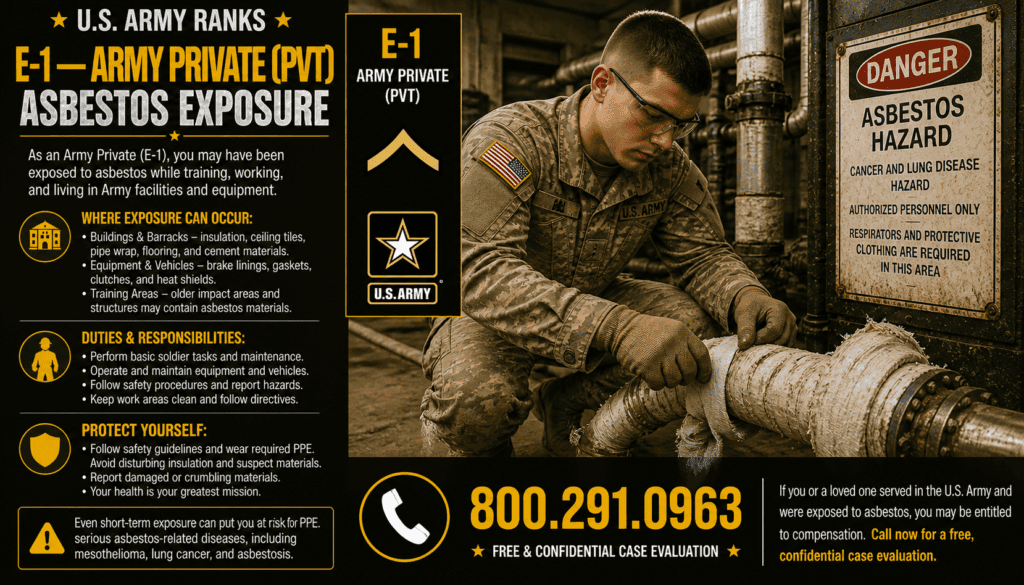
⚠️ E-1 Army Private (PVT) Asbestos Exposure
Asbestos Exposure Risks in the U.S. Army
For decades—from the 1940s through the late 1980s—the U.S. Army assigned new recruits, including E-1 Privates (PVT), to some of the most labor-intensive duties on bases, motor pools, and maintenance yards. These entry-level soldiers, often unaware of the dangers around them, carried out daily tasks in aging facilities built with asbestos products that were deteriorating by the time they served.
Because E-1 Privates spent so much time in boiler rooms, barracks maintenance areas, motor pools, and supply buildings, they often experienced high levels of asbestos exposure without ever being told these materials contained toxic fibers. Today, many veterans who began their careers as Privates face an increased risk of mesothelioma, asbestos-related lung cancer, and asbestosis.
This page outlines how E-1 Privates were exposed, which tasks carried the highest risk, and what compensation benefits are available today.
🎖 Why E-1 Privates Faced Asbestos Exposure
E-1 Privates are responsible for entry-level maintenance duties, cleaning assignments, supply transport, and “extra duty” tasks that frequently placed them near old insulation, aging boiler systems, and contaminated building materials.
Asbestos was used because it was:
🔥 Fireproof
🧱 Heat-resistant
💧 Moisture-resistant
⚙️ Durable and lightweight
💲 Extremely inexpensive
These qualities made asbestos a standard material in U.S. Army construction, heating systems, protective equipment, and motor pool components.
🛠 Typical Duties of an E-1 — Private (PVT)
E-1 Privates often served as general labor support for maintenance and engineering teams. Their duties routinely placed them in direct contact with asbestos-containing environments.
🛠 Barracks Cleaning & Maintenance
Privates frequently swept, mopped, and cleaned old Army barracks built with:
-
Asbestos floor tiles
-
Acoustic ceiling tiles
-
Drywall joint compound
-
Pipe insulation inside wall cavities
Disturbing these materials released dust that could easily become airborne.
🛠 Boiler-Room Support Tasks
Many E-1 Privates were assigned to:
-
Carry tools or supplies for boiler repair
-
Clean boiler-room floors
-
Remove old insulation debris
-
Assist NCOs during furnace maintenance
Boiler rooms contained some of the highest concentrations of asbestos, especially in pre-1980 Army bases.
🛠 Motor Pool Assistance
Privates supported mechanics by:
-
Cleaning brake dust
-
Transporting brake pads or clutch parts
-
Sweeping motor pool bays
-
Handing tools during vehicle repairs
Army jeeps, trucks, APCs, and construction vehicles used asbestos brakes and clutches, releasing microscopic fibers during maintenance.
🧩 Asbestos Exposure Sources for E-1 Privates
1️⃣ Pipe Insulation Fibers
Old barracks, mess halls, and administrative buildings contained steam-line insulation, which deteriorated and released loose fibers. Privates cleaning floor debris or accessing crawlspaces were frequently exposed.
2️⃣ Brake & Clutch Dust
Motor pools used asbestos-based:
-
Brake linings
-
Brake shoes
-
Clutch facings
-
Drum brakes
Privates sweeping or blowing dust out of repair bays inhaled fibers daily.
3️⃣ Old Floor Tiles & Ceiling Tile Debris
1×1 and 9×9 vinyl asbestos tiles cracked and released dust, especially in high-traffic barracks. Ceiling tiles also crumbled with age.
4️⃣ Heating & Boiler Systems
Boilers used asbestos in:
-
Gaskets
-
Refractory materials
-
Pipe wrapping
-
High-heat cement
Boiler rooms were extremely dusty, especially after decades of wear.
📊 Why These Exposure Points Matter for Claims
Identifying the tasks an E-1 Private performed is critical for:
-
VA disability claim approval
-
Trust fund qualification
-
Lawsuit evidence
-
Linking duties to specific asbestos manufacturers
-
Proving MOS-based exposure
Privates often qualify because their duties placed them near crumbling, friable asbestos materials daily.
📂 Real Veteran Examples: E-1 Duties Linked to Asbestos
Case 1 — Army Private Assigned to Boiler Room Cleanup
Exposure: Pipe insulation, boiler gaskets, refractory debris
Compensation: $2.9M (trust funds + lawsuit)
Case 2 — Motor Pool Private Sweeping Brake Dust
Exposure: Brake linings, clutch discs
Compensation: $2.4M
Case 3 — Barracks Maintenance Private
Exposure: Floor tile debris, ceiling tile dust, pipe lagging
Compensation: $2.1M
These results reflect typical exposure scenarios for E-1 Privates.
🧭 How E-1 Privates Prove Asbestos Exposure
You do NOT need to remember exact parts you handled.
Claims are proven using:
-
MOS or duty assignment
-
Service year ranges
-
Base construction dates
-
Military technical manuals
-
Maintenance logs
-
Unit records
-
Historic component lists
-
Army building specifications
Experts match your job duties with known asbestos components used at the time.
💰 Benefits for Former E-1 Privates Exposed to Asbestos
💙 VA Disability Benefits
-
Mesothelioma automatically rated 100% disability
-
Asbestos lung cancer often qualifies
-
Asbestosis is compensable depending on severity
💵 Asbestos Trust Funds
Over $30 billion remains available.
Trust funds compensate for exposure to specific products used in Army buildings, boiler rooms, and motor pools.
⚖️ Legal Compensation
Lawsuits are filed against manufacturers, not the military or government.
❤️ VA DIC for Families
Tax-free benefits for spouses, dependents, and survivors.
❓ Frequently Asked Questions — E-1 Private Asbestos Exposure
🟦 I was only an E-1 for a short time. Does it still count?
Yes. Even a few months of exposure can cause mesothelioma decades later.
🟦 I don’t remember being near asbestos. Can I still file?
Yes. MOS and assignment history alone often prove exposure.
🟦 Is sweeping brake dust dangerous?
Yes—Army brake dust contained high asbestos levels.
🟦 Does VA compensation reduce lawsuit or trust fund amounts?
No. They are separate.
🏅 Why Veterans Trust Mesothelioma Help Center
-
25+ years documenting Army asbestos exposure
-
Access to historic base construction records
-
Specialists familiar with E-1, E-2, and early-career duties
-
Millions recovered for Army veterans and families
-
No fees unless compensation is awarded
📞 Get Help Identifying Your Asbestos Exposure as an E-1 Private
If you or a loved one served as an E-1 Private and later developed mesothelioma, asbestos lung cancer, or asbestosis, our specialists can accurately identify where exposure occurred—even if you do not remember specific components.
📞 Call 800.291.0963 for a free case review and exposure analysis.