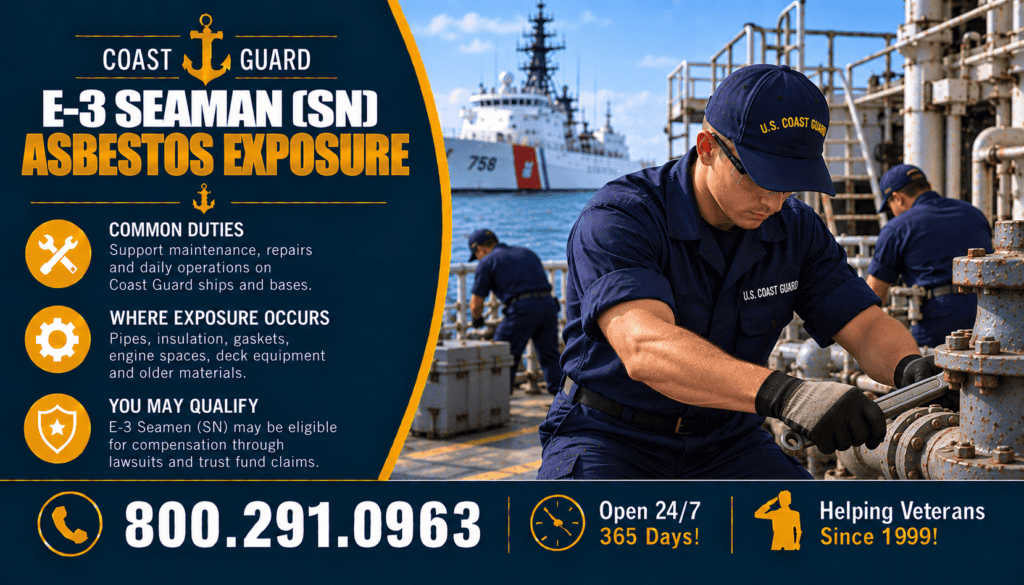
E-3 – Coast Guard Seaman (SN) Asbestos Exposure
⚠️ Asbestos Risks for Coast Guard Seaman (SN) Veterans
Coast Guard Seamen (SN) perform some of the most hands-on operational, deck, and repair duties aboard cutters, small boats, and shore installations. Because these assignments place them directly in working spaces containing pipe insulation, machinery compartments, ventilation systems, and shipboard construction materials, Seamen historically faced significant asbestos exposure—often without any warning or protective equipment.
From the 1940s through the 1990s, nearly every Coast Guard cutter, buoy tender, icebreaker, and station structure incorporated asbestos for heat resistance, fireproofing, strength, and durability. Seamen, who often rotated between deck, engineering, and repair responsibilities, encountered ACM in many high-exposure spaces daily.
The result: many Coast Guard Seaman (SN) veterans later developed mesothelioma, asbestos-related lung cancer, and asbestosis decades after service. This page outlines these risks clearly and explains benefits available today.
🛠 Typical Duties of a Coast Guard Seaman (SN)
🛳 Deck Crew & General Ship Operations
Seamen serve as the backbone of day-to-day ship functionality. Their responsibilities include:
-
standing lookout and navigation watch
-
line and rigging handling
-
maintaining deck fittings and machinery
-
assisting Boatswain’s Mates (BM) with deck evolutions
-
painting, sanding, and corrosion control
Many deck surfaces, panels, adhesives, and coatings contained asbestos. Grinding paint or prepping surfaces often released fine asbestos dust that settled onto uniforms, skin, and sleeping quarters.
🧭 Navigation & Bridge Support
SNs frequently assist officers on the bridge by:
-
maintaining navigation logs
-
assisting with communications equipment
-
monitoring radars and electronic systems
-
working around electrical panels and control circuits
Electrical components in older Coast Guard vessels used asbestos arc chutes, insulation boards, and wiring sheaths—especially in pre-1980 bridge equipment.
Bridge ceilings and partitions also often contained ACM fireproofing.
🛠 Repair Division Assistance
Coast Guard Seamen commonly worked with Damage Controlmen (DCs), Machinery Technicians (MKs), and Electrician’s Mates (EMs) during repairs:
-
cleaning pump rooms
-
assisting with valve and pump disassembly
-
scraping machinery housings
-
removing and replacing insulation jackets
-
cleaning up gasket debris
-
handling pipe covers and lagging fragments
Pump rooms and auxiliary machinery spaces historically contained the highest levels of asbestos aboard any vessel.
⚓ Support During Dry Dock & Overhauls
Seamen were routinely involved in:
-
paint removal
-
insulation tear-outs
-
compartment cleaning
-
bulkhead scraping
-
disassembling access panels
-
debris cleanup after shipyard repairs
Drydocks and shipyards had extremely high asbestos concentration because they performed:
-
mass lagging removal
-
ACM cutting, grinding, and sawing
-
boiler and turbine insulation replacement
Many SNs were unknowingly exposed to airborne asbestos without respirators.
🧹 Compartment Cleaning & Maintenance
SNs perform regular sweeping, mopping, scrubbing, and deep-cleaning of:
-
passageways
-
berthing areas
-
mess decks
-
storage compartments
-
fan rooms
-
auxiliary rooms
Older ships included asbestos in:
-
ceiling tiles
-
deck tiles
-
bulkhead panels
-
electrical duct coverings
-
bedding and wall insulation
Disturbing these materials released microscopic fibers.
🧱 Asbestos Exposure Risks for Coast Guard Seaman (SN)
1. Pump Room Insulation
Pump rooms contained:
-
steam and hot-water pipe insulation
-
gaskets and packing
-
pump and valve housings
-
high-temperature coatings
Heat and vibration caused lagging to deteriorate, shedding dust each time an SN entered for cleaning or checks.
2. Ceiling Tile & Flooring in Ship Compartments
Many Coast Guard ships had ACM in:
-
vinyl asbestos tile (VAT)
-
deck tile adhesives
-
ceiling insulation boards
-
wall liners and panels
Seamen cleaning or performing maintenance were directly exposed when tiles cracked, peeled, or were removed.
3. Contaminated Ventilation Systems
Asbestos fibers traveled through every part of a ship via:
-
ventilation blowers
-
ductwork
-
exhaust systems
-
fan rooms
SNs often cleaned grates, filters, ducts, and overheads where asbestos dust accumulated for decades.
4. Engine Room & Machinery Space Exposure
Even if not permanently assigned to engineering, SNs frequently assisted MKs and DCs. These spaces contained:
-
ACM insulation on turbines & exhaust pipes
-
boiler casings
-
pump assemblies
-
motor controllers
-
switchboards
-
gaskets & seals
Heat and wear caused insulation to flake and crumble.
5. Paint, Adhesives & Deck Coatings
Many deck and bulkhead materials contained asbestos for:
-
heat resistance
-
fire protection
-
non-skid properties
Chipping paint or grinding surfaces released fibers into breathing areas.
6. Emergency Gear & Firefighting Materials
Fire-resistant gear often included:
-
asbestos blankets
-
insulated gloves
-
heat-proof curtains
-
older protective suits
SNs handled these during firefighting drills and emergency exercises.
📊 Why Coast Guard SN Claims Are Strong
High Exposure Probability
SNs worked everywhere—from the bridge to engine spaces to deck areas—making exposure highly likely.
Routine Disturbance of ACM
Cleaning, scraping, sweeping, and sanding activities all released fibers.
Ventilation Spread
Asbestos contamination circulated throughout ship compartments, increasing exposure even outside engineering spaces.
Documented ACM Use
Coast Guard cutters, high-endurance vessels, buoy tenders, and patrol boats all used asbestos heavily until the 1990s.
📂 Evidence Used to Prove SN Asbestos Exposure
📁 Service Records
Confirm ship assignments and roles aboard.
🛳 Ship Blueprints & Technical Manuals
Show exact locations of:
-
pipe lagging
-
insulation blankets
-
ACM deck materials
🧰 Maintenance & Overhaul Histories
Prove exposure during:
-
dry docks
-
modernization
-
insulation removal projects
📜 Witness Testimony
Other crew members or engineers often corroborate exposure.
💼 Sample Compensation Outcomes for SN Veterans
Case Example 1 — Seaman on a 270-ft Medium Endurance Cutter
Heavy pump-room exposure.
Compensation: $2.8M
Case Example 2 — SN Assigned to Dry Dock Overhaul
Lagging removal & engine-room debris.
Compensation: $3.1M
Case Example 3 — SN on a Buoy Tender
Ventilation system asbestos contamination.
Compensation: $2.6M
💙 Benefits for Coast Guard Seaman (SN) Veterans
💵 Asbestos Trust Fund Payouts
Part of the $30+ billion available nationally.
⚖ Legal Compensation
Filed against product manufacturers—not against the Coast Guard.
❤️ Survivor Benefits
Families may also qualify if the veteran passed away from an asbestos illness.
📞 Get Help Identifying Your Coast Guard SN Asbestos Exposure
Coast Guard Seamen worked in some of the most contaminated spaces aboard U.S. ships, often without protections or warnings. Exposure during this rank is well-documented and highly compensable.
📞 Call 800.291.0963 for a free exposure review today.