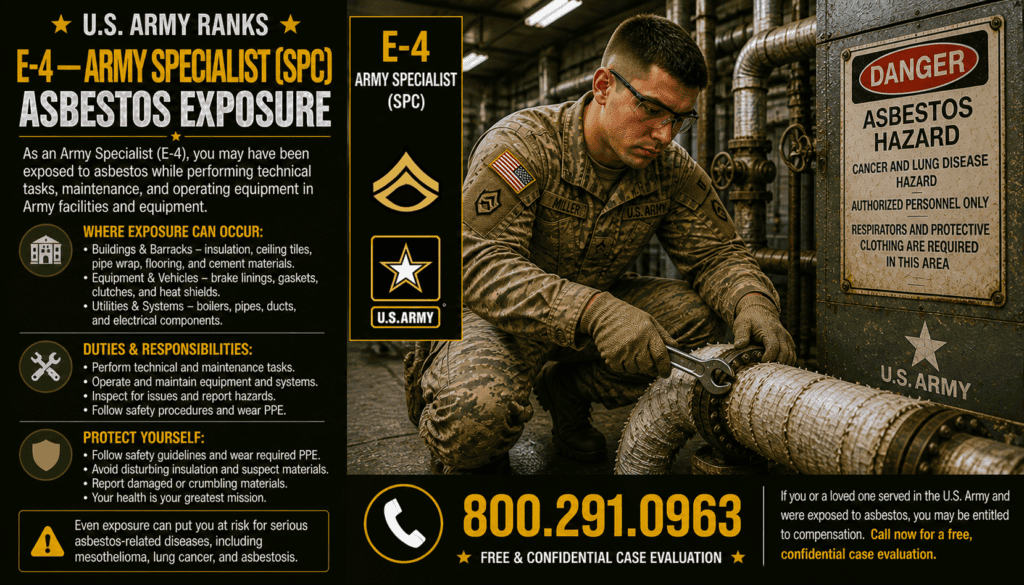
⚠️ E-4 Army Corporal (CPL) Asbestos Exposure
Risks in the U.S. Army
From the 1940s through the late 1980s, asbestos was widespread across U.S. Army bases, motor pools, engineering shops, and pre-1980 buildings. By the time a soldier reached E-4 — Army Corporal (CPL)—the first NCO rank—they transitioned from performing junior-level tasks to leading small teams, especially in engineering and mechanical units. This leadership role placed CPLs in environments where asbestos removal, repairs, demolition, and inspections exposed them to airborne asbestos fibers.
Unlike junior enlisted soldiers who performed all the physical labor, Corporals were typically responsible for supervising, inspecting, and assisting during work involving high-risk materials. Even without personally removing every piece of insulation or tile, CPLs routinely inhaled asbestos dust simply by being present during ACM (asbestos-containing materials) tasks.
This page explains exactly how E-4 Corporals were exposed, why their leadership duties created higher risk, and what compensation options are available today.
🎖 Why E-4 Army Corporals Faced Asbestos Exposure
🔎 Leadership Responsibilities Increased Direct & Passive Exposure
As the first step into the NCO corps, Corporals were expected to:
-
Lead engineering or maintenance teams
-
Supervise repairs involving older structures
-
Oversee mechanical work in motor pools
-
Inspect progress and verify task completion
-
Work alongside soldiers during high-risk tasks
-
Teach junior soldiers how to perform repairs
These responsibilities placed CPLs close to asbestos-containing debris, dust, and building materials—even when they were not performing the demolition themselves.
🔎 Asbestos Was Common in Army Technical Work
The Army used asbestos because it was:
🔥 Fireproof
🧱 Heat-resistant
💧 Moisture-resistant
⚙️ Durable under stress
💲 Extremely low-cost
Corporal-level duties placed soldiers directly in the environments where these materials were encountered—particularly in mechanical, electrical, construction, and engineering operations.
🛠 Typical Duties of an E-4 — Army Corporal (CPL)
🛠 Team Leader in Engineering or Mechanical Units
CPLs supervising engineering teams often worked around asbestos when:
-
Inspecting damaged facilities
-
Overseeing pipe and insulation repairs
-
Supervising barracks renovations
-
Standing by during demolition
-
Verifying the removal of hazardous materials
-
Helping troubleshoot heating system issues
Engineering teams were routinely assigned to repair older structures that used asbestos in:
-
Pipe insulation
-
Wallboard
-
Ceiling panels
-
Floor tiles
-
Boiler rooms
-
Mechanical ducts
Even if CPLs performed minimal hands-on demolition, the airborne fibers around them created significant exposure.
🛠 Supervising Junior Soldiers on Technical Tasks
Leadership responsibilities exposed CPLs to asbestos in several ways:
-
Motor pool work
-
Structural repair operations
-
Tile removal
-
Wall and ceiling demolition
-
Boiler system maintenance
-
Steam-line inspections
CPLs typically moved between several work areas, meaning they encountered multiple sources of asbestos dust during a single duty day.
🧩 Asbestos Exposure Sources for E-4 Army Corporals
1️⃣ Supervising ACM Repair Projects
Corporal-level exposure typically occurred during supervision of:
-
Pipe insulation removal
-
Asbestos-containing tile removal
-
Barracks demolition
-
Floor and ceiling repair
-
Boiler room cleanup
-
HVAC work involving asbestos duct insulation
Even passive supervision resulted in significant exposure because asbestos fibers remain airborne for hours after disturbance.
2️⃣ Presence During Brake & Clutch Work
Although SPCs and PFCs often handled the labor, Corporals supervising the work were exposed to fibers from:
-
Brake shoe removal
-
Grinding or sanding brake components
-
Clutch replacement
-
Gasket scraping
-
Heat shield removal
-
Air-compressor cleaning of vehicle parts
Motor pools were among the most contaminated asbestos environments in the entire Army.
3️⃣ Demolition of Pre-1980 Buildings
CPLs frequently oversaw soldiers removing:
-
Wallboard
-
Vinyl floor tiles
-
Acoustic ceiling tiles
-
Joint compound
-
Asbestos siding
-
Cement sheets
-
Pipe insulation
-
Adhesive materials
-
Roof shingles
Demolition remains one of the highest asbestos-producing tasks in Army history, and supervisors were always present during the dustiest stages.
📌 How E-4 Responsibilities Strengthen Asbestos Claims
E-4 Corporals qualify for strong claims because:
-
Their leadership role required their presence at high-risk sites
-
Supervision counts as exposure in VA and legal claims
-
They frequently inspected contaminated areas
-
Documentation shows CPLs managed asbestos-heavy tasks
-
Their MOS series often involves mechanical or engineering work
Even if Corporals never personally performed demolition, their claims are typically approved quickly due to their supervisory role.
📂 Real Veteran Examples: E-4 Army Corporal Exposure
⭐ Case 1 — CPL Engineering Team Leader
Exposure: Pipe insulation removal, wallboard demolition
Compensation: $3.4M (trust funds + lawsuit)
⭐ Case 2 — CPL Motor Pool Supervisor
Exposure: Brake/clutch repairs, gasket removal, engine insulation
Compensation: $3.1M
⭐ Case 3 — CPL Construction Section Leader
Exposure: Tile removal, ceiling tile demolition, adhesive dust
Compensation: $2.9M
These exposure pathways mirror the duties of thousands of Corporals from the 1950s through the 1980s.
🧭 How E-4 Army Corporals Prove Asbestos Exposure
🧾 Documentation Used to Confirm CPL Exposure
Corporals do not need to remember every specific task.
Exposure is proven using:
-
MOS and duty history
-
Unit engineering logs
-
Motor pool repair records
-
Building construction dates
-
Demolition assignments
-
Asbestos material supply lists
-
Technical manuals for 1950–1989 Army structures
-
Statements from fellow soldiers
CPLs supervising ACM work are automatically linked to known exposure sites.
💰 Benefits for E-4 Army Corporals Exposed to Asbestos
💙 VA Disability Benefits
-
Mesothelioma receives 100% disability rating
-
Lung cancer often qualifies when exposure-related
-
Asbestosis and pleural disease are compensable
💵 Asbestos Trust Funds
Over $30 billion is still available for asbestos victims.
CPL supervisors nearly always qualify due to their leadership proximity to high-risk tasks.
⚖️ Legal Compensation
Claims target manufacturers, not the Army.
❤️ VA DIC for Surviving Families
Spouses and dependents receive tax-free monthly benefits if illness was service-connected.
❓ Frequently Asked Questions — E-4 Army Corporal Asbestos Exposure
🟦 Does supervision count as asbestos exposure?
Yes—being present during demolition or brake/clutch work equals direct exposure.
🟦 I did not personally remove asbestos. Do I still qualify?
Absolutely. Leadership presence alone establishes exposure under VA standards.
🟦 Were Corporals exposed more than junior enlisted soldiers?
Often yes—because CPLs moved across multiple contaminated sites daily.
🟦 Do VA benefits reduce lawsuit or trust fund payments?
No. They are separate and do not affect each other.
🏅 Why Veterans Trust Mesothelioma Help Center
⭐ Expert Support for Army Corporals
-
25+ years documenting Army asbestos exposure
-
Specialists trained in engineering and mechanical MOS
-
Access to Army asbestos building material archives
-
Millions recovered for Corporals and families
-
No fees unless compensation is awarded
📞 Get Help Identifying Your Asbestos Exposure as an E-4 Army Corporal (CPL)
If you or a loved one served as an Army Corporal and later developed an asbestos-related illness, our specialists can identify exactly how exposure occurred—even if you don’t recall the specific materials.
📞 Call 800.291.0963 for a free case review and exposure analysis.