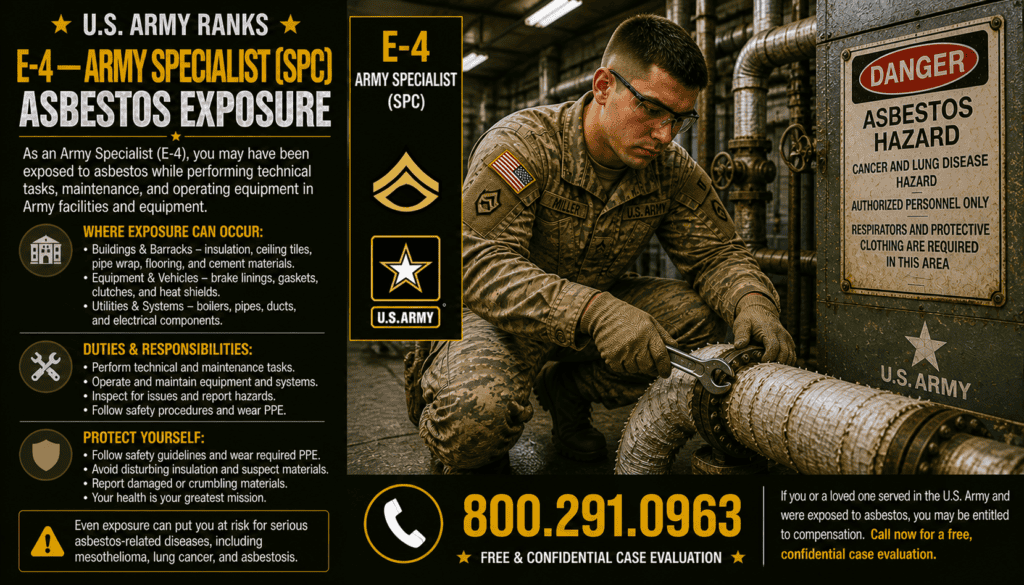
⚠️ E-4 Army Specialist (SPC) Asbestos Exposure
Asbestos Exposure Risks in the U.S. Army
As the Army advanced through the mid-20th century, asbestos became a core material used in vehicle systems, construction materials, boiler rooms, electrical panels, HVAC systems, and heating equipment. By the time thousands of soldiers reached the rank of E-4 — Army Specialist (SPC), their duties became more technical and hands-on—placing them directly in the highest-risk asbestos environments.
SPCs served as skilled mechanics, electricians, plumbers, masons, and HVAC/boiler technicians. These roles often required repairs, troubleshooting, demolition, installation, and equipment maintenance in locations where asbestos gaskets, heat shields, insulation, electrical panels, and boiler systems were deteriorating and releasing fibers.
Decades later, many former E-4 Army Specialists have developed mesothelioma, asbestos lung cancer, asbestosis, pleural scarring, and chronic breathing disorders linked to these exposures.
This page outlines how SPCs were exposed, why their MOS series had elevated risks, and what compensation is available today.
🎖 Why E-4 Army Specialists Faced Higher Asbestos Exposure
🔎 Why SPC Responsibilities Increased Risk
Unlike lower ranks, E-4 Specialists were:
-
Performing advanced mechanical work
-
Repairing electrical systems
-
Working inside boiler rooms
-
Installing or removing HVAC components
-
Handling gaskets, seals, wiring, insulation
-
Conducting demolition and reconstructions
-
Leading repair tasks with minimal supervision
These skilled roles directly exposed SPCs to asbestos materials in both Army vehicles and Army infrastructure.
🔎 Why Asbestos Was Everywhere in the Army
For decades, the military used asbestos because it was:
🔥 Fireproof
🧱 Heat-resistant
💧 Moisture-resistant
⚙️ Strong yet flexible
💲 Extremely cheap
It was considered the ideal material for engines, heating systems, motors, turbines, turbines, pipes, insulation, wiring, and vehicle repair components.
🛠 Typical Duties of an E-4 — Army Specialist (SPC)
🛠 63-Series Vehicle Mechanics
63-series mechanics worked on Army vehicles that almost universally used asbestos in:
-
Brake linings
-
Clutch systems
-
Gaskets
-
Engine insulation
-
Transmission components
-
Exhaust systems
-
Heat shields and fire barriers
Typical duties included:
-
Replacing gaskets
-
Removing brake shoes and clutch facings
-
Cleaning engine compartments
-
Grinding or scraping old parts
-
Working inside enclosed motor pool bays
-
Cutting or drilling through asbestos panels
These tasks produced high levels of airborne asbestos fibers, especially in older motor pools with poor ventilation.
🛠 12-Series Electricians, Plumbers & Masons
Specialists in the 12-series MOS routinely handled asbestos-containing building materials, including:
-
Wallboard
-
Tile backing
-
Joint compound
-
Cement boards
-
Pipe insulation
-
Electrical insulation panels
-
Switchgear and arc chutes
Their responsibilities included:
🛠 12B Electricians
-
Replacing wiring insulated with asbestos
-
Removing old electrical panels
-
Working behind asbestos cement boards
-
Cleaning panel dust
-
Replacing heat-resistant wiring components
🛠 12K Plumbers
-
Repairing steam pipes wrapped in asbestos
-
Removing deteriorating insulation
-
Working in boiler rooms
-
Cutting into contaminated walls and ceilings
🛠 12M Masons
-
Handling asbestos mortar, tile, and wallboard
-
Removing old construction materials
-
Cutting cement sheets with embedded asbestos
These jobs frequently released friable asbestos dust during repairs, renovations, and demolition.
🛠 91-Series HVAC & Boiler Technicians
Heating and cooling systems contained some of the highest asbestos concentrations on military installations.
91-series Specialists regularly handled:
-
Boiler insulation
-
HVAC duct insulation
-
Furnace cement
-
High-heat gaskets
-
Pipe wrap
-
Steam-line insulation
-
Refractory brick and mortar
Typical duties included:
-
Removing deteriorated boiler insulation
-
Cleaning ductwork
-
Replacing asbestos gaskets
-
Cutting or scraping furnace materials
-
Working directly beside cracking, dusty insulation
These boiler and furnace areas often had extreme levels of airborne asbestos fibers, especially during repairs.
🧩 Asbestos Exposure Sources for E-4 Army Specialists
1️⃣ Gaskets, Heat Shields & Engine Insulation
Army vehicles used asbestos in:
-
Engine gaskets
-
Heat shields
-
Exhaust insulation
-
Turbocharger insulation
-
Valve covers
-
Brake and clutch assemblies
63-series mechanics were exposed every time they:
-
Scraped old gaskets
-
Replaced seals
-
Pulled heat shields
-
Cleaned engine compartments
-
Sanded or drilled contaminated components
2️⃣ Electrical Panel Components
Electrical systems contained asbestos in:
-
Wiring insulation
-
Arc chutes
-
Switchgear
-
High-heat breaker panels
-
Asbestos cement backing boards
12-series electricians inhaled fibers while:
-
Removing old panels
-
Routing wiring
-
Cutting wallboard
-
Cleaning insulation dust
3️⃣ Boiler & Furnace Room Insulation
HVAC and heating systems relied on asbestos in:
-
Boiler refractory
-
Insulation blankets
-
Pipe lagging
-
Furnace cements
-
Steam-line wrapping
-
Duct insulation
91-series HVAC and boiler technicians were heavily exposed when:
-
Insulation cracked
-
Debris was swept
-
Ducting was opened
-
Boilers were scraped
-
Gaskets were replaced
Boiler rooms were among the most contaminated spaces in the Army.
📊 Why These Exposure Points Matter for Claims
📌 How SPC Duties Strengthen Asbestos Claims
E-4 Specialist responsibilities provide strong evidence for:
-
MOS-based exposure
-
Legal claim qualification
-
Trust fund eligibility
-
VA disability approval
-
Exposure to known manufacturers’ products
-
Documented exposure pathways
Because Specialists performed skilled technical work, their claims are often among the strongest.
📂 Real Veteran Examples: E-4 SPC Exposure
⭐ Case 1 — 63-Series SPC (Vehicle Mechanic)
Exposure: Gaskets, brake dust, heat shields
Compensation: $4.2M (lawsuit + trust funds)
⭐ Case 2 — 12-Series SPC (Electrician/Plumber)
Exposure: Electrical panel asbestos, pipe insulation
Compensation: $3.5M
⭐ Case 3 — 91-Series SPC (HVAC/Boiler Technician)
Exposure: Boiler insulation, furnace cement, duct debris
Compensation: $3.1M
These reflect some of the highest-risk SPC roles in the Army.
🧭 How E-4 Army Specialists Prove Asbestos Exposure
🧾 How Claims Are Verified
Veterans do not need to remember specific materials.
Exposure is proven with:
-
MOS duties
-
Work area history
-
Base construction records
-
Maintenance logs
-
Heating and boiler room diagrams
-
Army technical manuals
-
Testimony from coworkers
-
Known asbestos product lists
Experts identify exposure automatically based on your MOS and service years.
💰 Benefits for E-4 Army Specialists Exposed to Asbestos
💙 VA Disability Benefits
-
Mesothelioma = 100% disability rating
-
Lung cancer frequently qualifies
-
Asbestosis and pleural disease are compensable
💵 Asbestos Trust Funds
More than $30 billion remains available.
63-series, 12-series, and 91-series SPCs often qualify due to high exposure.
⚖️ Legal Compensation
Filed against manufacturers, not the Army.
❤️ VA DIC for Families
Survivors receive tax-free monthly benefits.
❓ Frequently Asked Questions — E-4 Army Specialist Asbestos Exposure
🟦 I only held SPC for a short time. Does that still qualify?
Yes. Mesothelioma can develop from short-term exposure.
🟦 Does gasket and brake work increase asbestos risk?
Absolutely—these tasks released heavy fiber concentrations.
🟦 Is HVAC and boiler work considered high exposure?
Yes—boiler rooms had some of the highest asbestos levels on bases.
🟦 Does VA disability reduce lawsuit or trust fund payments?
No. All sources of compensation remain separate.
🏅 Why Veterans Trust Mesothelioma Help Center
⭐ Expert Support for Army Specialists
-
25+ years documenting exposure
-
Specialists in 63-, 12-, and 91-series MOS
-
Access to Army asbestos part lists and manuals
-
Millions recovered for SPCs and families
-
No fees unless compensation is awarded
📞 Get Help Identifying Your Asbestos Exposure as an E-4 Army Specialist (SPC)
If you or a loved one served as an E-4 Specialist and later developed an asbestos-related illness, our team can identify exactly how and where exposure occurred—even without detailed memory.
📞 Call 800.291.0963 for a free case review and exposure analysis.