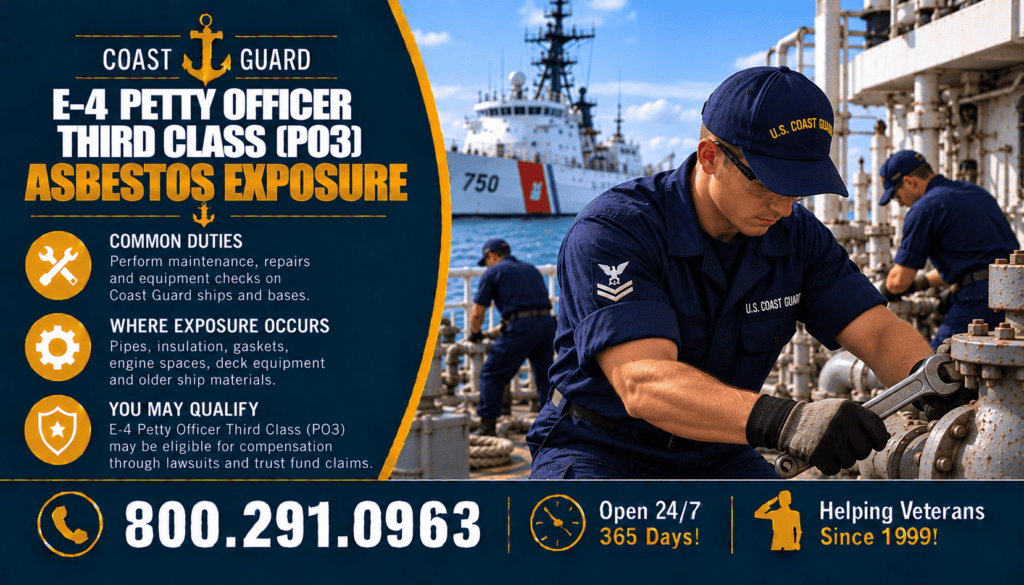
E-4 – Coast Guard Petty Officer Third Class (PO3) Asbestos Exposure
⚠️ Asbestos Risks for Coast Guard Petty Officer Third Class (PO3) Veterans
Coast Guard PO3s are the first non-commissioned petty officer rank—the point where members step into specialized engineering, electrical, and mechanical duties. Because PO3s often work directly with ship equipment, machinery, propulsion systems, and compartment maintenance, they experienced some of the highest levels of asbestos exposure aboard Coast Guard vessels and shore facilities throughout the 1940s–1990s.
Before asbestos restrictions took effect, nearly all Coast Guard cutters, patrol boats, buoy tenders, icebreakers, and support buildings were built with asbestos-containing materials (ACM). PO3s typically advanced into ratings such as:
-
Machinery Technician (MK)
-
Damage Controlman (DC)
-
Electrician’s Mate (EM)
-
Boatswain’s Mate (BM)
-
Electronics Technician (ET)
-
Fireman/Engineer trainee roles
Many of these technical specialties required PO3s to work hands-on around thermal insulation, gaskets, packing materials, turbines, boilers, and ventilation systems—all major sources of asbestos fiber release.
This page explains the duties, exposures, risk factors, and compensation opportunities for Coast Guard veterans who served as Petty Officer Third Class.
🛠 Typical Duties of a Coast Guard Petty Officer Third Class (PO3)
⚙ Rating-Specific Mechanical & Engineering Duties
PO3s in engineering ratings (MK, DC, FNs progressing into technical specialties) frequently worked in machinery spaces performing:
-
pump and valve repairs
-
gasket and packing replacements
-
turbine and heat-exchanger maintenance
-
engine disassembly and cleaning
-
oil and fuel system upkeep
-
troubleshooting mechanical failures
These tasks directly disturbed asbestos from:
-
engine room pipe insulation
-
boiler casings
-
gasket materials
-
high-heat seals
-
friction materials
-
housing covers coated with ACM
Engineering PO3s often encountered airborne fibers daily in confined spaces.
🔌 Electrical System Maintenance
PO3 Electrician’s Mates (EM) worked with:
-
switchboards
-
motor controllers
-
power distribution wiring
-
auxiliary electrical panels
-
emergency generators
Older ships used asbestos in:
-
wiring insulation
-
arc chutes
-
insulator boards
-
electrical cabinet liners
Removing panels or repairing circuits released dust that settled throughout compartments.
🛳 Deck & Structural Work
PO3 Boatswain’s Mates and deck ratings supervised:
-
line handling
-
rigging systems
-
deck machinery
-
small-boat operations
-
corrosion control
-
structural upkeep
Deck machinery used asbestos-containing:
-
brake linings
-
gaskets
-
friction materials
Chip-hammering paint or sanding coatings often disturbed ACM layers beneath.
🛠 Repair Division Leadership
As junior leaders, PO3s assisted technical supervisors with:
-
compartment overhauls
-
bulkhead repairs
-
pipe replacement
-
valve system tear-downs
-
equipment troubleshooting
These activities brought PO3s into high-risk areas such as boiler rooms, auxiliary rooms, and fire rooms—locations widely documented as asbestos hotspots.
🧭 Watchstanding & Engineering Rounds
PO3s frequently stood watches in:
-
engine rooms
-
machinery control rooms
-
boiler rooms
-
pump rooms
These spaces exposed them to continuous airborne asbestos due to heat, vibration, and constant wear of insulation systems.
🧱 Asbestos Exposure Risks for Coast Guard Petty Officer Third Class (PO3)
1. Boiler & Engine Space Insulation
Boiler rooms and engine rooms were filled with ACM insulation used on:
-
high-pressure steam pipes
-
exhaust systems
-
boiler access doors
-
turbines
-
condensers
-
expansion joints
Heat, humidity, and vibration caused this material to break down, releasing fibers every time PO3s performed checks or repairs.
2. Turbine Components
Turbine equipment used asbestos for:
-
turbine housing insulation
-
refractory bricks
-
heat shields
-
thermal blankets
PO3 engineers assisting with inspections or repairs inhaled asbestos from deteriorating components and insulation debris.
3. Gaskets, Valves & Pump Assemblies
Coast Guard ships heavily relied on asbestos for:
-
pump gaskets
-
valve packing
-
flange seals
-
pump insulators
-
stuffing box materials
PO3s removing or replacing these parts scraped or tore old ACM, releasing concentrated fibers directly into breathing zones.
4. Contaminated Ventilation Systems
Asbestos fibers from machinery spaces circulated through:
-
ducting
-
fan rooms
-
intake systems
-
HVAC pathways
PO3s performing ventilation maintenance or cleaning vent grates were repeatedly exposed to settled asbestos dust.
5. Deck & Structural ACM Materials
Ships built before 1990 contained asbestos in:
-
non-skid deck coatings
-
bulkhead wall panels
-
ceiling tiles
-
tile adhesives
-
door linings
-
fire-retardant materials
Routine PO3 maintenance—grinding, sanding, drilling, scraping—disturbed these materials year-round.
6. Shipyard & Dry Dock Exposure
PO3s frequently assisted during yard periods involving:
-
lagging removal
-
insulation replacement
-
valve and pump overhauls
-
compartment demolition
-
boiler rebuilds
Shipyards contained some of the most hazardous concentrations of asbestos fibers.
📊 Why PO3 Veterans Have Strong Asbestos Claims
Rating Roles Match High-Exposure Jobs
PO3 engineering and electrical ratings directly worked with ACM components.
Documentation Exists for Most Coast Guard Vessels
Maintenance logs, ship blueprints, and Navy/Coast Guard technical manuals clearly show ACM use.
Confined Spaces Intensified Exposure
Machinery rooms, pump rooms, and boiler rooms trap asbestos fibers.
Protective Gear Was Rare
Respirators were not standard issue for regular mechanical work before the 1990s.
📂 Evidence Used to Prove PO3 Exposure
📁 Service Records
Confirm vessel assignments, duties, and rating.
🛳 Ship Technical Manuals & Engineering Plans
Identify specific ACM components.
🧰 Overhaul & Shipyard Records
Document asbestos removal operations.
📜 Witness Statements
Statements from MKs, DCs, and EMs who served with the veteran often solidify claims.
💼 Sample Compensation Awards for PO3 Veterans
Case 1 — PO3 Machinery Technician (MK)
Pipe lagging & boiler debris exposure
Award: $3.4M
Case 2 — PO3 Damage Controlman (DC)
Turbine & pump-room ACM
Award: $3.1M
Case 3 — PO3 Electrician’s Mate (EM)
Electrical panel insulation & duct systems
Award: $2.8M
💙 Benefits Available to Coast Guard PO3 Veterans
💵 Asbestos Trust Funds
Over $30 billion available for eligible claims.
⚖ Legal Compensation
Filed against asbestos manufacturers—not the Coast Guard.
❤️ Survivor Benefits
Spouses and dependents may qualify for VA survivor benefits & trust fund claims.
📞 Get Help Identifying Your Coast Guard PO3 Asbestos Exposure
Petty Officer Third Class veterans were heavily exposed due to their hands-on work with ship systems and machinery. Even short-term exposure can lead to mesothelioma decades later.
📞 Call 800.291.0963 for a free case review today.