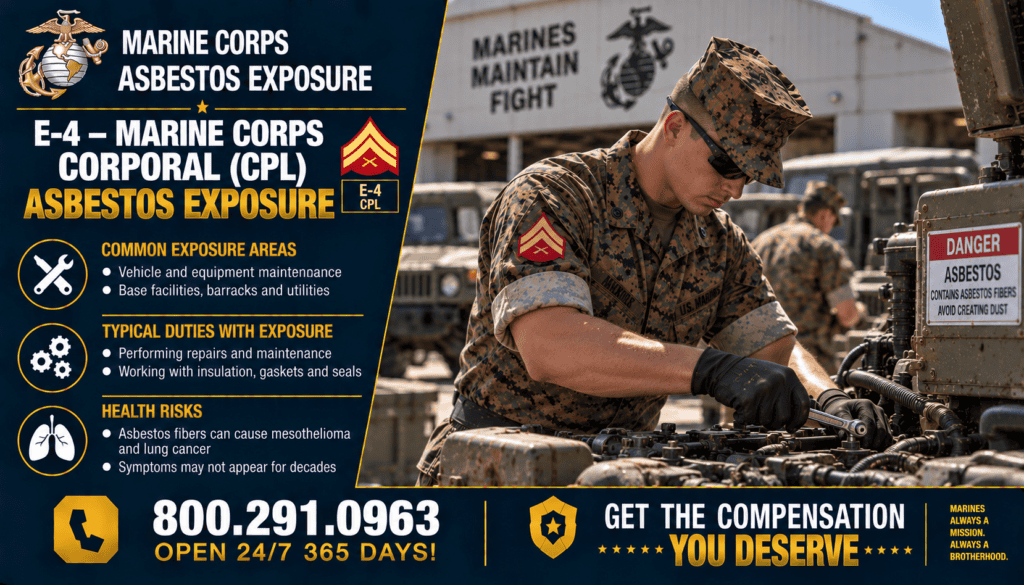
E-4 Marine Corps Corporal (Cpl) Asbestos Exposure
A U.S. Marine Corps Corporal (E-4) is a junior noncommissioned officer who may lead small teams while continuing substantial hands-on work within a military occupational specialty. Depending on MOS, era, unit, and assignment, a Corporal could work in maintenance shops, motor transport areas, aviation facilities, communications spaces, engineering areas, warehouses, utilities, field environments, barracks, and other Marine Corps facilities.
For an asbestos exposure investigation, the important question is not rank by itself. The focus is the Marine’s actual MOS, duty stations, equipment, buildings, maintenance tasks, work practices, dates of service, and proximity to specific materials. Some historical military and industrial products contained asbestos, but asbestos content varied by manufacturer, model, component, product, era, and location.
Corporal service should also be viewed as part of the Marine’s complete occupational history. Work performed earlier as a Marine Corps Lance Corporal (E-3) may have involved many of the same tools, vehicles, equipment, shops, or facilities. After promotion, duties performed as a Marine Corps Sergeant (E-5) may provide additional evidence about continuing occupational assignments. The U.S. Marine Corps Ranks Asbestos Exposure guide provides the broader rank context, while the U.S. Marine Corps Asbestos Exposure resource covers Marine Corps exposure issues more broadly.
🎖️ E-4 Corporal Role and Responsibilities
Marine Corps Corporals may serve as team leaders, fire-team leaders, technicians, maintainers, equipment operators, instructors, or junior supervisors depending on MOS and unit mission. Unlike more senior enlisted positions that can become increasingly supervisory, an E-4 may still spend substantial time performing the same hands-on work as the Marines being led.
| Duty or Setting | Possible Exposure Pathway | Evidence to Investigate |
|---|---|---|
| Hands-on technical MOS | Work around vehicles, aircraft, machinery, utilities, communications systems, or repair equipment | MOS history, unit records, technical manuals |
| Maintenance and repair | Servicing or removing older heat-resistant, friction, sealing, or insulating components | Work orders, parts records, maintenance logs |
| Small-unit leadership | Working alongside junior Marines during equipment, field, and facility tasks | Unit records, duty descriptions, witness statements |
| Field operations | Work around generators, vehicles, temporary facilities, and support equipment | Exercise, deployment, and unit histories |
| Facility assignments | Time in older barracks, shops, warehouses, hangars, utilities, or renovation areas | Base, building, maintenance, and renovation records |
🛠️ Possible Asbestos Exposure Pathways
Asbestos was historically incorporated into some products because of its resistance to heat, fire, friction, and wear. Depending on the manufacturer, product, component, era, and location, relevant materials could include certain insulation products, gaskets, packing, friction materials, flooring, roofing, wall or ceiling materials, and other heat-resistant components.
A Corporal could potentially experience direct exposure while repairing, removing, cutting, scraping, replacing, or cleaning around an asbestos-containing material. Bystander exposure could occur when a Marine worked near other personnel or contractors disturbing such materials.
Neither situation should be assumed from rank or job title alone. A useful investigation identifies the specific task, material or component, work area, frequency, duration, proximity, and historical evidence that asbestos was present.
🔧 Hands-On MOS and Maintenance Duties
The E-4 level can be particularly important when reconstructing occupational exposure because Corporals may combine leadership duties with routine technical work. Depending on MOS, that work may involve motor transport, aviation maintenance, engineering, communications, utilities, electrical systems, generators, mechanical equipment, or construction support.
Vehicles and ground equipment
Some historical vehicles and equipment used asbestos-containing friction, gasket, sealing, insulating, or heat-resistant components. The relevant vehicle, component, manufacturer, model, and time period should be identified before concluding that asbestos was present.
Aviation and support equipment
Some historical aviation and ground-support systems incorporated heat-resistant materials. An exposure investigation should focus on the specific aircraft or equipment, component, maintenance procedure, and service period.
Mechanical, electrical, and utility work
Some historical boilers, piping systems, pumps, valves, generators, electrical systems, and related equipment used asbestos-containing insulation, gaskets, packing, or other components. Actual product and equipment evidence remains important.
🏕️ Training, Field, and Unit Environments
Corporals may train junior Marines and participate directly in field exercises, equipment preparation, inspections, maintenance, and operational assignments. These activities can place an E-4 in motor pools, shops, ranges, tactical positions, temporary facilities, communications areas, and equipment yards.
Field exercises
Field work may involve generators, vehicles, communications equipment, mechanical systems, and temporary facilities. The existence of this equipment does not prove asbestos exposure; the specific component and work activity matter.
Training and unit buildings
Some older military buildings historically contained asbestos-containing construction or mechanical materials. Potential exposure generally becomes more relevant when those materials were damaged, deteriorating, repaired, renovated, or removed.
🏢 Barracks, Shops, and Support Facilities
A Marine Corps Corporal may spend time in barracks, maintenance shops, warehouses, communications buildings, motor transport facilities, aviation spaces, utility areas, training structures, and other support buildings.
Depending on construction date and later renovation, some older facilities used asbestos-containing flooring, insulation, roofing, ceiling or wall materials, fire-resistant products, or mechanical components. Presence in an older building alone does not establish exposure.
Useful evidence can include the exact building, dates of occupancy, maintenance or renovation history, the condition of suspect materials, and whether the Corporal worked in or near activities that disturbed them.
🗂️ Earlier and Later Enlisted Service
A Corporal’s exposure history should not be isolated to the period when the Marine held E-4. Earlier service as a Lance Corporal (E-3) may show when hands-on MOS duties, equipment assignments, or recurring facility work began. Those details can help establish continuity in the occupational history.
Later service as a Sergeant (E-5) may show whether the Marine continued performing the same technical duties or shifted toward greater supervision. Comparing adjacent ranks can therefore help reconstruct what work was actually performed, where it occurred, and how long particular assignments continued.
For the complete rank structure, see U.S. Marine Corps Ranks Asbestos Exposure. Broader Marine Corps exposure information is available through the U.S. Marine Corps Asbestos Exposure guide.
📋 Evidence for a Corporal Exposure History
Because asbestos-related diseases may develop many years after exposure, reconstructing an E-4 Marine’s work history can require several kinds of records. The goal is to connect the individual Marine to a specific place, task, product, component, or exposure event rather than relying on rank alone.
| Evidence | What It May Help Establish |
|---|---|
| Military personnel records | Units, duty stations, ranks, deployments, and service dates |
| MOS and training records | Occupational specialty, training, and expected duties |
| Maintenance and unit records | Equipment, repair work, shops, and maintenance periods |
| Technical manuals and parts records | Components used in relevant vehicles, aircraft, machinery, or systems |
| Building and base records | Facility construction, renovation, demolition, and maintenance history |
| Manufacturer or product records | Whether a particular product or component contained asbestos |
| Coworker testimony | Actual duties, work areas, frequency, duration, and proximity |
| Medical records | Diagnosis and relevant medical history |
🫁 Asbestos-Related Health Risks
Inhalation of asbestos fibers is associated with serious diseases including mesothelioma, lung cancer, and asbestosis. Because these diseases can have long latency periods, an occupational or military exposure history from decades earlier may remain medically relevant.
A diagnosis by itself does not establish when or where asbestos exposure occurred or prove legal causation. Medical professionals may consider occupational and environmental history, smoking history, other risk factors, imaging, pathology, and other clinical evidence.
Need help now? If you are trying to reconstruct a Marine Corps Corporal’s asbestos exposure history, Call 800.291.0963, use our 24/7 live chat, or Submit Your Case. MOS records, duty stations, equipment, maintenance work, buildings, deployments, and coworker information can provide useful starting points.
⚖️ Legal Options and Claim Investigation
A Marine Corps veteran diagnosed with an asbestos-related disease may be able to investigate legal claims or veterans benefits depending on the individual facts. Eligibility can depend on diagnosis, exposure history, available evidence, responsible companies, jurisdiction, benefit requirements, and filing deadlines.
Potential legal investigations may examine asbestos product manufacturers, suppliers, contractors, or bankruptcy trusts when supported by the evidence. Eligible veterans may also investigate VA benefits. Marine Corps service, rank, or diagnosis alone does not guarantee compensation or benefits.
What an investigation may review
- Diagnosis and pathology records.
- Personnel, MOS, training, and unit records.
- Duty stations, deployments, and assignment history.
- Specific vehicles, aircraft, equipment, machinery, and components.
- Barracks, shops, utilities, aviation facilities, motor transport areas, and other buildings.
- Maintenance, renovation, construction, or demolition activity.
- Manufacturer, supplier, and product records.
- Coworker or witness statements.
- Potential asbestos trust information.
- Jurisdiction and applicable filing deadlines.
❓ Frequently Asked Questions
What rank is a Marine Corps Corporal?
Corporal is the E-4 enlisted grade in the U.S. Marine Corps. It is above Lance Corporal (E-3) and below Sergeant (E-5).
Were all Marine Corps Corporals exposed to asbestos?
No. Rank alone does not establish asbestos exposure. The Marine’s MOS, duties, duty stations, equipment, buildings, products, service period, and actual work conditions must be investigated.
Could an E-4 Corporal have direct asbestos exposure?
Possibly. Corporals may perform hands-on maintenance, repair, equipment, engineering, or construction duties. Exposure would still require evidence that asbestos-containing material was present and disturbed.
Could a Corporal have bystander exposure?
Possibly. A Marine could work near maintenance, repair, renovation, or other activity involving asbestos-containing materials. The material, task, proximity, duration, and work conditions all matter.
Why is the Marine’s MOS important?
The MOS helps identify likely duties and work environments, but it does not prove asbestos exposure. Investigators still need evidence about actual assignments, equipment, products, and tasks.
Why should E-3 and E-5 service also be reviewed?
Adjacent ranks can help show whether the Marine performed the same occupational duties before and after serving as a Corporal. That may provide a more complete timeline of equipment, facilities, and potential exposure events.
Can asbestos exposure be relevant to lung cancer?
Yes. Asbestos exposure is a recognized cause of lung cancer. Determining whether asbestos contributed to an individual’s disease requires evaluation of the person’s medical and exposure history.
Can a family investigate a claim after a veteran’s death?
Depending on the diagnosis, evidence, responsible parties, jurisdiction, and filing deadlines, surviving family members may be able to investigate wrongful death or other asbestos-related claims.
☎️ Help for Marine Corps Corporals, Veterans, and Families
If you or a family member served as a Marine Corps Corporal and later developed mesothelioma or lung cancer, an exposure investigation can examine the Marine’s complete service history rather than rank alone—including MOS duties, earlier and later assignments, duty stations, vehicles, aircraft, equipment, facilities, maintenance work, deployments, and available historical records.
Call 800.291.0963 to discuss a Marine Corps asbestos exposure history. Live chat is available 24/7, 365 days a year. You can also Submit Your Case online.
There is no guarantee that a diagnosis or service history will qualify for compensation or VA benefits. Eligibility depends on the facts, evidence, responsible parties, jurisdiction, applicable benefit requirements, and filing deadlines.
⚕️ Legal & Medical Information Disclaimer
This page provides general educational information and is not medical or legal advice. It does not establish diagnosis, asbestos exposure, causation, liability, VA eligibility, or compensation. Consult qualified medical and legal professionals for guidance specific to your situation.