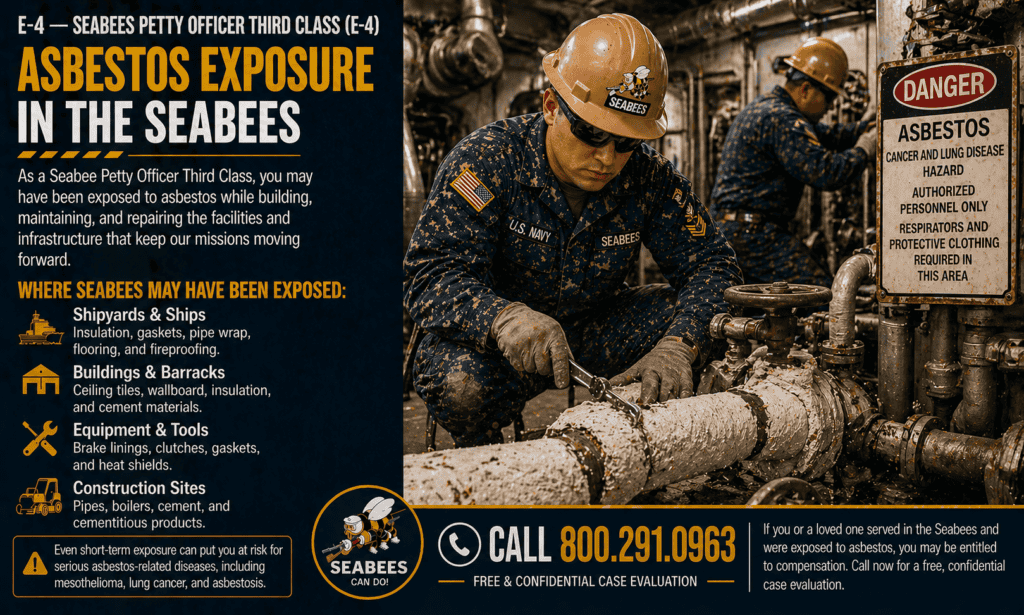
E-4 – Seabees Petty Officer Third Class (PO3)
Asbestos Exposure Risks for Journeyman-Level Naval Construction Specialists
The U.S. Navy Seabees are among the most skilled and versatile construction forces in the world, responsible for building bases, repairing facilities, constructing infrastructure, and supporting military operations across every global theater. Historically, however, they also faced extreme exposure to asbestos, which was used heavily in construction, utilities, electrical systems, plumbing, flooring, roofing, siding, and mechanical components before the early 1980s.
By the time a Seabee reaches E-4, Petty Officer Third Class (PO3), they are no longer apprentices. They are trained tradesmen—carpenters, plumbers, electricians, builders, steelworkers, or equipment operators—who directly handle materials, supervise junior personnel, and perform technical repair and renovation work. These duties placed them in daily contact with asbestos-containing materials (ACMs), often without proper respiratory protection.
This 1,200-word page explains:
-
The skilled trade role PO3s perform within Seabee construction
-
How drywall, joint compound, flooring, gaskets, pumps, roofing, and siding created repeated exposures
-
Why journeyman Seabees experienced some of the highest cumulative asbestos levels in the military
-
Long-term health risks
-
VA disability eligibility and legal compensation options
The Skilled Journeyman Role of an E-4 Seabees PO3
Seabees PO3s are the backbone of Naval Construction Battalions. They bridge the gap between junior laborers and senior technicians, performing hands-on construction work while increasingly supervising small teams.
Typical Duties
🛠️ Trained carpenter, plumber, builder, electrician, or equipment operator
Their professional tasks vary by rating:
Builders (BU)
-
drywall installation and removal
-
framing, flooring, roofing
-
concrete mixing and blockwork
-
siding repair
-
interior finishing
Utilitiesmen (UT)
-
plumbing installation
-
pipefitting
-
boiler and pump repair
-
HVAC servicing
-
steam and waterline maintenance
Construction Electricians (CE)
-
wiring buildings
-
installing or removing electrical panels
-
conduit cutting
-
replacing fixtures
-
connecting distribution systems
Equipment Operators (EO)
-
operating graders, dozers, backhoes
-
moving demolition debris
-
trenching for utilities
-
clearing old structures
Steelworkers (SW)
-
fabricating metal frames
-
welding and cutting
-
working in confined construction spaces
Regardless of specialty, PO3s were exposed to ACM in nearly every workplace environment.
Why PO3 Seabees Had Extremely High Asbestos Exposure
Three factors made asbestos exposure nearly unavoidable:
1️⃣ Seabees were trained to work directly with construction materials
Most ACMs—tile, drywall, insulation, roofing, gaskets—were cut, drilled, nailed, scraped, sanded, removed, or installed by PO3s.
2️⃣ Navy bases built before 1980 were saturated with asbestos
WWII and Cold War construction relied heavily on asbestos for insulation and fire resistance.
3️⃣ PO3s supervised junior troops during the most hazardous tasks
They were physically present during demolition, renovation, and utilities repair.
Below is a detailed breakdown of the major exposure sources.
Exposure Source #1: Drywall, Joint Compound & Interior Finishing
Almost all drywall products used before 1980 contained asbestos—especially joint compound, which baked asbestos fibers into the mud used between drywall seams.
PO3 Builders and Electricians often:
-
sanded joint compound
-
cut into existing walls
-
removed damaged drywall
-
replaced interior finishing
-
drilled holes for wiring or plumbing
-
tore down walls during renovations
Why This Was Dangerous
Sanding or cutting joint compound creates massive clouds of airborne asbestos dust. Even sweeping the floor in a renovation space stirred up fibers lingering from previous work.
Asbestos from drywall mud was extremely friable, meaning:
-
particles became airborne easily
-
dust settled into HVAC vents
-
fibers remained in work areas for days
-
workers inhaled asbestos without any visible warning
PO3s supervising work crews received repeated cumulative exposure.
Exposure Source #2: Flooring ACM
Flooring was one of the most widespread sources of asbestos in naval construction.
PO3 tradesmen handled:
-
vinyl asbestos tile (VAT)
-
asbestos-backed linoleum
-
black flooring adhesives (cutback mastic)
-
floor underlayment containing asbestos
-
concrete slab coverings fortified with asbestos fibers
How Flooring Exposed Seabee PO3s
Exposure occurred when flooring was:
-
cut
-
scraped
-
sanded
-
removed
-
broken
-
drilled into
-
damaged during demolition
Old tile becomes brittle and cracks easily, creating fine dust that sticks to boots, clothing, and tools. PO3s inhaled these fibers during routine renovation work, often without realizing materials contained ACM.
Exposure Source #3: Pump Gaskets and Packing
Seabees working as Utilitiesmen (UT) or Construction Mechanics (CM) frequently repaired pumps, valves, and mechanical systems.
These systems used:
-
asbestos gaskets
-
asbestos valve packing
-
asbestos rope sealants
-
asbestos-based heat insulation
Typical PO3 Tasks That Released Fibers
-
scraping old gaskets from pump housings
-
replacing valve packing
-
opening sealed mechanical joints
-
removing insulation blankets
-
repairing heat-bearing pipes
Old gaskets often disintegrated during removal, releasing fibers directly into the worker’s breathing zone.
PO3s performed this work regularly, especially during base repair missions and overseas deployments.
Exposure Source #4: Roofing and Siding
Roofing and siding products used in military facilities almost always contained asbestos, including:
-
shingles
-
felt underlayment
-
tar paper
-
siding panels (especially transite board)
-
adhesives and mastics
Seabee Builders and Equipment Operators encountered ACM while performing:
-
roof replacement
-
siding repair
-
removal of storm-damaged exterior panels
-
demolition of huts, barracks, or admin buildings
-
overseas humanitarian construction in older structures
Why Exterior Work Was Hazardous
Cutting, prying, or breaking transite siding released large quantities of friable chrysotile and amosite fibers.
In warm climates—such as the Pacific, Mediterranean, and Middle East—sun-baked asbestos materials deteriorated faster, becoming powdery and highly airborne.
Exposure Source #5: Demolition Work
PO3s frequently supervised or performed demolition of pre-1980 structures.
During demolition they encountered:
-
plaster
-
insulation
-
roofing layers
-
asbestos floor tile
-
asbestos siding
-
pipe insulation
-
HVAC duct insulation
-
electrical panel fireproofing
-
boiler-room debris
Demolition dust contained a mixture of multiple ACMs, making exposure levels extremely high.
Even PO3s who served only one deployment might have inhaled millions of fibers during a single project.
Long-Term Health Risks for Seabee PO3 Veterans
Asbestos exposure is cumulative. Journeyman-level Seabees saw asbestos in nearly every project type, significantly increasing long-term risk.
Diseases may take 20–50 years to appear.
Common illnesses include:
-
Mesothelioma (aggressive cancer of the lung or abdominal lining)
-
Asbestos-related lung cancer
-
Asbestosis (lung scarring)
-
Pleural plaques
-
Respiratory impairment
PO3s who worked from the 1960s through the late 1980s are especially vulnerable today.
VA Disability Benefits for PO3 Seabees
The VA recognizes Seabee trades as high-risk occupations due to extensive exposure in construction and demolition environments.
PO3-level duties—supervising and performing skilled trades—provide strong evidence of exposure.
Evidence That Strengthens a Claim
-
rating (BU, CE, CM, UT, EO, SW)
-
personnel files showing construction projects
-
records of deployment to older bases
-
witness/buddy statements
-
medical diagnosis linking asbestos exposure
Mesothelioma receives automatic 100% disability with additional benefits for dependents.
Asbestos Trust Funds & Legal Compensation
More than $30 billion remains in asbestos trust funds. These funds pay military veterans who were exposed through products produced by manufacturers—not the Navy.
Seabees may qualify for:
-
trust fund payouts
-
manufacturer settlements
-
additional compensation for dependents
-
survivor benefits
PO3 veterans exposed during a single deployment or multiple duty stations may be eligible.
📞 Free Case Review for Seabee PO3 Veterans
If you served as an E-4 Seabees Petty Officer Third Class (PO3) and later developed mesothelioma, asbestos lung cancer, or asbestosis, you may qualify for significant financial compensation.
📞 Call 800.291.0963 now for a free, confidential case review.
A specialist can confirm exposure sources and help you access VA benefits and legal compensation.