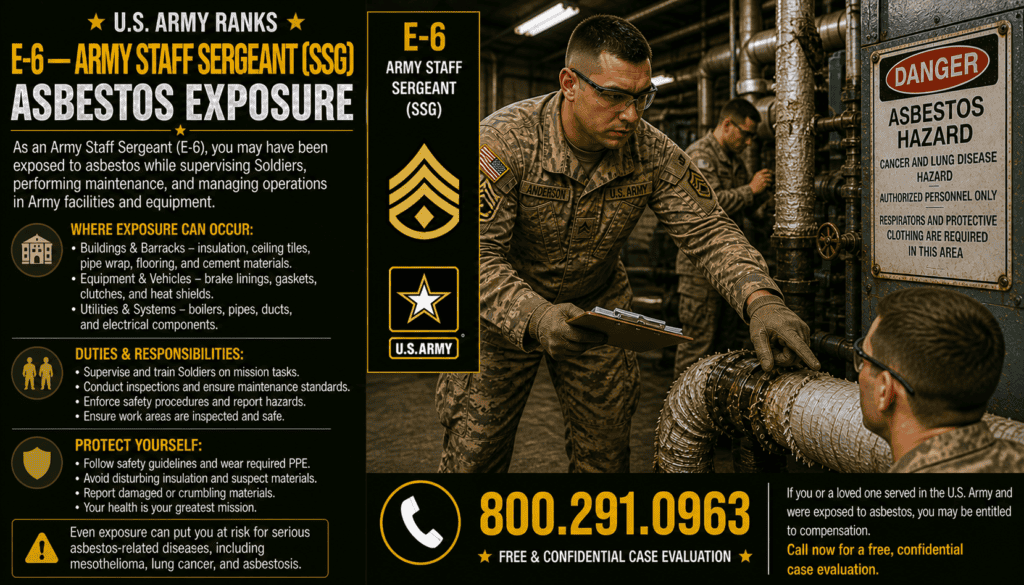
⚠️ E-6 Army Staff Sergeant (SSG) Asbestos Exposure
Risks in the U.S. Army
Between the 1940s and the late 1980s, the U.S. Army relied heavily on asbestos-containing materials across its bases, motor pools, heating systems, and engineering facilities. When a soldier advanced to E-6 — Army Staff Sergeant (SSG), they assumed leadership roles that placed them directly inside high-risk maintenance areas, aging military buildings, and mechanical repair facilities.
Even when Staff Sergeants weren’t performing hands-on tasks, they supervised mission-critical repairs and inspections that routinely put them in contact with:
-
Brake and clutch dust
-
Boiler room insulation
-
Engine components
-
Steam-line lagging
-
Pipe insulation
-
Asbestos-backed tile and wallboard
Today, many former SSGs are being diagnosed with mesothelioma, asbestos lung cancer, and chronic respiratory illness connected to their service.
🎖 Why E-6 Army Staff Sergeants Faced Significant Asbestos Exposure
🔎 Leadership Presence Increased Daily Exposure
Staff Sergeants were exposed not because they performed every task, but because they:
-
Supervised teams working with asbestos
-
Reviewed repairs inside contaminated buildings
-
Entered boiler rooms and steam plants
-
Oversaw brake and clutch work in motor pools
-
Inspected barracks during renovation
-
Verified progress on engineering projects
-
Worked alongside specialists during technical tasks
Their continuous movement between contaminated work areas made cumulative exposure extremely high.
🔎 Asbestos Was Built Into Army Structures and Equipment
The Army used asbestos because it was:
🔥 Fireproof
🧱 Heat-resistant
💧 Moisture-resistant
⚙️ Durable
💲 Cheap
This meant Staff Sergeants supervising maintenance, construction, or mechanical work encountered asbestos daily.
🛠 Typical Duties of an E-6 — Army Staff Sergeant (SSG)
🛠 Section Leader for Maintenance or Engineering Teams
SSGs typically led soldiers performing:
-
Vehicle repairs
-
Structural maintenance
-
Demolition and renovation
-
Heating and boiler system repairs
-
Electrical troubleshooting
-
Engineering operations
Older Army buildings—especially those built before 1980—contained asbestos in tile, insulation, wallboard, joint compound, and heating systems. Simply walking through these areas exposed SSGs to airborne fibers.
🛠 Motor Pool Supervisor
As motor pool NCOs, SSGs oversaw:
-
Brake changes
-
Clutch replacements
-
Gasket scraping
-
Heat shield removal
-
Engine insulation handling
-
Exhaust system repairs
Brake and clutch work was one of the Army’s highest asbestos exposure points. Even overseeing the job placed SSGs at risk.
🛠 Engineering & Utilities NCOIC
Engineering teams handled tasks involving:
-
Wall and ceiling demolition
-
Floor tile removal
-
HVAC repairs
-
Pipe insulation removal
-
Boiler inspections
-
Electrical panel replacement
Any Staff Sergeant present during these activities inhaled asbestos fibers from disturbed building materials.
🧩 Asbestos Exposure Sources for E-6 Army Staff Sergeants
1️⃣ Brake & Clutch Repair Oversight
Motor pools contained asbestos in virtually all brake and clutch components through the 1980s. SSGs were exposed during:
-
Brake shoe grinding
-
Clutch plate removal
-
Gasket scraping
-
Air-compressor cleaning
-
Sweeping fiber-contaminated bays
Brake dust exposure is one of the most documented causes of mesothelioma among Army maintenance personnel.
2️⃣ Demolition & Renovation of Pre-1980 Buildings
SSGs supervising renovations encountered asbestos in:
-
Wallboard
-
Vinyl floor tiles
-
Ceiling panels
-
Tile adhesive
-
Roofing and siding
-
Pipe insulation
-
Duct insulation
-
Cement sheets
Disturbing these materials created clouds of friable asbestos dust—one of the most dangerous exposure types.
3️⃣ Boiler Rooms & Heating Systems
Heating systems were filled with asbestos in:
-
Boiler insulation
-
Steam-line lagging
-
Furnace cement
-
High-heat gaskets
-
Pipe wrap
-
Refractory materials
Boiler rooms were among the highest-exposure locations for Army NCOs.
📊 Why These Exposure Points Matter for Claims
📌 Why SSG Asbestos Claims Are Strong
Staff Sergeants qualify for strong claims because:
-
Their leadership required presence in high-risk areas
-
Their MOS roles are tied to known asbestos exposure sites
-
They supervised ACM removal and demolition
-
They were frequently inside contaminated buildings
-
Their duties spanned multiple asbestos-heavy environments
For NCOs, supervision alone is treated as asbestos exposure under VA and legal standards.
📂 Real Veteran Examples: E-6 Staff Sergeant Asbestos Exposure
⭐ Case 1 — SSG Motor Pool Leader
Exposure: Brake/clutch repairs, gasket dust, engine insulation
Compensation: $4.2M
⭐ Case 2 — SSG Engineering Section Leader
Exposure: Tile/wall demolition, pipe insulation removal
Compensation: $3.8M
⭐ Case 3 — SSG Utilities & Boiler NCOIC
Exposure: Boiler insulation, furnace cement, HVAC ducts
Compensation: $3.6M
🧭 How E-6 Army Staff Sergeants Prove Asbestos Exposure
🧾 How Exposure Is Documented
SSGs do not need to recall every repair. Exposure is confirmed through:
-
MOS records
-
NCO job descriptions
-
Motor pool logs
-
Building construction dates
-
Unit maintenance reports
-
Technical manuals
-
Witness statements
-
Asbestos component supply lists
Supervisors qualify because they were physically present during asbestos-containing work.
💰 Benefits for E-6 Army Staff Sergeants Exposed to Asbestos
💙 VA Disability Benefits
-
Mesothelioma = 100% disability rating
-
Asbestos-related lung cancer often qualifies
-
Asbestosis and pleural conditions also eligible
💵 Asbestos Trust Funds
More than $30 billion remains available.
Staff Sergeants supervising brake repairs and building demolition nearly always qualify.
⚖️ Legal Compensation
Claims target manufacturers, never the Army.
❤️ VA DIC for Families
Surviving dependents receive tax-free monthly benefits.
❓ Frequently Asked Questions — E-6 Army Staff Sergeant Asbestos Exposure
🟦 Does supervising asbestos work count as exposure?
Yes. Supervision is considered direct exposure by the VA and courts.
🟦 Do SSGs need proof of specific asbestos products?
No. MOS + work environment = confirmed exposure.
🟦 Were Staff Sergeants exposed more than junior soldiers?
Often yes—because SSGs rotated through multiple contaminated areas.
🟦 Do VA benefits reduce lawsuit or trust fund compensation?
No. They are completely separate.
🏅 Why Veterans Trust Mesothelioma Help Center
⭐ Dedicated Support for Army NCOs
-
25+ years documenting Army asbestos exposure
-
Expertise in mechanical, engineering, and utility MOS
-
Access to historical Army asbestos product archives
-
Millions recovered for NCO families
-
No fees unless compensation is awarded
📞 Get Help Identifying Your Asbestos Exposure as an E-6 Army Staff Sergeant (SSG)
If you or a loved one served as an Army Staff Sergeant and were later diagnosed with an asbestos-related illness, our specialists can trace your exposure—even decades later.
📞 Call 800.291.0963 for a free case review and exposure analysis.