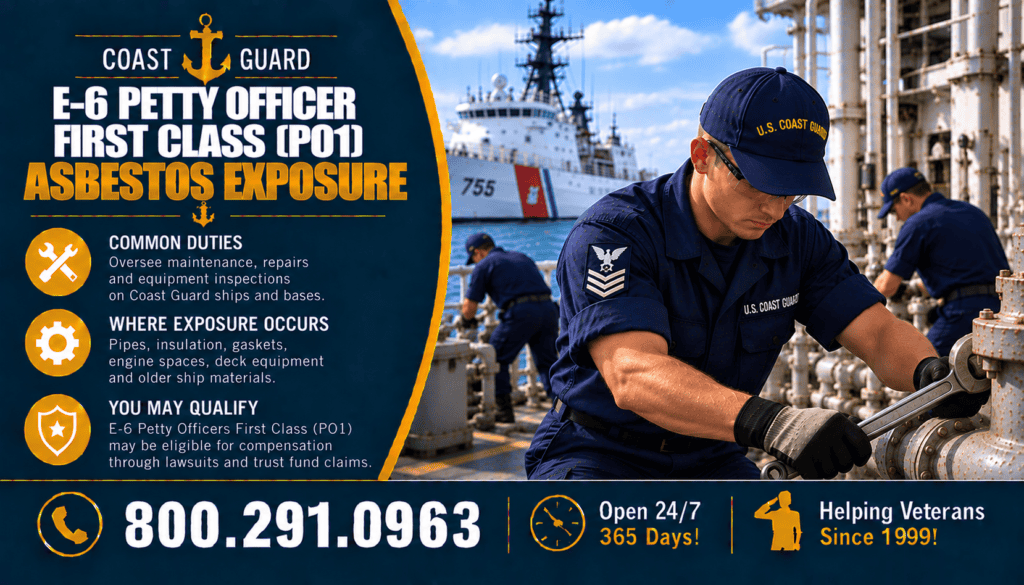
E-6 – Coast Guard Petty Officer First Class (PO1) Asbestos Exposure
⚠️ Asbestos Risks for Coast Guard Petty Officer First Class (PO1) Veterans
Coast Guard Petty Officer First Class (PO1) personnel serve as highly skilled technical leaders and work-center supervisors responsible for directing engineering, deck, electrical, and operational divisions aboard Coast Guard cutters, patrol boats, buoy tenders, icebreakers, and shore installations. Because PO1s oversee maintenance, inspections, repairs, and system operations, they were frequently stationed in some of the highest-risk asbestos environments across the entire Coast Guard.
Prior to the 1990s, nearly every Coast Guard vessel contained asbestos in insulation, deck tiles, piping systems, boilers, turbines, pumps, and electrical equipment. PO1s, who often supervised engine rooms, turbine areas, and pump systems, were repeatedly exposed to airborne asbestos fibers during both routine operations and major maintenance periods.
As a result, PO1 veterans represent one of the Coast Guard ratings most commonly diagnosed decades later with mesothelioma, asbestos-related lung cancer, and asbestosis.
This detailed page outlines PO1 duties, exposure sources, legal importance, and compensation pathways available today.
🛠 Typical Duties of a Coast Guard Petty Officer First Class (PO1)
🛳 Work-Center Supervisor for Engineering, Deck & Electrical Divisions
PO1s serve as the senior enlisted leaders within their assigned divisions, directing day-to-day operations such as:
-
managing maintenance schedules
-
supervising junior technicians (MKs, DCs, EMs, ETs)
-
conducting safety checks
-
ensuring proper operation of machinery and equipment
-
overseeing troubleshooting and repairs
Much of this oversight occurs within machinery spaces and ship compartments filled with aging asbestos materials.
⚙ Engineering & Machinery Space Leadership
PO1s in engineering roles frequently oversee:
-
engine inspections
-
pump and valve repair
-
lubrication and fuel systems
-
boiler operations
-
heat exchangers
-
turbine performance
These environments contained extensive asbestos insulation, especially on:
-
high-temperature pipes
-
exhaust coverings
-
steam lines
-
expansion joints
-
turbine housings
Cracked, worn, or deteriorating lagging released fibers that PO1s inhaled during inspections and supervision.
🔧 Turbine & Pump Work
PO1s often directed or personally assisted in:
-
turbine inspections
-
pump rebuilds
-
gasket replacements
-
packing changes
-
valve testing
-
filter and strainer cleaning
These tasks frequently required removing, scraping, or disturbing asbestos-containing components.
🔌 Electrical & Auxiliary Systems Oversight
PO1 electricians supervised:
-
motor controllers
-
switchboards
-
emergency generator systems
-
wiring and distribution panels
These systems commonly contained asbestos in:
-
wiring insulation
-
panel liners
-
arc shields
-
fireproof barriers
Any maintenance on these systems disturbed fibers trapped inside cabinets.
🛠 Safety, Damage Control & Firefighting Leadership
PO1s were responsible for:
-
firefighting readiness
-
emergency gear inspections
-
compartment safety
-
structural integrity checks
Older Coast Guard firefighting equipment used asbestos in:
-
thermal gloves
-
fireproof blankets
-
nozzle insulation
-
protective suits
Handling this gear contributed to sustained exposure.
🧹 Supervision During Overhauls & Dry Docks
PO1s frequently acted as division supervisors during:
-
dry dock periods
-
insulation removal
-
machinery overhauls
-
compartment demolition
-
structural rebuilds
Shipyard environments contained extremely high airborne asbestos concentrations, and PO1s were exposed whether they worked with tools or supervised from within the space.
🧱 Asbestos Exposure Risks for Coast Guard PO1 Veterans
1. Engine Room Oversight
Engine rooms contained some of the densest asbestos installations, including:
-
pipe lagging
-
valve packing
-
pump insulation
-
boiler casings
-
refractory brick
-
turbine insulation
PO1s overseeing daily operations inhaled fibers released from constant heat, vibration, and deterioration.
2. Turbine & Pump Work
Turbines required asbestos for:
-
thermal protection
-
vibration stabilization
-
fireproofing
Pump systems used asbestos in:
-
gaskets
-
packing rings
-
friction materials
Any time PO1s supervised, repaired, or inspected these systems, asbestos fibers became airborne.
3. Fireproof Insulation Materials
Coast Guard ships contained asbestos in:
-
bulkhead insulation
-
overhead panels
-
acoustic tiles
-
deck tiles
-
fireproof adhesives
PO1s conducting inspections, overseeing compartment maintenance, or managing damage control teams were exposed when these materials cracked or aged.
4. Ventilation System Contamination
Ventilation ducts circulated asbestos fibers throughout ship compartments. PO1s encountered accumulation when:
-
inspecting vent grates
-
cleaning fan rooms
-
working inside HVAC spaces
-
checking overheads
This passive exposure occurred even outside machinery spaces.
5. Deck Machinery & Line Handling Equipment
Deck systems used asbestos in:
-
winch brake linings
-
capstan friction materials
-
davit systems
-
mooring equipment
PO1s supervising line handling operations often stood directly near asbestos-containing machinery.
6. Shipyard & Overhaul Exposure
During shipyard periods, PO1s were present during:
-
ACM removal
-
boiler rebuilds
-
pipe replacement
-
structural demolition
-
electrical system upgrades
These conditions created the heaviest fiber concentrations of any Coast Guard environment.
📊 Why Coast Guard PO1 Veterans Have Strong Asbestos Claims
Clear Documentation of PO1 Duty Locations
Engine rooms, boiler rooms, pump rooms, and electrical areas are known asbestos hotspots.
PO1 Supervisory Roles Increase Exposure Windows
PO1s spend extended time in hazard zones overseeing junior technicians.
High-Heat Machinery Rooms Accelerate Insulation Breakdown
This caused asbestos fibers to become airborne for decades.
Shipyard Work Intensified Exposure
PO1s often supervised or participated in major ACM removal operations.
Multiple Ratings Are High-Risk
MKs, DCs, EMs, and ETs all historically faced extremely high exposure levels.
📂 Evidence Used to Prove PO1 Asbestos Exposure
📁 Service Records & Rating Assignments
Show where the PO1 served and what duties were performed.
🛳 Cutter Engineering Plans and Manuals
Identify ACM components such as:
-
pipe lagging
-
insulation blankets
-
gaskets
-
turbine housing materials
🧰 Overhaul Logs & Shipyard Records
Document insulation tear-outs or compartment demolition.
📜 Witness Statements
Multiple Coast Guard ratings can corroborate exposure:
-
MK
-
DC
-
EM
-
ET
-
BM
💼 Sample Compensation Awards for PO1 Veterans
Case 1 — PO1 Machinery Technician (MK)
Engine room & turbine exposure
Compensation: $3.7M
Case 2 — PO1 Electrician’s Mate (EM)
Electrical insulation & ventilation contamination
Compensation: $3.2M
Case 3 — PO1 Damage Controlman (DC)
Dry dock work & ACM demolition
Compensation: $3.9M
💙 Benefits Available for Coast Guard PO1 Veterans
💵 Asbestos Trust Funds
More than $30 billion available nationwide.
⚖ Legal Compensation
Claims filed against asbestos manufacturers—not the Coast Guard or federal government.
❤️ Survivor Benefits
Families may qualify for benefits if the veteran passed from mesothelioma or asbestos-related cancer.
📞 Get Help Identifying Your Coast Guard PO1 Asbestos Exposure
Petty Officer First Class veterans supervised some of the most hazardous asbestos areas aboard Coast Guard ships and shore facilities. Even limited exposure can cause serious illnesses decades later.
📞 Call 800.291.0963 for a free exposure review today.