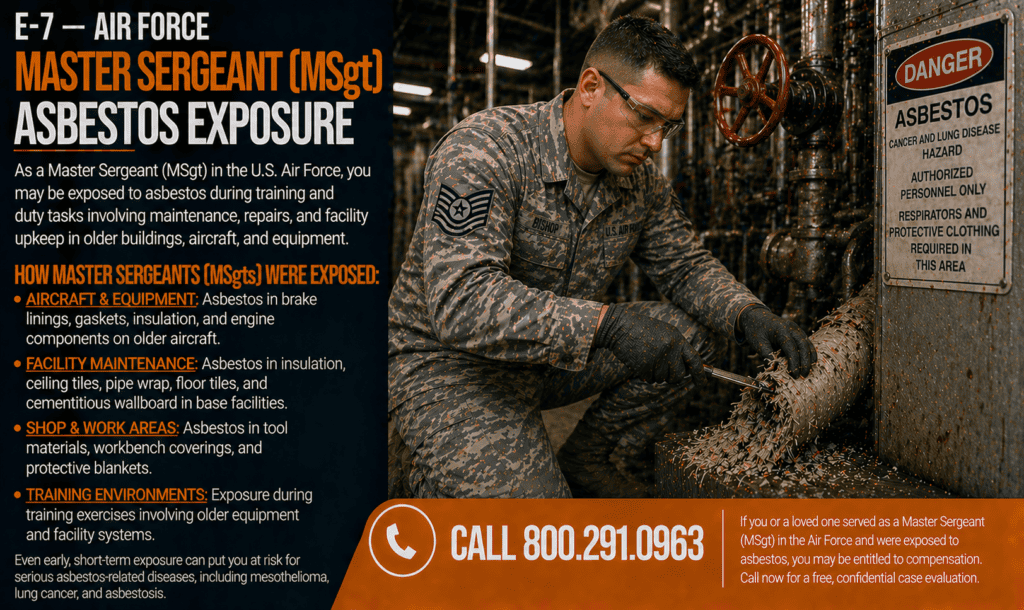
⚠️ E-7 — Air Force Master Sergeant (MSgt) Asbestos Exposure
Risks in Legacy Aircraft Maintenance
From the 1940s through the late 1980s, the U.S. Air Force relied heavily on asbestos for thermal protection, fireproofing, insulation, wiring, and aircraft system components. When an airman advanced to E-7 — Master Sergeant (MSgt), they stepped into senior NCO leadership roles over propulsion, avionics, structural maintenance, and flightline operations—fields that historically handled some of the highest concentrations of asbestos-containing materials (ACM) in the entire military.
Legacy Air Force aircraft—including the C-130, KC-135, F-4 Phantom, A-7 Corsair, B-52 Stratofortress, and P-3 variants—contained asbestos in insulation blankets, brake systems, electrical panels, wiring insulation, gaskets, fireproofing shields, and heat-resistant components.
Master Sergeants supervising these maintenance operations were repeatedly exposed to airborne fibers released during inspections, repairs, part replacements, and depot-level work.
This page explains in detail how E-7 Master Sergeants were exposed, why their leadership roles increased risk, and what benefits are available today.
🎖 Why E-7 Master Sergeants Faced Elevated Asbestos Exposure
🔎 Senior NCO Leadership Increased Daily Exposure
MSgts were exposed because they routinely supervised or inspected:
-
Propulsion systems
-
Avionics components
-
Electrical work
-
Structural repairs
-
Fireproofing systems
-
High-temperature engine components
-
Aircraft renovation and depot overhaul
-
Hangar maintenance tasks
Even when MSgts were not performing the repairs themselves, their presence during high-risk maintenance activities exposed them to asbestos fibers.
🔎 Legacy Aircraft Contained High Amounts of ACM
Air Force aircraft used asbestos because it was:
🔥 Extremely fire-resistant
🛡 Heat-absorbing and insulating
⚙️ Durable under high-stress flight conditions
💧 Moisture-resistant
💲 Inexpensive to produce
These characteristics made asbestos ideal for:
-
Insulation blankets
-
Engine heat shields
-
Brake/clutch materials
-
Electrical insulation boards
-
Wiring insulation
-
Fireproof barriers
-
High-temperature gaskets
MSgts supervising these areas encountered ACM daily.
🛠 Typical Duties of an E-7 — Air Force Master Sergeant (MSgt)
🛠 Senior NCO for Propulsion Systems
Propulsion MSgts supervised inspections, troubleshooting, and repairs on systems that included asbestos in:
-
Engine insulation blankets
-
Heat shields
-
Combustion-area gaskets
-
Exhaust components
-
Fireproof padding
Supervising jet engine tear-downs, compressor inspections, and turbine repairs routinely produced asbestos dust.
🛠 Senior NCO for Avionics Systems
Avionics MSgts oversaw work involving:
-
Circuit breaker panels containing ACM
-
Insulation backing behind instrument panels
-
High-heat arc-chutes
-
Wiring wrapped in asbestos insulation
-
Electrical shielding
Avionics bays on legacy aircraft were tightly enclosed, causing airborne asbestos fibers to remain concentrated during repairs.
🛠 Senior NCO for Structural Systems
Structural MSgts supervised crews who:
-
Removed asbestos-backed panels
-
Cut or drilled ACM structural components
-
Replaced deteriorated insulation
-
Worked with asbestos-containing adhesives and sealants
-
Repaired airframe sections lined with fireproofing
Sheet metal and structural maintenance often disturbed dry, brittle ACM that released heavy dust.
🧩 Asbestos Exposure Sources for E-7 Master Sergeants
1️⃣ Legacy Aircraft Insulation
Aircraft insulation was one of the largest sources of asbestos in the Air Force.
MSgts were exposed when handling or supervising work involving:
-
Engine insulation blankets
-
Cockpit insulation
-
Wall and ceiling panels
-
Fire-barrier blankets
-
APU insulation
-
Heat-resistant interior padding
These materials became brittle with age, releasing microscopic asbestos fibers during removal or inspection.
2️⃣ High-Temperature ACM Components
MSgts supervising engine and avionics work encountered numerous high-temperature components built with asbestos, including:
-
Turbine gaskets
-
Exhaust gaskets
-
Burner can linings
-
Jet pipe insulation
-
Brake system components
-
Arc chutes in electrical systems
Engine shops and avionics bays were among the highest-exposure environments.
3️⃣ Fireproofing Materials in Hangars & Aircraft
Asbestos fireproofing was used in:
-
Hangar walls
-
Fire curtains
-
Emergency blankets
-
Aviation firefighting gear
-
Fireproofing spray coatings
-
Structural fire barriers
During hangar renovations or material handling, MSgts supervising operations inhaled stray airborne fibers.
⚓ Branch Comparison: Air Force MSgt Exposure Levels
✈️ Air Force Exposure Overview (35 Words)
Master Sergeants supervising propulsion, avionics, and structural maintenance worked daily with asbestos-containing insulation, high-temperature components, fireproofing, and aircraft electrical systems—placing them among the Air Force’s most consistently exposed NCOs.
📊 Why These Exposure Points Matter for Claims
📌 How E-7 Responsibilities Strengthen Asbestos Claims
Master Sergeants qualify for strong asbestos-related claims because:
-
Their MOS duties placed them directly in ACM environments
-
They supervised high-risk aircraft maintenance operations
-
Their rank required constant presence during inspections
-
Exposure is documented across multiple aircraft systems
-
Air Force technical manuals confirm ACM use in legacy aircraft
Even without remembering individual parts, MSgts qualify based on their supervisory role alone.
📂 Real Veteran Examples: E-7 Master Sergeant Asbestos Exposure
⭐ Case 1 — MSgt Propulsion Specialist
Exposure: Engine insulation blankets, turbine gaskets, fireproofing shields
Compensation: $4.4M
⭐ Case 2 — MSgt Avionics Leader
Exposure: Arc chutes, asbestos wiring insulation, electrical panels
Compensation: $3.9M
⭐ Case 3 — MSgt Structural Systems Superintendent
Exposure: ACM adhesives, insulation removal, fireproof barrier repairs
Compensation: $3.6M
These exposures reflect the environments where most MSgts served from the 1950s–1980s.
🧭 How E-7 Master Sergeants Prove Asbestos Exposure
🧾 Documentation Used for MSgt Claims
MSgts do not need to identify every asbestos component they worked with.
Claims are proven using:
-
MOS records
-
Aircraft system manuals
-
Maintenance logs
-
Hangar renovation records
-
Depot overhaul reports
-
Legacy aircraft ACM lists
-
Witness statements
-
Established ACM components by aircraft model
Air Force documentation clearly shows asbestos in propulsion, structural, and avionics systems—making MSgt claims strong and verifiable.
💰 Benefits for E-7 Master Sergeants Exposed to Asbestos
💙 VA Disability Benefits
-
Mesothelioma = 100% disability rating
-
Asbestos-related lung cancer often approved
-
Asbestosis and pleural disease also eligible
💵 Asbestos Trust Funds
More than $30 billion remains available for veterans harmed by ACM.
MSgts supervising legacy aircraft maintenance often qualify for multiple trust funds.
⚖️ Legal Compensation
Claims target manufacturers, not the Air Force or government.
❤️ VA DIC for Families
Surviving dependents receive tax-free monthly benefits if illness was service-connected.
❓ Frequently Asked Questions — E-7 Master Sergeant Asbestos Exposure
🟦 Do supervisors qualify even without hands-on work?
Yes. Supervisor presence during ACM work is treated as direct exposure.
🟦 Do I need to remember specific aircraft parts?
No. Air Force technical manuals list ACM for you.
🟦 Were MSgts more exposed than junior airmen?
Often yes—because MSgts rotated through multiple maintenance shops daily.
🟦 Does VA compensation reduce lawsuit or trust fund money?
No. They are entirely separate.
🏅 Why Veterans Trust Mesothelioma Help Center
⭐ Specialized Support for Senior Air Force NCOs
-
25+ years tracking Air Force asbestos components
-
Experts familiar with propulsion, avionics, and structural MOS
-
Access to historical aircraft ACM databases
-
Millions recovered for Air Force families
-
No fees unless compensation is awarded
📞 Get Help Identifying Your Asbestos Exposure as an E-7 Air Force Master Sergeant (MSgt)
If you or a loved one served as a Master Sergeant and later developed mesothelioma or another asbestos-related illness, our specialists can identify exactly how exposure occurred using aircraft records, technical manuals, and maintenance logs.
📞 Call 800.291.0963 for a free case review and exposure analysis.