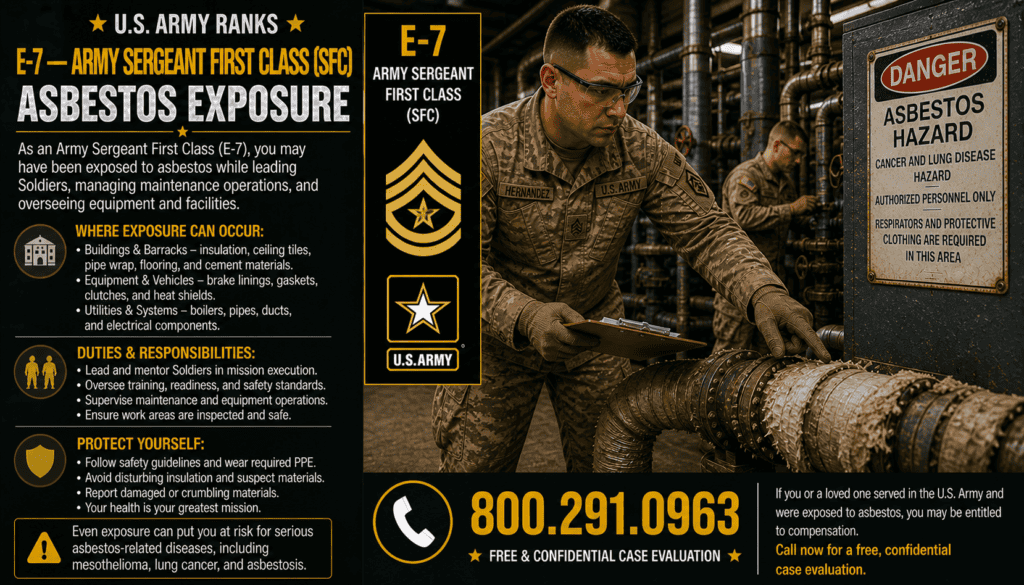
⚠️ E-7 Army Sergeant First Class (SFC) Asbestos Exposure Lawsuit
Risks in Maintenance & Engineering Leadership
From the 1940s through the late 1980s, asbestos was used throughout U.S. Army buildings, heating systems, vehicle fleets, and engineering facilities. When a soldier reached E-7 — Army Sergeant First Class (SFC), they stepped into a senior NCO leadership position—responsible for overseeing entire maintenance sections, supervising engineering operations, and managing complex repair duties across aging Army infrastructure.
Because SFCs were present during boiler work, steam-line repairs, renovation projects, damaged insulation removal, and facility maintenance, their exposure risk was extremely high. Even when they were not performing the manual labor, SFCs supervised soldiers working directly with asbestos-containing materials (ACM), placing them in contaminated environments daily.
This page explains how Sergeant First Class duties created elevated asbestos exposure, where exposure occurred, and what benefits may be available today.
🎖 Why E-7 Army Sergeants First Class Faced High Asbestos Exposure
🔎 High-Level Maintenance & Engineering Responsibilities
SFCs coordinated and supervised work involving:
-
Heating and boiler systems
-
Steam distribution networks
-
Building maintenance operations
-
Pre-1980 facility repairs and renovations
-
Pipe insulation inspections
-
Vehicle and equipment maintenance
-
Utilities and infrastructure support
These tasks regularly disturbed asbestos-based insulation, tiles, gaskets, duct systems, and wallboard.
🔎 Daily Presence in Multiple Contaminated Locations
As senior NCOs, SFCs moved frequently between:
-
Boiler rooms
-
Motor pools
-
Engineering shops
-
Barracks renovation sites
-
Utility tunnels
-
Mechanical rooms
-
Building maintenance areas
This rotation meant they inhaled asbestos fibers released by demolition, grinding, cutting, scraping, and insulation handling.
🛠 Typical Duties of an E-7 — Army Sergeant First Class (SFC)
🛠 Senior Maintenance and Engineering Manager
SFCs were responsible for managing and supervising soldiers performing:
-
Heating system repairs
-
Steam line troubleshooting
-
Electrical and utilities work
-
Building renovations
-
Barracks maintenance
-
Asbestos-affected structure repairs
-
Mechanical diagnostics
-
Plumbing and pipe maintenance
Because most pre-1980 facilities were built with asbestos, SFCs inevitably encountered ACM during inspections, supervision, and work coordination.
🛠 Overseeing Multi-Specialty Construction and Repair Teams
SFCs supervised:
-
Electricians
-
HVAC technicians
-
Boiler operators
-
Steam plant workers
-
Carpenters
-
Plumbers
-
Pipefitters
-
Utility repair teams
These specialties routinely handled asbestos-backed wallboard, pipe insulation, old cement board, furnace cement, asbestos-filled gaskets, and tile adhesives.
🛠 Inspection & Quality Control of Aging Facilities
SFCs frequently:
-
Inspected boiler rooms
-
Reviewed steam distribution systems
-
Monitored insulation conditions
-
Oversaw repairs in contaminated structures
-
Evaluated pre-1980 building degradation
-
Approved completion of renovation work
Every inspection brought them into direct contact with deteriorating ACM.
🧩 Asbestos Exposure Sources for E-7 Army Sergeants First Class
1️⃣ Boiler & Steam Distribution Systems
These were among the most asbestos-heavy systems in Army facilities.
SFCs were exposed when supervising:
-
Boiler insulation removal
-
Steam-line repairs
-
Lagging replacement
-
Furnace cement applications
-
High-heat gasket removal
-
Pipe wrap stripping
-
Contaminated boiler-room cleanup
Boiler rooms frequently contained friable asbestos and poor ventilation.
2️⃣ Damaged Insulation in Older Facilities
Army structures built before 1980 used asbestos in:
-
Wall insulation
-
Pipe wrapping
-
HVAC duct lining
-
Boiler and furnace insulation
-
Ceiling and floor tiles
-
Fireproofing materials
-
Joint compound
-
Cement sheets
When SFCs supervised repair or renovation teams, they were exposed to airborne dust released from dry, brittle insulation materials.
3️⃣ Demolition & Renovation of Pre-1980 Barracks and Buildings
Exposure occurred during removal or disturbance of:
-
Wallboard
-
Ceiling panels
-
Floor tiles
-
Tile backing
-
Structural fireproofing
-
Asbestos siding
-
Roofing shingles
-
Adhesive materials
Renovation work is documented as one of the greatest risk factors for NCOs.
📊 Why These Exposure Points Matter for Claims
📌 Why E-7 Asbestos Claims Are Especially Strong
SFCs qualify for strong asbestos-related claims because:
-
Their duties place them in high-risk ACM environments
-
They supervised repairs that disturbed asbestos
-
They inspected aging facilities containing ACM
-
Documentation strongly confirms these exposure pathways
-
They were exposed through multiple specialties and locations
Claims do not rely on memory—MOS and roles already match known asbestos hazards.
📂 Real Veteran Examples: E-7 Sergeant First Class Asbestos Exposure
⭐ Case 1 — SFC Utilities & Boiler Manager
Exposure: Boiler insulation, furnace cement, steam-line lagging
Compensation: $4.1M
⭐ Case 2 — SFC Engineering Section Supervisor
Exposure: Wall/ceiling demolition, damaged pipe insulation
Compensation: $3.7M
⭐ Case 3 — SFC Building Maintenance NCOIC
Exposure: Asbestos floor tiles, old insulation, cement board
Compensation: $3.5M
These cases reflect the core duties of most SFCs serving in the 1950–1980 period.
🧭 How E-7 Army Sergeants First Class Prove Asbestos Exposure
🧾 How Exposure Is Documented
SFCs do not need to recall exact tasks or materials.
Exposure is proven through:
-
MOS and duty records
-
Boiler-room construction dates
-
Building renovation logs
-
Engineering shop records
-
Steam plant diagrams
-
Unit maintenance reports
-
Army technical manuals
-
Witness statements
Leadership presence is considered sufficient exposure.
💰 Benefits for E-7 Army Sergeants First Class Exposed to Asbestos
💙 VA Disability Benefits
-
Mesothelioma = 100% disability rating
-
Asbestos-related lung cancer often qualifies
-
Asbestosis and pleural disease are compensable
💵 Asbestos Trust Funds
More than $30 billion remains available.
SFCs supervising boiler rooms and renovation operations nearly always qualify.
⚖️ Legal Compensation
Claims target manufacturers, not the Army.
❤️ VA DIC for Families
Surviving dependents may receive tax-free monthly benefits.
❓ Frequently Asked Questions — E-7 Army Sergeant First Class Asbestos Exposure
🟦 Does supervising asbestos-related work count as exposure?
Yes. Supervisory presence is treated as direct exposure.
🟦 I didn’t personally remove insulation—does it matter?
No. Being present during removal or disturbance qualifies.
🟦 Were SFCs exposed more than junior ranks?
Often yes—because SFCs inspected and managed multiple contaminated areas.
🟦 Does VA compensation reduce trust fund or legal awards?
No. They are completely separate.
🏅 Why Veterans Trust Mesothelioma Help Center
⭐ Specialized Support for Army NCOs
-
25+ years documenting Army asbestos exposure
-
Experts familiar with building maintenance and heating systems
-
Access to historical Army asbestos product data
-
Millions recovered for NCO families
-
No fees unless compensation is awarded
📞 Get Help Identifying Your Asbestos Exposure as an E-7 Army Sergeant First Class (SFC)
If you or a loved one served as an Army Sergeant First Class and later developed an asbestos-related illness, our specialists can identify the exact exposure sources—even decades later.
📞 Call 800.291.0963 for a free case review and exposure analysis.