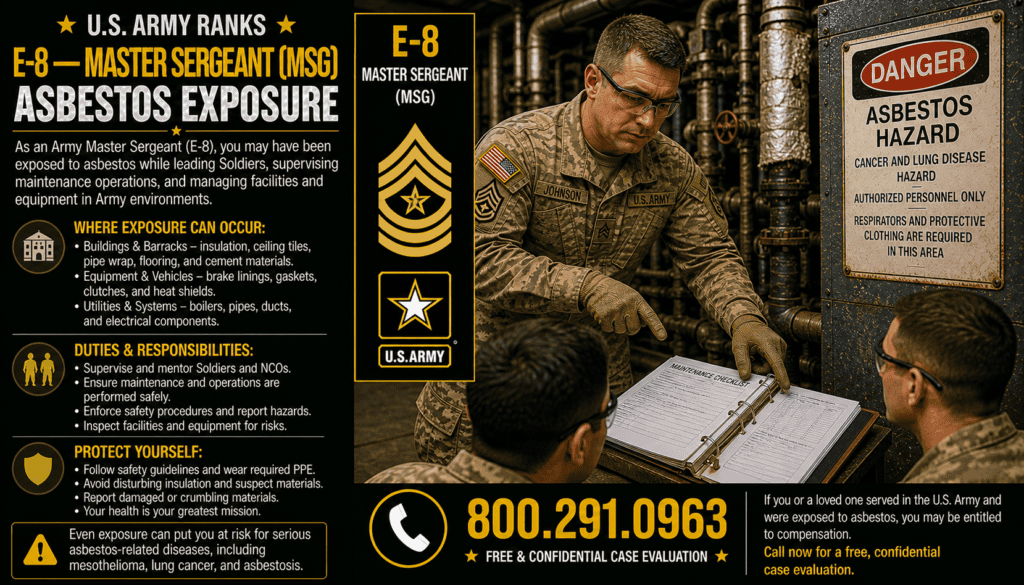
⚠️ E-8 Army Master Sergeant (MSG) / First Sergeant (1SG)
Asbestos Exposure Risks in Company-Level Leadership
From the 1930s through the late 1980s, the U.S. Army built barracks, headquarters buildings, motor pools, and administrative facilities using large quantities of asbestos. By the time a soldier reached E-8 — Army Master Sergeant (MSG) or First Sergeant (1SG), they became responsible for company-level operations, facility oversight, and daily supervision of soldiers working throughout these buildings.
Master Sergeants and First Sergeants routinely entered WWII-era and Korean War-era structures, many of which used asbestos in:
-
Ceiling tiles
-
Wallboard
-
Floor tiles
-
Pipe insulation
-
Boiler rooms
-
Cement sheets
-
Electrical panels
-
Fireproofing
Even administrative areas—where MSGs and 1SGs spent much of their day—often contained asbestos-backed materials that deteriorated over time.
This page explains how E-8 leadership roles created significant asbestos exposure, why older structures were especially dangerous, and what compensation options exist for veterans today.
🎖 Why E-8 MSGs and 1SGs Were Frequently Exposed to Asbestos
🔎 Oversight of Aging WWII and Korean War Buildings
MSGs and 1SGs oversaw:
-
Barracks operations
-
Company headquarters
-
Administrative buildings
-
Supply rooms
-
Armories
-
Training facilities
-
Old motor pools
-
WWII-era boiler rooms
Many of these structures were built between 1935 and 1960, decades when asbestos was the primary construction material used by the military.
🔎 Leadership Duties Required Constant Presence Inside ACM Areas
E-8 NCOs had daily responsibilities inside contaminated spaces:
-
Conducting inspections
-
Checking on soldiers and duty stations
-
Reviewing building work orders
-
Supervising maintenance operations
-
Overseeing barracks cleanup and repairs
-
Managing utilities and facility issues
Simply walking through these aging structures exposed them to airborne fibers.
🛠 Typical Duties of an E-8 — Army Master Sergeant (MSG) / First Sergeant (1SG)
🛠 Company-Level Operations and Facility Oversight
MSGs and 1SGs were responsible for:
-
Building administration
-
Duty assignments
-
Soldier welfare and housing
-
Facility maintenance oversight
-
Work-order management
-
Barracks inspections
-
Utility system monitoring
-
Emergency repair coordination
Older Army buildings contained asbestos in nearly every major component—walls, ceilings, floors, heating ducts, and steam lines.
🛠 Supervising Maintenance and Repair Teams
Although they did not perform the manual labor, E-8 NCOs supervised soldiers and contractors handling:
-
Damaged insulation removal
-
Tile replacement
-
Ceiling panel repairs
-
Pipe insulation handling
-
Barracks renovation
-
Boiler room servicing
-
Office upgrades
-
Electrical panel repairs
Their oversight duties placed them directly in areas where asbestos was disturbed.
🛠 Daily Exposure in Administrative Areas with ACM
Administrative and company headquarters buildings often contained:
-
Asbestos ceiling tiles
-
Vinyl asbestos floor tiles
-
Cement board
-
Insulation behind walls
-
Fireproofing
-
Pipe and radiator insulation
MSGs and 1SGs spent hours each day in these environments, breathing in fibers released by aging materials.
🧩 Asbestos Exposure Sources for E-8 Army Master Sergeants & First Sergeants
1️⃣ WWII-Era and Korean War-Era Buildings
These structures were built when asbestos use was at its highest.
E-8 NCOs were exposed in buildings containing:
-
Asbestos wallboard
-
Plaster and joint compound
-
Vinyl asbestos floor tile
-
Acoustic ceiling tiles
-
Pipe insulation
-
Radiator covers
-
Cement sheeting
-
Fireproof coatings
Decades of heat, moisture, and aging caused these materials to crack, flake, and release fibers into the air.
2️⃣ Administrative Areas with ACM
Even “office” areas contained asbestos, including:
-
Ceiling panels
-
Floor tiles
-
HVAC duct lining
-
Old electrical boards
-
Filing room insulation
-
Steam-line coverings
MSGs and 1SGs handled facility issues daily—walking through hallways, offices, storage rooms, and utility spaces filled with deteriorating ACM.
3️⃣ Boiler Rooms, Utility Tunnels & Heating Systems
Though not assigned to perform repairs, E-8 NCOs supervised:
-
Boiler inspections
-
Steam-line maintenance
-
Radiator repairs
-
Furnace work
-
Duct cleaning
-
Heating system troubleshooting
These areas are documented as some of the highest-risk asbestos locations on Army installations.
📊 Why These Exposure Points Matter for Claims
📌 Why E-8 Asbestos Claims Are Especially Strong
MSGs and 1SGs qualify for strong claims because:
-
They worked daily in asbestos-filled administrative buildings
-
They supervised soldiers performing ACM repairs
-
Their roles required inspections in high-risk areas
-
WWII/Korean War structures had extremely high ACM content
-
Exposure is well documented across Army installations
For E-8 leaders, simply working inside a pre-1980 building counts as asbestos exposure.
📂 Real Veteran Examples: E-8 Master Sergeant / First Sergeant Asbestos Exposure
⭐ Case 1 — 1SG in WWII Barracks Complex
Exposure: Ceiling tile debris, pipe insulation, boiler rooms
Compensation: $4.0M
⭐ Case 2 — MSG Company Operations Leader
Exposure: Asbestos floor tiles, deteriorated wallboard, duct insulation
Compensation: $3.6M
⭐ Case 3 — 1SG Headquarters Building Supervisor
Exposure: ACM in administrative areas, steam-line insulation
Compensation: $3.4M
These cases reflect the common environments for senior Army NCOs serving from the 1950s–1980s.
🧭 How E-8 Master Sergeants & First Sergeants Prove Asbestos Exposure
🧾 How Exposure Is Documented
MSGs and 1SGs do not need to recall specific repairs or materials.
Exposure is proven using:
-
MOS and duty descriptions
-
Building construction dates
-
Base facility maps
-
Work-order logs
-
Utility room and boiler room records
-
Army engineering manuals
-
Witness statements
-
Historical ACM component lists
Most E-8 duties automatically place veterans in asbestos environments.
💰 Benefits for E-8 MSGs and 1SGs Exposed to Asbestos
💙 VA Disability Benefits
-
Mesothelioma = 100% disability rating
-
Asbestos-related lung cancer often qualifies
-
Asbestosis and pleural thickening are compensable
💵 Asbestos Trust Funds
Over $30 billion remains available.
MSGs and 1SGs exposed in WWII/Korean War buildings almost always qualify.
⚖️ Legal Compensation
Claims target manufacturers, not the Army.
❤️ VA DIC for Families
Surviving families may receive tax-free monthly benefits.
❓ Frequently Asked Questions — E-8 MSG/1SG Asbestos Exposure
🟦 Do administrative buildings really contain asbestos?
Yes—most pre-1980 Army office buildings used ACM in ceilings, floors, and insulation.
🟦 I didn’t work in a motor pool—do I still qualify?
Yes. Exposure in WWII/Korean War buildings is well documented.
🟦 Were E-8 leaders exposed more than junior soldiers?
Often yes—because they supervised all facility areas, including the oldest contaminated structures.
🟦 Does VA compensation reduce legal or trust fund awards?
No. They are separate systems and do not overlap.
🏅 Why Veterans Trust Mesothelioma Help Center
⭐ Specialized Support for Senior Army NCOs
-
25+ years documenting Army asbestos exposure
-
Expertise in barracks, HQ buildings, and WWII-era construction
-
Access to historical Army installation building records
-
Millions recovered for MSGs and 1SG families
-
No fees unless compensation is awarded
📞 Get Help Identifying Your Asbestos Exposure as an E-8 Army Master Sergeant (MSG) or First Sergeant (1SG)
If you or a loved one served as an E-8 in the U.S. Army and later developed an asbestos-related illness, our specialists can identify exactly where exposure occurred—even if you don’t remember specific details.
📞 Call 800.291.0963 for a free case review and exposure analysis.