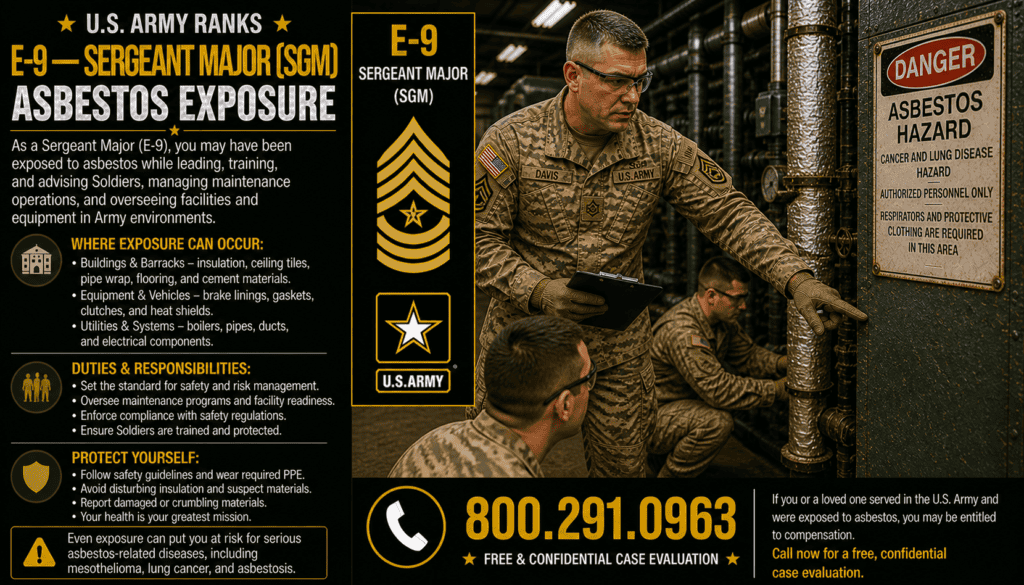
⚠️ E-9 Army Sergeant Major (SGM) / Command Sergeant Major (CSM)
Asbestos Exposure Risks
For decades, asbestos was used widely across U.S. Army bases, administrative buildings, housing structures, maintenance facilities, and support areas. Senior enlisted leaders—Sergeant Majors (SGM) and Command Sergeant Majors (CSM)—were not typically the ones performing hands-on mechanical work, but their career-long presence in older facilities often placed them in chronic, low-grade asbestos environments.
Because asbestos fibers remain airborne when disturbed and settle into ventilation systems, flooring materials, ductwork, and ceiling structures, many high-ranking enlisted leaders unknowingly spent years breathing in asbestos dust inside their offices, conference areas, barracks, and headquarters buildings. These exposures accumulate over decades and can later lead to mesothelioma, asbestos-related lung cancer, and asbestosis, even when exposures seemed minimal at the time.
This page outlines how E-9 leaders were exposed, why long-term office exposure is medically significant, and how SGM/CSM veterans or their families can pursue VA benefits, trust fund compensation, and legal recovery.
✨ Why Senior Enlisted Leaders Faced Hidden Asbestos Risks
While SGMs and CSMs oversaw large units, training operations, and installation-level readiness—not day-to-day mechanical labor—they spent thousands of hours inside:
📌 Command offices
📌 Battalion and brigade headquarters
📌 Administrative wings
📌 Training and operations planning rooms
📌 WWII-era and Vietnam-era facilities
📌 Barracks and staff buildings
📌 Conference rooms and leadership suites
Decades of foot traffic, heating/cooling cycles, and building deterioration released microscopic asbestos fibers from:
• Floor tiles
• Tile adhesive (mastic)
• Old duct insulation
• Pipe and boiler wrapping
• Ceiling tiles
• Fireproof wallboard
• HVAC systems
Leaders rarely realized they were breathing asbestos daily.
🛠️ Typical Duties of an E-9 Army Sergeant Major (SGM/CSM)
E-9s represent the highest enlisted leadership positions in the U.S. Army. Their responsibilities include:
-
Senior enlisted advisor to the battalion, brigade, or installation commander
-
Oversight of all enlisted training, readiness, and discipline
-
Coordination of operations, logistics, and mission support
-
Facility usage supervision
-
Quality-of-life and housing oversight
-
Daily work inside high-traffic administrative areas
-
Long-term presence in older command buildings
These duties placed SGMs and CSMs in older, asbestos-contaminated buildings for prolonged periods—often for 10, 15, or 20+ years.
🧱 Asbestos Exposure Risks for E-9 SGMs and CSMs
1. Long-Term Office Exposure (Primary Risk)
Even though SGMs/CSMs weren’t usually in motor pools or boiler rooms, countless Army command offices built before the late 1980s contained:
-
Asbestos vinyl flooring
-
Floor tile adhesive
-
Acoustic ceiling tiles
-
HVAC duct insulation
-
Pipe insulation in walls
-
Fireproof wallboard
-
Old electrical panels
When these materials age, fibers flake into the air and circulate through ventilation.
2. Renovation and Construction Dust
Senior leaders often worked inside facilities undergoing:
-
HVAC upgrades
-
Ceiling tile removal
-
Floor tile replacement
-
Pipe/boiler repairs
-
Office expansions
-
Barracks renovations
These projects—especially pre-1980—released heavy asbestos dust.
3. Heating and Cooling System Contamination
Asbestos-lined ductwork and boiler systems released fibers into:
-
Ventilation grates
-
Office airflow
-
Common meeting rooms
-
Admin hallways
SGMs and CSMs spent hours each day breathing air from these systems.
4. Base-wide Movement Over Many Years
Because E-9s often remained in the Army for 20–30 years, they were stationed at:
-
WWII-era posts
-
Korean War-era buildings
-
Vietnam-era administrative wings
These aging structures produced chronic, low-level exposure.
🏛️ Common Asbestos-Containing Materials Found in SGM/CSM Work Areas
Flooring and Tile Materials
-
9-inch and 12-inch asbestos tiles
-
Tile backing and mastic
-
Worn floor adhesive
-
Cracked vinyl flooring
Ceiling and Wall Materials
-
Acoustic asbestos ceiling tiles
-
Wallboard and joint compound
-
Fireproof panels
-
Electrical insulation board
Ventilation and Heating Systems
-
HVAC duct insulation
-
Boiler wrapping
-
Steam line materials
-
Heating system cements
Office and Facility Components
-
Filing room insulation
-
Old administrative building wiring
-
Breakroom panels
-
Fireproof doors and coatings
These materials remain dangerous even when not heavily damaged, because normal wear releases microscopic fibers.
📈 Why Office Exposure Still Causes Mesothelioma
Medical studies show that:
-
Prolonged, low-dose exposure can still cause mesothelioma
-
Many veterans with the disease never handled asbestos directly
-
Asbestos fibers linger in the lungs for life
-
Cumulative exposure over decades greatly increases risk
SGMs and CSMs often spent more time in Army facilities than any other enlisted rank, making long-term exposure highly significant.
📊 How E-9 Exposure Helps Strengthen VA and Legal Claims
When reviewing claims for an SGM or CSM, experts look for:
1. Duration of Service
20–30 years in asbestos-built facilities shows long-term cumulative exposure.
2. Duty Assignments
Installation headquarters, admin wings, training facilities, and WWII-era buildings are all high-risk.
3. Building Construction Records
Records show where ACM (asbestos-containing materials) were used.
4. Environmental and Renovation History
Renovations of pre-1980 buildings greatly increase exposure evidence.
5. MOS, Rank, and Building Types
Senior NCO offices are well-documented asbestos zones.
This evidence is often sufficient even if the veteran does not remember asbestos.
📚 Real Examples of Office-Based Asbestos Exposure
Case 1 — Battalion CSM
Work Areas: 1950s barracks offices, ceiling tile renovations
Compensation: $3.1 million (legal + trust funds)
Case 2 — Division SGM
Work Areas: Administrative headquarters with asbestos flooring
Compensation: $2.8 million
Case 3 — Training Command SGM
Work Areas: HVAC ductwork contamination
Compensation: $2.6 million
These cases show that leadership positions still carry high exposure.
🧭 How E-9 Veterans Prove Exposure
SGMs/CSMs do not need to recall exact materials.
Evidence relies on:
-
Building age
-
Construction records
-
Ventilation system materials
-
Flooring and ceiling tile types
-
Army asbestos surveys
-
Duty history and assignment length
Experts cross-check all this to build a strong claim.
💙 Benefits Available to E-9 Veterans with Asbestos Diseases
VA Disability Benefits
-
Mesothelioma = 100% rating
-
Lung cancer typically qualifies
Asbestos Trust Fund Compensation
Over $30 billion still available.
Legal Compensation
Filed against manufacturers, not the Army.
VA DIC Benefits for Families
Tax-free monthly benefits if the veteran has passed away.
❓ Frequently Asked Questions — E-9 Asbestos Exposure
Can I qualify even if I worked in an office?
Yes. Long-term office exposure is medically recognized.
Do I need proof of specific materials?
No—building age and duty history usually verify exposure.
Can families file after a veteran dies?
Yes—DIC + trust fund claims remain available.
Do VA benefits offset legal compensation?
No. They are separate.
🏅 Why Senior Leaders Trust Mesothelioma Help Center
-
25+ years specializing in veterans’ asbestos cases
-
Access to historic Army construction and facility records
-
Detailed building-by-building exposure mapping
-
No fees unless compensation is awarded
-
Dedicated support for families
📞 Get Help Identifying Your Asbestos Exposure as an E-9 Army Sergeant Major (SGM/CSM)
If you or a loved one served as an E-9 in the U.S. Army and later developed mesothelioma, asbestos lung cancer, or asbestosis, experts can help identify exactly where and how exposure occurred, even decades later.
📞 Call 800.291.0963 for a free exposure review.