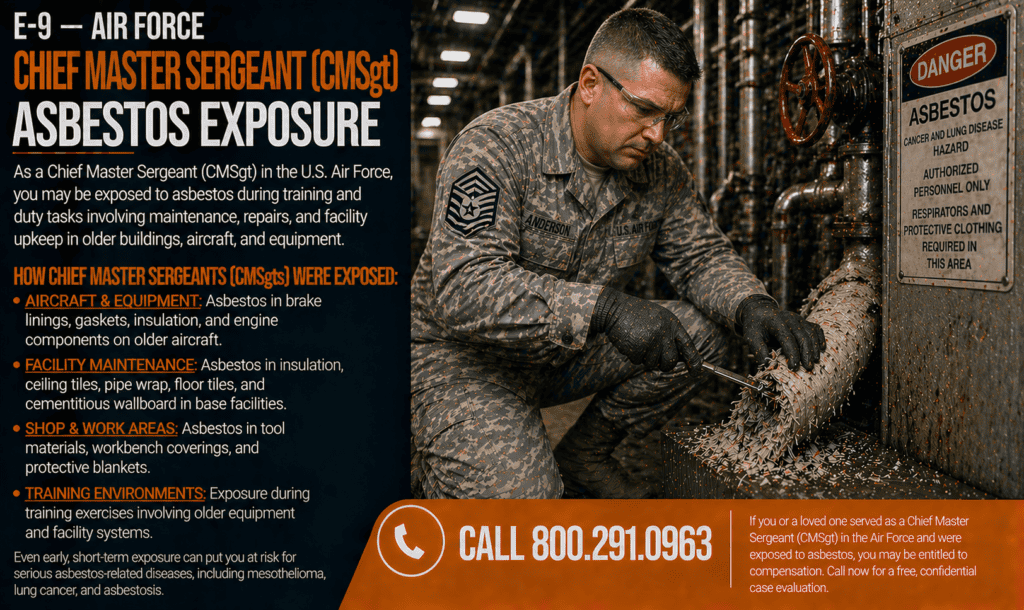
⚠️ E-9 – Air Force Chief Master Sergeant (CMSgt): Asbestos Exposure
Risks for Senior Enlisted Air Force Leadership
Chief Master Sergeants (CMSgts) represent the pinnacle of the enlisted ranks in the U.S. Air Force. They serve as senior enlisted advisors, maintenance chiefs, squadron superintendents, flight chiefs, and base-level enlisted leaders who oversee massive operations across aircraft maintenance, flightline readiness, avionics, AGE units, electrical shops, and industrial facilities.
Although CMSgts are less hands-on than junior ranks, their long careers—often 25–30+ years—place them inside decades-old Air Force structures built with asbestos, including:
-
Aircraft hangars
-
Mechanical rooms
-
Avionics shops
-
Engine maintenance facilities
-
Administrative offices in pre-1980 buildings
-
Duct systems lined with asbestos
-
Floor tiles, ceiling tiles, and wallboard containing ACM
Their leadership duties require constant presence in every area where Airmen work—including the oldest and most contaminated buildings on base. This combination of long-term presence + high-risk environments makes asbestos exposure a major risk for CMSgts.
Today, many CMSgts are being diagnosed with mesothelioma, asbestos lung cancer, pleural thickening, and asbestosis, often traced back to decades of exposure inside pre-1980 Air Force facilities.
🛠️ Typical Duties of an E-9 Chief Master Sergeant
CMSgts serve as the senior enlisted authority for units, squadrons, or even entire wings. Their responsibilities include overseeing daily operations across all maintenance, technical, and industrial environments.
Typical CMSgt responsibilities include:
-
Serving as Chief Enlisted Manager (CEM) for maintenance and operations
-
Conducting walkthroughs of aircraft hangars and industrial shops
-
Advising commanders on maintenance, facilities, and personnel readiness
-
Overseeing performance of multiple high-risk maintenance shops
-
Managing facility conditions and infrastructure concerns
-
Inspecting mechanical rooms, boiler rooms, and utility areas
-
Supervising squadron operations during maintenance surges
-
Conducting safety evaluations in older buildings
-
Visiting avionics, propulsion, structural, and electrical shops
-
Overseeing AGE support facilities and engine test cells
-
Monitoring work conditions for hundreds of Airmen
-
Participating in emergency response and environmental hazard reviews
CMSgts rarely perform physical repairs, but they spend vast amounts of time in asbestos-contaminated facilities, often more frequently than junior technicians.
🧱 Asbestos Exposure Risks for CMSgts
Long-Term Exposure Inside Pre-1980 Buildings
Many Air Force base facilities—especially maintenance shops—were built between the 1940s and late 1970s using asbestos throughout the structure.
CMSgts frequently worked inside or conducted inspections in buildings containing:
-
Asbestos ceiling tiles
-
ACM floor tiles
-
Cement asbestos board
-
Wallboard with asbestos joint compound
-
HVAC systems lined with ACM
-
Pipe and steam line insulation
-
Fireproofing on structural beams
These materials shed fibers continuously due to:
-
Age
-
Vibration from aircraft engines
-
Daily temperature changes
-
Maintenance activities
-
Building renovations
Because CMSgts spend decades inside these buildings, they experience high cumulative exposure.
Leadership Presence in Industrial Areas
CMSgts frequently move throughout the base, including:
-
Propulsion shops
-
Avionics labs
-
Structural repair areas
-
Jet engine test cells
-
AGE facilities
-
Electrical and wiring shops
-
Metal fabrication bays
-
Flightline hangars
These facilities historically contained some of the highest asbestos loads in the entire Air Force.
CMSgts inhale fibers from:
-
Old insulation
-
Contaminated dust on tools, benches, and floors
-
Deteriorating ducts
-
Debris created by ongoing maintenance
-
Renovation or abatement projects conducted nearby
Even without touching asbestos components, daily presence in these industrial areas created prolonged exposure.
ACM in Floors, Ceilings, and Duct Systems
Asbestos-containing materials (ACM) were used extensively in the:
-
HVAC duct lining
-
Ceiling tiles and acoustic panels
-
Vinyl floor tiles
-
Mastic under the floors
-
Wallboard and plaster
-
Cement board partitions
-
Boiler insulation
-
Mechanical room components
CMSgts are frequently assigned offices inside these very buildings.
Additionally:
-
HVAC vibration
-
Engine testing
-
Aircraft taxiing
-
Shop activity
all contributed to loose asbestos fibers circulating through the air.
✈️ Why CMSgts Experience Some of the Highest Cumulative Exposure in the USAF
CMSgts face significant exposure for structural reasons:
-
They spend decades—often 25–30 years—in industrial facilities
-
They visit every maintenance shop, even the most contaminated ones
-
They supervise areas where asbestos-containing insulation is removed
-
They oversee emergency responses in mechanical rooms with ACM
-
They are present during base renovation and demolition projects
-
They often have offices inside pre-1980 buildings
-
Their leadership responsibilities require constant movement through hazardous zones
This makes their cumulative exposure far higher than that of lower-ranking mechanics whose exposure was shorter in duration.
🧩 Common Asbestos-Containing Materials Encountered by CMSgts
Inside Maintenance Hangars
-
Fireproofing spray
-
Aging insulation panels
-
Vinyl asbestos tile (VAT) flooring
-
Asbestos ceiling tiles
-
Roof insulation
-
Duct insulation
Inside Mechanical/Utility Areas
-
Boilers
-
Steam pipes
-
Pumps and valves
-
Electrical panels
-
ACM gaskets
Inside Office/Administrative Facilities
-
Floor tiles
-
Ceiling tile
-
Wallboard compounds
-
HVAC duct linings
Inside Avionics, Propulsion, and Structural Shops
-
Insulation blankets
-
Wiring insulation
-
Heat shielding
-
Fireproof wall panels
CMSgts entered all of these environments regularly.
📈 Why E-9 CMSgt Claims Are Strong
CMSgts often have highly provable asbestos claims because:
-
Their facility exposure is long-term and well documented
-
They held leadership positions requiring entry into contaminated buildings
-
Hangars and mechanical rooms are known ACM hot spots
-
Their careers spanned decades when buildings still contained asbestos
-
Environmental exposure alone is enough to cause mesothelioma
-
Air Force base records confirm asbestos usage in key buildings
-
CMSgt duties required presence in every high-risk shop
These claims are among the strongest in the Air Force.
📊 How CMSgts Prove Exposure for VA Disability & Legal Claims
CMSgts do not need to remember exact asbestos components.
Exposure is proven through:
-
Base engineering & environmental surveys
-
Hangar and building construction records
-
HVAC and duct system documentation
-
Boiler room schematics
-
Shop ACM inventory lists
-
Wing and squadron duty logs
-
Assignment records
-
Witness statements from NCOs and officers
-
Renovation/abatement histories
This documentation establishes clear, irrefutable exposure.
📚 Real Examples of CMSgt Asbestos Exposure Cases
Case 1 — CMSgt Maintenance Superintendent
Exposure: Long-term hangar contamination
Compensation: $4.1 million
Case 2 — CMSgt Squadron Senior Enlisted Leader
Exposure: ACM in ceilings, ducts, and mechanical rooms
Compensation: $3.9 million
Case 3 — CMSgt Avionics/Propulsion Leader
Exposure: Environmental dust from multiple shops
Compensation: $3.7 million
Case 4 — CMSgt Base-Level Senior Enlisted Advisor
Exposure: Pre-1980 admin buildings + hangar walk-throughs
Compensation: $4.0 million
🧭 How CMSgts Document Exposure Today
Exposure is supported using:
-
Facility age and asbestos inventories
-
Maintenance shop surveys
-
Base civil engineering documents
-
Squadron environmental reports
-
Duty assignment and AFSC history
-
Renovation and abatement logs
CMSgts do not need technical memory—records prove the case.
💙 Benefits Available to CMSgts Exposed to Asbestos
VA Disability Benefits
-
Mesothelioma = 100% disability rating
-
Lung cancer often qualifies
Asbestos Trust Funds
Over $30 billion available.
Legal Compensation
Filed against manufacturers—not the Air Force.
VA DIC Benefits for Families
Tax-free benefits for surviving spouses.
❓ Frequently Asked Questions — E-9 CMSgt Asbestos Exposure
I didn’t touch aircraft parts—do I still qualify?
Yes. Environmental exposure alone is enough.
Are pre-1980 buildings dangerous?
Yes—nearly every building constructed before 1980 used asbestos extensively.
Do CMSgts qualify for trust fund compensation?
Yes—exposure in old facilities is a recognized pathway.
Can families file after the veteran passes away?
Yes—VA DIC + trust fund claims remain open to survivors.
🏅 Why Chief Master Sergeants Trust Mesothelioma Help Center
-
25+ years documenting senior enlisted exposure
-
Access to historic base and hangar asbestos lists
-
Specialists trained in environmental & industrial exposure routes
-
Millions recovered for CMSgts and families
-
No fees unless compensation is awarded
📞 Get Help Identifying Your Asbestos Exposure as an E-9 Chief Master Sergeant
If you or a loved one served as a CMSgt and later developed mesothelioma or asbestos lung cancer, specialists can identify the exact buildings and facility materials responsible—even decades later.
📞 Call 800.291.0963 for a free exposure review.