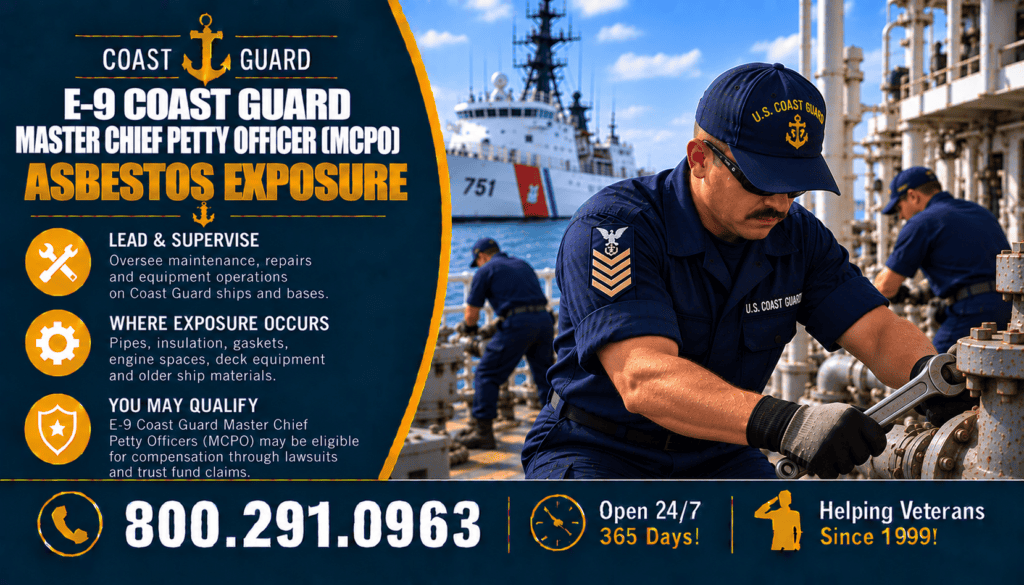
E-9 – Coast Guard Master Chief Petty Officer (MCPO) Asbestos Exposure
⚠️ Asbestos Risks for Coast Guard Master Chief Petty Officer (MCPO) Veterans
Master Chief Petty Officers (MCPOs) are the highest enlisted leaders in the United States Coast Guard. They serve as senior advisors, division chiefs, department-level authorities, and command leadership for entire cutter crews, shore facilities, engineering divisions, and operational departments.
Because MCPOs are present in every major compartment, conduct high-level inspections, and oversee maintenance and modernization projects, they accumulate extensive asbestos exposure across the longest military careers—often 20 to 30+ years of service.
Historically, Coast Guard ships, stations, and administrative buildings constructed from the 1940s through the early 1990s contained significant asbestos installations, including insulation, tiles, piping, boilers, turbines, pumps, electrical equipment, ventilation systems, wall panels, and fireproof materials. MCPOs spent decades working in and supervising these spaces, making them one of the most at-risk groups for mesothelioma, asbestos-related lung cancer, and asbestosis later in life.
This page details the duties, environments, exposure sources, and compensation opportunities for Coast Guard Master Chiefs.
🛠 Typical Duties of a Coast Guard Master Chief Petty Officer (MCPO)
🛳 Highest Enlisted Leadership
As the senior-most enlisted member of their unit or department, MCPOs routinely oversee:
-
entire engineering departments
-
all electrical and auxiliary systems
-
deck and operations divisions
-
training and technical readiness
-
crew administration and safety standards
Their leadership roles require entering and inspecting all major ship compartments—including those with aging asbestos materials.
⚙ Department-Level Technical Oversight
MCPOs supervise multiple work-centers simultaneously, including:
-
propulsion systems
-
hull integrity
-
deck machinery
-
electrical distribution
-
ventilation systems
-
damage control equipment
These systems historically used asbestos for heat resistance, soundproofing, and fireproofing.
🛠 Command Presence in Engineering & Machinery Spaces
MCPOs conduct inspections and readiness checks in:
-
engine rooms
-
boiler rooms
-
pump rooms
-
turbine spaces
-
generator rooms
-
HVAC compartments
These areas contained the highest concentration of asbestos aboard Coast Guard cutters.
⚓ Oversight of Shipboard Command Areas
MCPOs frequently worked in command centers, communications rooms, and administrative office spaces aboard cutters. These areas contained:
-
asbestos-containing ceiling tiles
-
deck tiles and adhesives
-
wall insulation panels
-
wiring insulation behind consoles
Even non-engineering spaces carried asbestos risks.
🏛 Administrative Leadership at Shore Facilities
MCPOs stationed at bases, air stations, and support facilities oversaw:
-
administrative operations
-
personnel readiness
-
safety inspections
-
building condition evaluations
Many legacy Coast Guard buildings contained ACM in:
-
linoleum backing
-
boiler rooms
-
ductwork
-
exterior siding
-
roofing
-
acoustic ceiling panels
Exposure occurred during inspections, renovations, or routine presence in aging structures.
🛠 Supervision During Shipyard & Modernization Projects
MCPOs often acted as senior enlisted project leads during:
-
major dry dock periods
-
lagging removal
-
compartment demolition
-
boiler overhauls
-
turbine rebuilds
-
structural refurbishments
-
modernization of ship systems
Shipyards historically produced the highest airborne asbestos concentrations, making supervisory roles extremely hazardous.
🧱 Asbestos Exposure Risks for Coast Guard MCPO Veterans
1. Shipboard Command Areas
While command centers appear “cleaner” than engineering spaces, they contained:
-
asbestos ceiling panels
-
deck tiles with asbestos adhesives
-
bulkhead insulation
-
wiring insulation behind panels
MCPOs spent significant daily time in these spaces.
2. Legacy Administrative Buildings with ACM
Older Coast Guard shore facilities contained asbestos in:
-
floor tiles
-
roofing tiles
-
siding
-
drywall compound
-
heating and boiler systems
-
steam pipe insulation
-
ventilation ducts
MCPOs conducted building walk-throughs and safety inspections—activities that often stirred dormant asbestos dust.
3. Engineering Spaces and Machinery Rooms
Even at E-9, MCPOs regularly entered the most asbestos-heavy areas, including:
-
engine rooms
-
fire rooms
-
pump rooms
-
auxiliary machinery spaces
-
propulsion control rooms
Cracked lagging, vibration, steam, and heat caused significant fiber release.
4. Supervising Repairs Involving Asbestos-Containing Materials
MCPOs supervised teams working on:
-
pipe insulation and lagging removal
-
gasket and packing replacement
-
valve and pump rebuilds
-
deck tile removal
-
structural modifications
-
bulkhead repairs
Even without direct hands-on work, supervisors inhale fibers released into the air.
5. Ventilation System Fiber Spread
Airborne asbestos traveled through ventilation ducts, accumulating in:
-
fan rooms
-
overhead areas
-
intake vents
-
plenum chambers
MCPOs inspecting HVAC systems or certifying spaces encountered high-concentration dust.
6. Shipyard & Dry Dock Exposure
Shipyards contained the most dangerous asbestos levels due to:
-
constant insulation removal
-
grinding and cutting ACM
-
compartment demolition
-
boiler and turbine replacement
-
hull reconstruction
MCPOs participating in oversight or quality control were heavily exposed.
7. Firefighting & Safety Systems
Coast Guard firefighting equipment used asbestos in:
-
fire curtains
-
insulated gloves
-
protective suits
-
emergency heat shields
MCPOs frequently handled, inspected, and certified this equipment.
📊 Why Coast Guard MCPO Veterans Have Strong Asbestos Claims
Long Careers = High Exposure Accumulation
MCPOs typically serve 20–30+ years, greatly increasing lifetime exposure.
Presence in Every Major Compartment
Master Chiefs inspect more ACM-filled spaces than almost any other enlisted rank.
Supervisory Work During Shipyard Overhauls
Shipyards provide some of the strongest evidence in asbestos claims.
Exposure in Both Shipboard and Shore Facilities
Dual environments strengthen compensation eligibility.
High-Risk Ratings Throughout Career
Most MCPOs spent earlier ranks in engineering, electrical, or hull maintenance specialties—already high-risk fields.
📂 Evidence Used to Prove MCPO Asbestos Exposure
📁 Service & Personnel Records
Show long service history, ship assignments, and senior leadership duties.
🛳 Technical Manuals & Cutter Records
Identify:
-
pipe lagging
-
insulation blankets
-
fireproof panels
-
ACM gaskets
-
turbine housings
🧰 Dry Dock & Overhaul Documentation
Prove exposure during major modernization events.
📜 Witness Statements
Rank-and-file testimony and peer statements often confirm exposure:
-
MKs
-
DCs
-
EMs
-
ETs
-
BMs
-
CPO/SCPO peers
💼 Sample Compensation Awards for MCPO Veterans
Case 1 — MCPO Machinery Technician
Multiple cutter tours + shipyard exposure
Compensation: $4.6M
Case 2 — MCPO Electrician
Electrical ACM + administrative building contamination
Compensation: $4.1M
Case 3 — MCPO Operations/Command Leadership
Exposure from legacy offices and command centers
Compensation: $3.9M
💙 Benefits Available to Coast Guard MCPO Veterans
💵 Asbestos Trust Fund Compensation
Part of the $30+ billion available nationwide.
⚖ Legal Claims Target Manufacturers
Not the Coast Guard or U.S. government.
❤️ Survivor Benefits
For families if the MCPO passed away from mesothelioma or asbestos-related cancer.
📞 Get Help Identifying Your Coast Guard MCPO Asbestos Exposure
Master Chiefs spent decades in Coast Guard ships and facilities built with asbestos. Exposure is extremely well documented and supports strong legal and trust fund claims.
📞 Call 800.291.0963 for a free exposure review today.