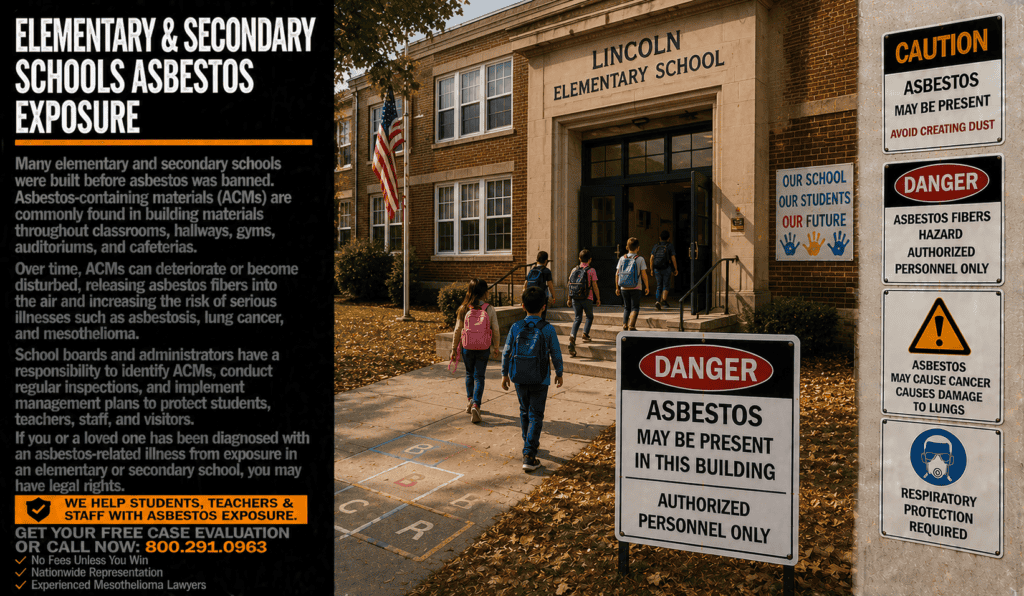
🏫 Elementary & Secondary Schools Asbestos Exposure
Elementary and secondary schools used asbestos in insulation, ceiling tiles, flooring, and fireproofing materials.
Elementary and secondary school buildings constructed throughout much of the 20th century commonly incorporated asbestos-containing materials. From kindergarten classrooms to high school gymnasiums, asbestos was used extensively to improve fire resistance, sound control, insulation, and durability. At the time, asbestos was considered a safe and effective building material, and its health risks were not fully disclosed or understood.
Today, thousands of public and private elementary and secondary schools still contain asbestos. While many districts maintain asbestos management plans, exposure risks remain when aging materials deteriorate or are disturbed during maintenance, renovations, or emergency repairs. Students, teachers, custodial staff, and maintenance workers may be exposed to asbestos fibers over long periods—often without any warning signs.
🧱 Why Asbestos Was Used in Elementary & Secondary Schools
From the 1930s through the late 1970s, asbestos was widely used in school construction because it offered multiple advantages for large educational facilities:
-
🛡️ Fire resistance for classrooms, hallways, boiler rooms, and electrical areas
-
🔥 Thermal insulation for heating systems and steam pipes
-
🎧 Sound absorption in classrooms, auditoriums, and cafeterias
-
🧱 Durability in flooring, ceilings, walls, and roofing materials
-
💲 Cost efficiency, especially for publicly funded school construction
School districts across the country relied on asbestos products to meet fire codes and construction budgets. Unfortunately, many of these materials remain in place decades later.
🧪 Common Asbestos-Containing Materials in Elementary & Secondary Schools
Asbestos may still be present in many areas of K–12 school buildings, including:
🧰 Insulation Systems
-
Boiler insulation
-
Steam pipe insulation
-
HVAC duct insulation
🔳 Flooring & Ceiling Materials
-
Vinyl floor tiles
-
Floor tile adhesives and mastics
-
Acoustic ceiling tiles
🔥 Fireproofing & Wall Materials
-
Sprayed-on fireproofing
-
Plaster and joint compounds
-
Cement wall panels
⚙️ Mechanical & Utility Areas
-
Gaskets and seals
-
Electrical panel insulation
-
Mechanical room components
When these materials are intact and undisturbed, immediate risk may be low. However, aging, cracking, vibration, water damage, or renovation work can release microscopic asbestos fibers into the air.
⚠️ How Asbestos Exposure Happens in Schools
Asbestos exposure occurs when fibers become airborne and are inhaled or ingested. In elementary and secondary schools, this may occur during:
-
Routine maintenance and repairs
-
Renovation or modernization projects
-
Ceiling tile or flooring replacement
-
HVAC upgrades or ductwork repairs
-
Flooding, roof leaks, or structural damage
Asbestos fibers are invisible and odorless, meaning exposure can occur without anyone realizing it. Children may be especially vulnerable because they breathe more rapidly than adults and spend long hours in the same classrooms.
🧑🏫 Who Is Most at Risk in Elementary & Secondary Schools
👶 Students
Children attending schools with aging asbestos materials may experience low-level exposure over many years. Because asbestos-related diseases have long latency periods, early exposure can increase lifetime health risks.
👩🏫 Teachers & School Staff
Teachers, aides, cafeteria workers, and administrative staff often work in the same building for decades, increasing cumulative exposure.
🛠️ Custodial & Maintenance Workers
Maintenance staff face higher exposure risk because they may disturb asbestos during repairs, cleaning, or emergency work involving ceilings, pipes, or mechanical systems.
🧬 Health Risks Linked to School Asbestos Exposure
Asbestos-related illnesses often take decades to develop. Conditions linked to asbestos exposure include:
🫁 Asbestosis
A chronic lung disease caused by scarring of lung tissue, leading to shortness of breath and reduced lung capacity.
🧠 Mesothelioma
A rare and aggressive cancer affecting the lining of the lungs or abdomen. Mesothelioma is almost always caused by asbestos exposure.
🫁 Lung Cancer
Long-term asbestos exposure significantly increases lung cancer risk, particularly when combined with smoking.
Symptoms may not appear for 20 to 50 years after exposure, which often delays diagnosis.
📜 Asbestos Regulations in Elementary & Secondary Schools
Federal regulations require schools to:
-
Inspect buildings for asbestos-containing materials
-
Maintain written asbestos management plans
-
Conduct periodic re-inspections
-
Repair or remove damaged asbestos materials
These laws focus on management, not mandatory removal. As a result, many students and staff continue to occupy buildings that contain asbestos today.
❓ Frequently Asked Questions (FAQs)
1️⃣ Do most elementary and secondary schools contain asbestos?
Many schools built before 1980 used asbestos-containing materials, though not every building contains asbestos.
2️⃣ Is asbestos dangerous if it is not disturbed?
Asbestos is most dangerous when materials are damaged or disturbed. Deteriorating materials increase exposure risk.
3️⃣ Can childhood asbestos exposure cause illness later in life?
Yes. Diseases like mesothelioma often develop decades after exposure, including exposure during childhood.
4️⃣ How can parents find out if a school has asbestos?
Schools are required to keep asbestos management plans on file. Parents can request access from the school district.
5️⃣ Should asbestos always be removed from schools?
Not always. However, damaged or deteriorating asbestos must be properly repaired or removed to prevent exposure.
⚖️ How a Lawyer Can Help Get Compensation
Individuals diagnosed with asbestos-related illnesses may have legal options. An experienced asbestos lawyer can help by:
-
Investigating where and when asbestos exposure occurred
-
Identifying responsible manufacturers or contractors
-
Filing claims against asbestos trust funds
-
Pursuing compensation for medical bills, lost income, and pain and suffering
-
Assisting families with wrongful death claims
Asbestos cases are complex and time-sensitive. Legal guidance can help protect your rights and maximize compensation.
📞 Free Case Evaluation – Get Help Today
If you or a loved one were exposed to asbestos in an elementary or secondary school and later developed an asbestos-related illness, help is available.
📞 Call Now for a FREE Case Evaluation: 800-291-0963
There is no obligation, and compensation may be available.
📌 Key Takeaways
-
Elementary and secondary schools widely used asbestos in construction
-
Many schools still contain asbestos today
-
Exposure can occur during maintenance, renovations, or deterioration
-
Students, teachers, and staff may face long-term health risks
-
Legal options may be available for asbestos-related illnesses