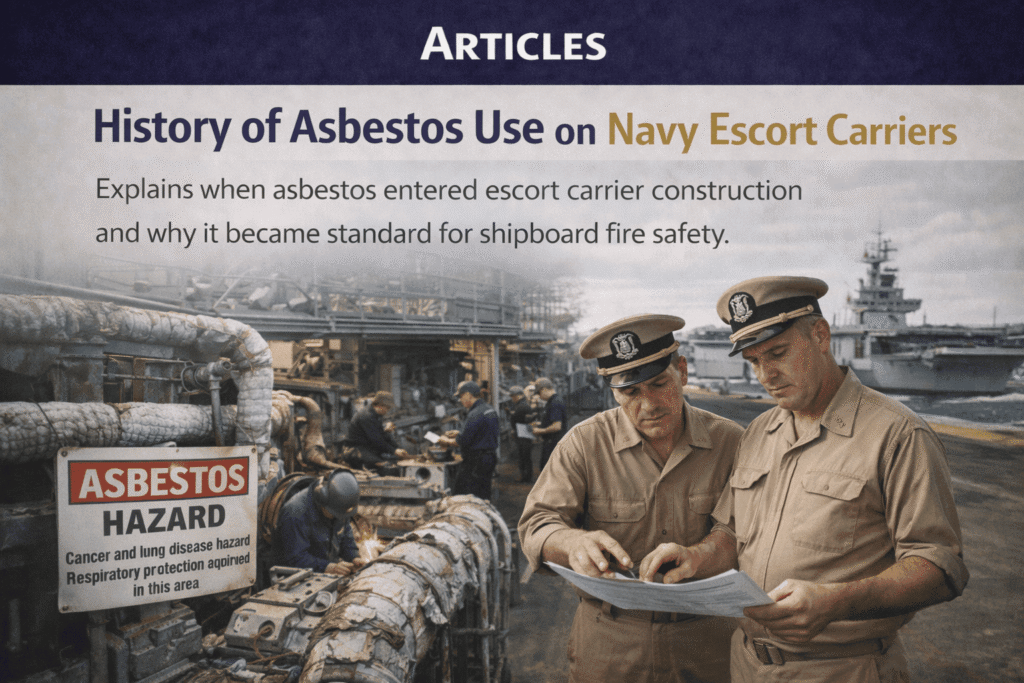
🔹 History of Asbestos Use on Navy Escort Carriers
Navy escort carriers (often called “jeep carriers”) were built quickly during wartime to provide air support, convoy protection, and submarine defense. Because these ships carried aviation fuel, ammunition, and high-heat machinery, fire safety was critical. Asbestos became a standard material because it resisted fire, handled extreme temperatures, and was inexpensive.
Unfortunately, the same material that protected escort carriers later caused serious diseases in thousands of sailors and shipyard workers.
This article explains when asbestos entered escort carrier construction, why it became standard, and how its widespread use created long-term health risks.
🕰️ Early Naval Engineering and Fire Risk
By the early 1900s, naval ships relied on:
• High-pressure boilers
• Steam turbines
• Electrical systems
• Fuel and ammunition storage
These systems created constant fire danger in tight steel spaces.
Early insulation like cork and wood failed under high heat. Engineers needed a material that could:
• Resist extreme temperatures
• Prevent fires from spreading
• Insulate steam pipes and boilers
• Protect sailors from burns
• Survive saltwater environments
Asbestos met all of these needs.
🚢 When Asbestos Entered Escort Carrier Construction
Asbestos appeared in Navy ships in the early 1900s, but its use expanded rapidly during major wars.
Key periods:
• 1900–1915 – Early use in boilers and pipes
• World War I – Expanded engine room use
• 1920s–1930s – Standard naval material
• World War II – Massive use in escort carriers
• 1950s–1970s – Continued use despite health warnings
Most escort carriers built during World War II used asbestos in nearly every system.
🔥 Why Asbestos Became Standard on Escort Carriers
Fire Resistance
Escort carriers carried aviation fuel, bombs, and ammunition. Fires could destroy the ship in minutes. Asbestos did not burn, making it ideal for walls, ceilings, wiring, and machinery.
Heat Insulation
Boilers, turbines, and steam pipes ran at extreme temperatures. Asbestos insulation protected sailors from burns.
Durability
Saltwater corroded many materials. Asbestos resisted moisture, chemicals, and decay.
Low Cost
Asbestos was cheap and easy to mass-produce—important during wartime shipbuilding.
Lightweight
Ships needed strong but light materials. Asbestos added protection without heavy weight.
Because of these benefits, asbestos was called a “miracle material.”
⚓ World War II: Peak Asbestos Use
World War II was the height of asbestos use. Escort carriers were built fast to meet wartime demand.
During construction:
• Walls and ceilings were sprayed with asbestos
• Pipes were wrapped in asbestos cloth
• Boilers were covered with asbestos cement
• Machinery was insulated with asbestos
Sailors lived and worked inside asbestos-filled ships every day.
🏗️ Construction and Shipyard Overhauls
Escort carriers required frequent repairs and upgrades.
During shipyard work:
• Old asbestos insulation was stripped
• Boilers and pipes were uncovered
• New asbestos materials were installed
• Dust filled enclosed compartments
These periods caused extreme asbestos exposure.
🚨 Ignored Health Warnings
By the 1930s and 1940s, doctors had linked asbestos to lung disease. However:
• War needs outweighed health concerns
• Manufacturers hid risks
• The Navy trusted industry claims
• Sailor health studies were not done
Asbestos stayed standard for decades.
📍 Where Asbestos Was Used on Escort Carriers
Asbestos appeared throughout escort carriers:
• Boiler insulation and lagging
• Steam pipes and valves
• Turbines and generators
• Electrical wiring
• Fireproof bulkheads and decks
• Gaskets and seals
• Aviation support equipment
• Hangar deck fireproofing
• Crew quarters
• Ventilation systems
Fibers entered nearly every compartment.
🛠️ Daily Life in an Asbestos Environment
Common exposure activities:
• Chipping old insulation
• Replacing gaskets
• Welding near asbestos pipes
• Sanding fireproof walls
• Sleeping in asbestos-lined quarters
Ventilation systems carried fibers everywhere.
🔄 Maintenance and Overhauls: Highest Risk
During overhauls:
• Insulation was scraped and cut
• Boilers were opened
• Machinery coverings were removed
• Dust filled tight spaces
Many sailors experienced their heaviest exposure during these periods.
🧬 Long-Term Health Consequences
Asbestos diseases often appear 20–50 years later.
Common illnesses:
• Mesothelioma
• Lung cancer
• Asbestosis
• Pleural disease
Many escort carrier veterans were diagnosed decades after service.
❓ Escort Carrier – History FAQs
Were all escort carriers built with asbestos?
Most built before the 1980s used asbestos widely.
Why was asbestos trusted so long?
It worked well and risks were hidden.
Did sailors know it was dangerous?
Most were never warned.
Can old exposure still cause disease today?
Yes—symptoms appear decades later.
⚖️ How an Asbestos Lawyer Can Get You Compensation
An asbestos lawyer builds your case by connecting your service to asbestos companies.
An asbestos lawyer will:
• Review ship assignments and duties
• Identify asbestos products on your ship
• Match products to manufacturers
• Work with doctors to confirm disease
• File lawsuits and trust fund claims
You pay nothing unless compensation is recovered.
📞 Get Help Now
If you served aboard a Navy escort carrier and later developed mesothelioma, lung cancer, or another asbestos-related disease, you may be entitled to compensation.
You may qualify for:
• Lawsuit settlements or verdicts
• Asbestos trust fund payments
• VA disability and survivor benefits
There is no upfront cost.
📞 Call now for a free, confidential case consultation:
800.291.0963