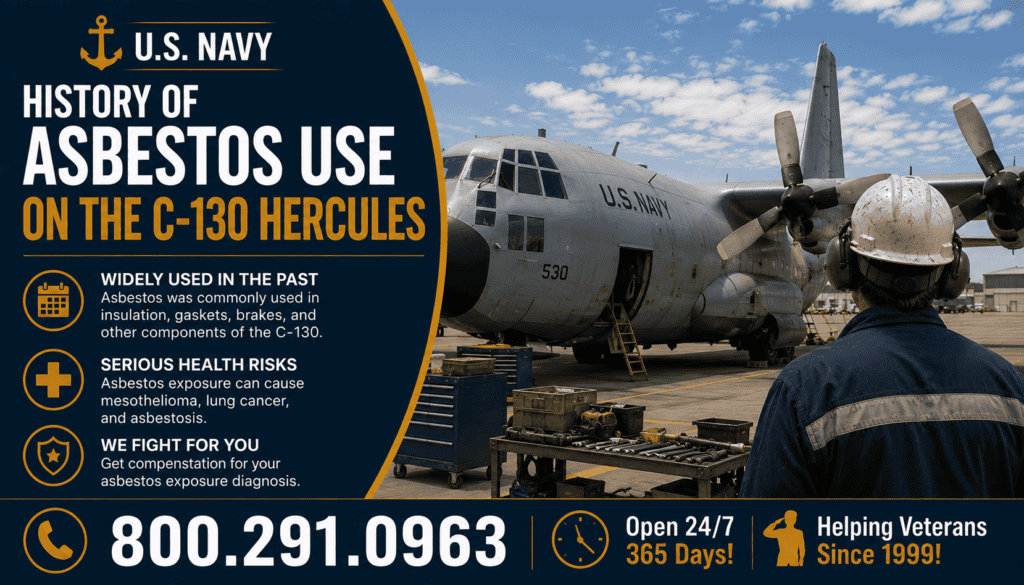
🔹 History of Asbestos Use on the C-130 Hercules
Asbestos became a standard industrial material long before the C-130 Hercules was designed. By the time the aircraft entered service in the 1950s, asbestos was already widely used in military manufacturing because of its ability to resist heat, fire, and friction. Aircraft designers relied on it to protect crews and equipment from extreme temperatures, sparks, and mechanical stress.
This article explains when asbestos entered military aircraft manufacturing, why it became standard for aviation safety, and how its use on the C-130 later harmed thousands of service members.
🔥 Early Aviation and the Need for Fire Safety
As military aircraft became larger and more powerful in the 1940s and 1950s, fire risk increased dramatically. Engines, exhaust systems, brakes, wiring, and hydraulics produced intense heat in confined spaces.
Engineers needed materials that could:
• Resist extreme temperatures
• Prevent fires from spreading
• Handle friction in brakes and clutches
• Insulate engines and wiring
• Withstand vibration and stress
Asbestos met all of these needs better than most materials available at the time.
📅 When Asbestos Entered C-130 Manufacturing
The C-130 Hercules first flew in 1954 and entered service in 1956. At that point, asbestos was already standard in:
• Aircraft manufacturing
• Shipbuilding
• Automotive brakes
• Industrial insulation
Because of this, asbestos was built directly into many early C-130 components.
Key periods:
• 1940s–1950s – Asbestos becomes standard in aviation
• 1950s–1970s – Heavy use in brakes, engines, wiring, and insulation
• 1980s – Gradual reduction as health risks became undeniable
• 1990s+ – New aircraft mostly asbestos-free, older planes still contaminated
Most C-130 aircraft built before the 1980s contained asbestos.
⚙️ Why Asbestos Became Standard in the C-130
Asbestos was chosen for aviation because of several critical advantages:
Fire Resistance
Aircraft fires could be catastrophic. Asbestos did not burn, making it ideal for fireproofing.
Heat Insulation
Engines and exhaust systems reached extreme temperatures. Asbestos protected nearby components and crew.
Friction Control
Brakes and clutches generated intense heat. Asbestos handled friction better than most materials.
Durability
Aircraft vibrated constantly. Asbestos resisted wear, chemicals, and moisture.
Low Cost
Asbestos was cheap and easy to source, making it attractive to manufacturers.
Because of these traits, asbestos was promoted as essential for aviation safety.
✈️ Cold War Era and Heavy Asbestos Use
The C-130 became a workhorse during the Cold War and Vietnam War. It was used for:
• Cargo transport
• Troop movement
• Medical evacuation
• Special operations
• Humanitarian missions
During this period:
• Aircraft were serviced constantly
• Brakes and engines were replaced often
• Insulation was repaired repeatedly
• Wiring systems were upgraded
Each repair disturbed asbestos materials.
⚠️ Ignored Health Warnings
By the 1930s, doctors had linked asbestos to lung disease. By the 1960s, cancer risks were becoming clear. Despite this:
• Manufacturers kept using asbestos
• Military demand outweighed safety
• Workers were rarely warned
• Protective gear was not provided
Maintenance crews worked in asbestos dust without knowing the danger.
🧠 Typical Asbestos Use on Early C-130 Aircraft
Asbestos commonly appeared in:
• Brake pads and linings
• Engine insulation blankets
• Exhaust system insulation
• Heat shields
• Wiring coverings
• Electrical panels
• Gaskets and seals
• Vibration dampeners
• Fireproof panels
These parts were disturbed repeatedly during routine maintenance.
🔧 Maintenance Made Exposure Inevitable
C-130 aircraft required constant servicing:
• Brake replacement after landings
• Engine overhauls
• Wiring repairs
• Insulation replacement
• Structural modifications
Each task released asbestos fibers. Enclosed hangars trapped dust, increasing exposure.
📉 Decline of Asbestos in Aviation
By the late 1970s and 1980s:
• Medical proof of cancer risk was overwhelming
• OSHA began regulating asbestos
• Manufacturers started phasing it out
• Safer materials were developed
However, many older C-130 aircraft continued flying with original asbestos parts for decades.
🩺 Long-Term Health Consequences
Asbestos diseases often appear 20–50 years after exposure.
Common illnesses include:
• Mesothelioma
• Lung cancer
• Asbestosis
• Pleural disease
Many C-130 veterans were diagnosed decades after service.
❓ C-130 Asbestos History – FAQs
Was every C-130 built with asbestos?
Most aircraft built before the 1980s used asbestos in brakes, insulation, wiring, and fireproofing.
Why didn’t the military stop using asbestos sooner?
Military demand and industry pressure delayed change despite known risks.
Could flight crews be exposed too?
Yes. Fibers spread through air systems and maintenance areas.
Did hangars increase exposure?
Yes. Enclosed spaces trapped asbestos dust.
⚖️ How an Asbestos Lawyer Can Get You Compensation
An asbestos lawyer connects your aircraft service to asbestos products and manufacturers.
An asbestos lawyer will:
• Trace your aircraft assignments
• Identify asbestos-containing components
• Match parts to manufacturers
• Work with doctors to prove disease
• File lawsuits and trust fund claims
📞 Get Help Now
If you worked on or flew aboard a C-130 Hercules and later developed mesothelioma, lung cancer, or another asbestos-related disease, you may be entitled to compensation.
You may qualify for:
• Lawsuit settlements or verdicts
• Asbestos trust fund payments
• VA disability and survivor benefits
There is no upfront cost.
📞 Call now for a free, confidential case consultation:
800.291.0963