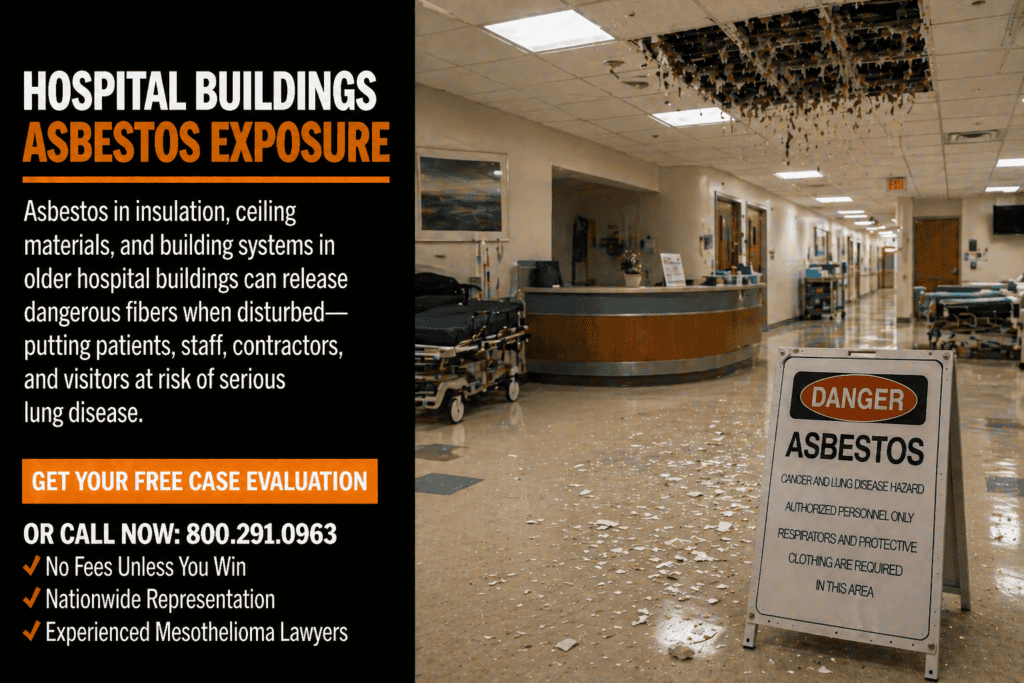
🏥 Hospital Buildings Asbestos Exposure
Hospitals are complex facilities that may remain in service for decades while patient wings, laboratories, mechanical systems, operating areas and utility spaces are repeatedly renovated or expanded. Depending on a hospital’s construction history, some older buildings may have contained asbestos-containing insulation, flooring, ceiling materials, fireproofing, roofing or mechanical-system components.
Working in, receiving care in or visiting an older hospital does not by itself prove asbestos exposure. A useful investigation should connect the person to a specific hospital, building or wing, department, work area, job or activity, dates, material and disturbance event.
See the broader Healthcare & Institutional Buildings Asbestos Exposure hub and Buildings Asbestos Exposure resource for related building categories.
🏥 How Asbestos Exposure Could Occur in Hospital Buildings
Potential hospital exposure depended on whether asbestos-containing material was actually present and whether it released airborne fibers after damage or disturbance. EPA notes that the mere presence of intact asbestos-containing material may not represent a health risk; concern centers on fibers becoming airborne and being inhaled.
Hospital activities worth investigating include:
- Repairing older boilers, steam lines and insulated piping.
- Replacing or modifying HVAC systems.
- Removing older flooring or ceiling materials.
- Opening walls and ceilings for electrical or communications work.
- Renovating patient rooms, laboratories and operating areas.
- Repairing roofs or fireproofed structural areas.
- Demolishing older hospital wings.
- Cleaning construction or maintenance debris near work areas.
OSHA specifically identifies asbestos as a hospital facilities-management hazard and notes that maintenance workers and engineers can encounter asbestos around older insulated boilers and piping and during renovations involving older building materials.
📍 Hospital Areas and Systems to Investigate
⚙️ Boiler Rooms and Central Utility Plants
Hospital heating and steam systems can be important in historical exposure investigations. OSHA specifically identifies furnace rooms, insulated boilers and old piping as possible asbestos exposure sources for hospital engineers and maintenance workers.
🛏️ Patient Wings and Treatment Areas
Patient rooms, corridors, nursing stations and treatment spaces may undergo repeated flooring, ceiling, wall, plumbing and electrical renovations.
🔬 Laboratories
Hospital laboratories can contain specialized ventilation, utilities and workspaces that may be modified repeatedly. Related research facilities are addressed in the healthcare institutional silo.
🏥 Operating and Procedure Areas
Modernization projects may involve ceilings, walls, flooring, utilities, ventilation and adjacent mechanical systems. The exact construction records should determine which materials warrant investigation.
🏢 Administrative and Office Areas
Older office portions of a hospital can contain the same types of historical building materials found in other commercial and institutional properties.
🛠️ Maintenance Shops, Tunnels and Service Areas
Facilities personnel may work away from patient-care spaces in mechanical rooms, utility corridors, service areas and maintenance shops. These locations can be important when reconstructing occupational exposure.
🧱 Asbestos-Containing Materials in Older Hospitals
No material should be identified as asbestos-containing based only on appearance or the age of a hospital. EPA advises that suspect building material cannot reliably be identified as asbestos simply by looking at it; historical records, professional inspection or appropriate analysis may be needed.
| Hospital Area | Material or System to Investigate | Potential Disturbance |
|---|---|---|
| Boiler and utility rooms | Pipe, boiler, tank and duct insulation | Repair, removal or replacement |
| Patient and office areas | Certain floor and ceiling materials | Renovation or replacement |
| Mechanical systems | Certain thermal insulation and associated materials | Maintenance and upgrades |
| Walls and partitions | Certain surfacing, compounds and panels | Cutting, drilling or demolition |
| Structural areas | Certain fireproofing and sprayed-on materials | Renovation or demolition |
| Roofs | Certain historical roofing materials | Repair or tear-off |
EPA’s current operations-and-maintenance guidance specifically identifies hospitals among the types of facilities that may contain asbestos materials managed in place. EPA groups building ACM into categories including surfacing material, thermal-system insulation and miscellaneous materials such as certain floor or ceiling tiles, cement panels, roofing and electrical or sound insulation.
For additional historical building-material categories, see Common Asbestos Materials Found in Pre-1970s Buildings.
👷 Hospital Workers and Contractors Potentially at Risk
Potential exposure can vary greatly by occupation. Hospital engineers and maintenance trades who directly repaired building systems may have had different exposure opportunities from nurses, physicians and administrative staff working primarily in finished spaces.
- Hospital engineers — boiler rooms, steam systems, piping and mechanical equipment.
- Facilities and maintenance workers — repairs involving ceilings, walls, floors and utility systems.
- Boiler and utility workers — heating plants, steam lines and insulated equipment.
- Custodial and environmental-services workers — cleaning and floor work, including areas near maintenance activity.
- Plumbers and pipefitters — pipe systems, valves and mechanical spaces.
- Electricians — walls, ceilings, electrical rooms and utility spaces.
- HVAC technicians — ductwork, mechanical equipment and insulated systems.
- Carpenters and construction workers — renovations, additions and demolition.
- Roofers — historical roofing systems.
- Healthcare employees — potential exposure requires evidence of disturbed asbestos-containing material in or near occupied work areas.
OSHA warns that hospital maintenance personnel can be unaware of asbestos hazards associated with older boilers, piping, renovations, floor tiles and ceiling tiles.
See High-Risk Jobs for Asbestos Exposure for broader occupational information.
🔨 Maintenance, Renovation and Demolition Exposure
Hospital construction can be unusually complex because renovation may occur while nearby departments remain operational. Older wings may be modernized in phases, utilities rerouted, ceilings opened and mechanical systems replaced.
EPA recommends that before renovation or remodeling that could disturb suspected asbestos-containing material, building asbestos inspection and assessment records be reviewed, the area be visually reinspected and the likelihood of disturbance evaluated. EPA notes that renovations and replacement of utility systems increase the potential for disturbing asbestos-containing material.
Projects worth investigating include:
- Boiler and steam-system replacement.
- Patient-room modernization.
- Operating-room and laboratory renovations.
- Flooring and ceiling replacement.
- Electrical and communications upgrades.
- HVAC modernization.
- Roofing work.
- New hospital additions.
- Demolition of obsolete wings.
EPA’s asbestos NESHAP establishes work-practice requirements for covered renovation and demolition projects, while OSHA asbestos standards establish worker-protection requirements for covered asbestos work.
See Historic Building Renovation Job Sites Asbestos Exposure for additional renovation-related information.
📂 Hospital Asbestos Records and Exposure Evidence
A useful investigation moves beyond “I worked at an old hospital” toward:
Person → Hospital → Building/Wing → Department/Area → Job/Task → Material → Disturbance → Date
- Identify the hospital and exact campus location.
- List the building, wing, floor and department.
- Record employment or contractor dates.
- Identify the person’s job and routine duties.
- List renovations, shutdowns and major maintenance projects.
- Look for asbestos surveys and inspection reports.
- Locate O&M plans and asbestos-management records where available.
- Review facilities work orders, plans and specifications.
- Identify abatement contractors and construction trades.
- Locate coworkers, engineers, supervisors or other witnesses.
EPA recommends permanent recordkeeping for asbestos O&M programs, including inspection and assessment reports, O&M plans, work procedures, fiber-release reports, maintenance-work approvals, evaluations of work affecting ACM and reinspection or surveillance information. These records can be valuable when they survive from the relevant hospital and time period.
See Steps to Prove Asbestos Exposure in Older Buildings for a broader evidence framework.
🫁 Health Risks and Potential Legal Options
Inhaling airborne asbestos fibers can cause serious asbestos-related diseases. OSHA identifies mesothelioma, lung cancer and asbestosis among the health effects associated with asbestos exposure.
A diagnosis does not establish that a particular hospital caused the exposure. A complete investigation may need to examine other hospitals, employers, construction projects, military service, asbestos-containing products and other possible exposure sources.
When evidence connects exposure to identifiable asbestos-containing products, contractors or potentially responsible companies, legal options may be investigated. See Mesothelioma Lawsuit and Asbestos Exposure Lawsuit.
Compensation is not guaranteed and depends on the diagnosis, exposure evidence, applicable law and filing deadlines.
❓ Hospital Buildings Asbestos Exposure Questions
Did every older hospital contain asbestos?
No. A hospital’s age may justify further investigation, but it does not prove that any particular material contained asbestos.
Where might asbestos-containing materials be investigated in a hospital?
Depending on the building and era, investigators may examine pipe and boiler insulation, certain flooring and ceiling materials, mechanical systems, roofing, fireproofing and other installed building products.
Which hospital workers may have had more direct exposure opportunities?
Hospital engineers, maintenance workers, boiler personnel, plumbers, electricians, HVAC technicians and renovation contractors may have directly worked on building materials and systems.
Could nurses and doctors have been exposed to asbestos?
Potentially, if asbestos-containing material was disturbed in or near their work areas. Merely working in an older hospital does not prove exposure.
Why are boiler rooms important in hospital asbestos investigations?
OSHA specifically identifies older insulated boilers and piping as possible asbestos exposure sources for hospital engineers and maintenance workers.
Can hospital renovation records help establish exposure?
Potentially. Surveys, O&M records, work orders, plans, specifications, abatement records and contractor files can help identify materials, work locations and dates.
Can a demolished hospital wing still be investigated?
Potentially. Historical building plans, asbestos surveys, facilities records, permits, contractor documents, photographs and witness accounts may survive after demolition.
🚀 Turn a Hospital Work History Into a Clear Exposure Record
📞 Review the Hospital, Building, Department, Job and Evidence
If you or a loved one worked in a hospital building and later developed mesothelioma or asbestos-related lung cancer, a focused review can help identify possible exposure sources and surviving records.
- Hospital — facility, campus, building, wing, department and dates.
- Work — occupation, duties, maintenance, renovations and nearby trades.
- Exposure — boilers, piping, insulation, flooring, ceilings and mechanical systems.
- Evidence — surveys, O&M records, plans, work orders, abatement files and witnesses.
Call 800.291.0963 now, use live chat 24/7/365, or Submit Your Case for a free, confidential case review.
Compensation is not guaranteed. Potential legal options depend on the diagnosis, exposure evidence, potentially responsible parties, applicable law and filing deadlines.
⚕️ Legal & Medical Information Disclaimer
This page provides general educational information and is not legal or medical advice. Working in, receiving care in or visiting a hospital building does not by itself prove asbestos exposure, disease causation, legal liability or eligibility for compensation.