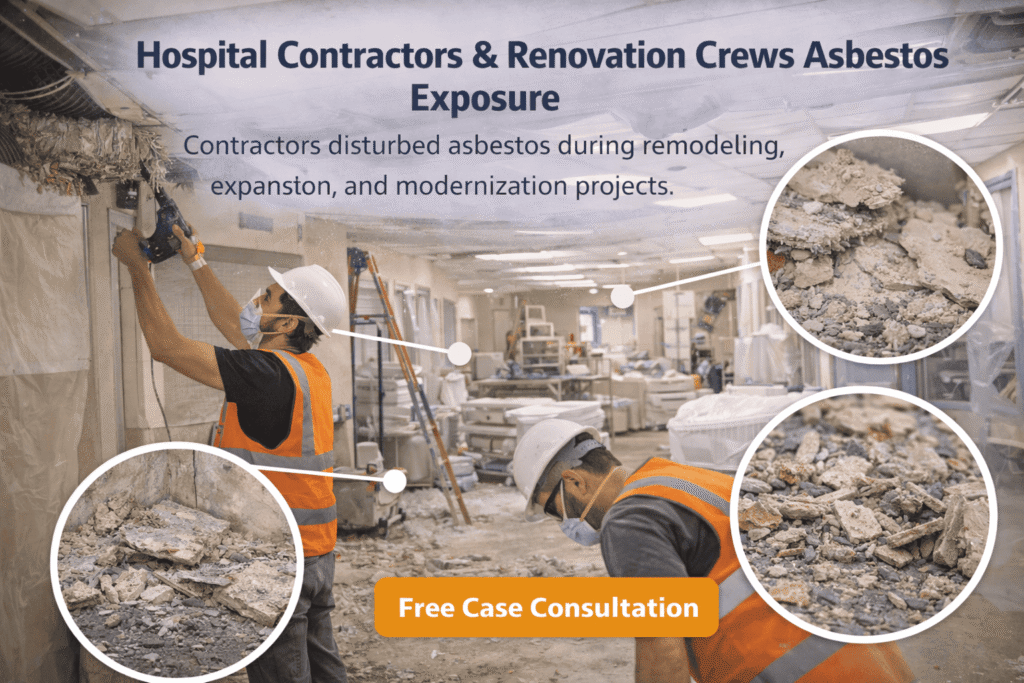
🏗️ Hospital Contractors & Renovation Crews Asbestos Exposure
Hospital contractors and renovation crews were heavily exposed to asbestos while remodeling, expanding, and modernizing older hospital buildings that contained asbestos insulation, fireproofing, flooring, piping, HVAC materials, electrical components, and structural panels—often while hospitals remained fully operational.
Hospitals undergo constant renovation to accommodate new technology, expand patient capacity, and meet updated safety standards. In facilities built or renovated before the 1980s, nearly every renovation project disturbed asbestos-containing materials. Contractors—including carpenters, laborers, electricians, plumbers, HVAC technicians, demolition crews, and general trades—were frequently the first to disturb hidden asbestos, often without adequate warnings or protection.
Unlike planned asbestos abatement projects, many hospital renovations were performed under tight timelines, at night or in phases, while patients and staff remained inside the building. This created some of the highest-risk asbestos exposure scenarios in healthcare environments.
🏛️ Why Hospital Renovation Crews Faced Extreme Asbestos Exposure
Hospital contractors experienced elevated asbestos exposure because they:
-
🧱 Cut into walls, ceilings, and floors containing asbestos
-
🔥 Removed fireproofing and insulation during remodels
-
🌬️ Modified HVAC systems that spread fibers building-wide
-
⚡ Rewired electrical systems insulated with asbestos
-
⏱️ Worked under tight schedules with limited containment
Renovation crews often encountered asbestos unexpectedly, especially in older wings, basements, tunnels, and mechanical chases.
🧪 Asbestos-Containing Materials Disturbed During Hospital Renovations
Contractors and renovation crews commonly disturbed asbestos in:
🧱 Structural & Interior Materials
-
Spray-applied asbestos fireproofing
-
Drywall joint compound and plaster
-
Asbestos cement panels and boards
🪜 Flooring & Ceiling Systems
-
Vinyl asbestos floor tiles
-
Sheet flooring and mastics
-
Acoustic ceiling tiles and insulation
🔥 Piping & Mechanical Systems
-
Steam pipe insulation and lagging
-
Valve packing and gaskets
-
Boiler and heat exchanger insulation
🌬️ HVAC & Ventilation Components
-
Insulated ductwork and plenums
-
Fire dampers and air handler linings
⚡ Electrical Systems & Fireproofing
-
Asbestos-insulated wiring
-
Electrical panels and arc shields
-
Fire-rated wallboards and sealants
Because renovation work involved cutting, drilling, sawing, and demolition, asbestos fibers were easily released into the air.
⚠️ How Asbestos Exposure Occurred During Hospital Renovation Work
Exposure commonly occurred during:
-
Demolishing walls, ceilings, and floors
-
Removing old insulation and fireproofing
-
Cutting into asbestos-containing materials
-
Scraping adhesives and mastics
-
Replacing pipes, ducts, and wiring
-
Core drilling for new systems
-
Cleanup and debris handling
Many of these activities generated dense dust clouds, often in confined spaces without proper containment.
🌫️ Widespread Asbestos Spread During Active Hospital Renovations
Renovation-related exposure was amplified because:
-
🌬️ HVAC systems distributed fibers beyond work zones
-
🏥 Occupied floors remained open during construction
-
🧹 Debris handling re-aerosolized settled asbestos
-
🚶 Worker movement spread contamination
Asbestos fibers migrated into patient rooms, nursing stations, corridors, operating suites, and offices—placing hospital staff and patients at risk alongside contractors.
🧑🏭 Contractor Roles Most at Risk
🏗️ Demolition & General Laborers
Performed tear-outs and debris removal.
🔧 Plumbers & Pipefitters
Removed insulated pipes, valves, and fittings.
⚡ Electricians
Handled asbestos-insulated wiring and fireproofed panels.
🌬️ HVAC Technicians
Cut into ductwork and fire dampers.
🪚 Carpenters & Drywall Crews
Cut walls, ceilings, and asbestos-containing boards.
🧹 Cleanup & Debris Workers
Handled contaminated dust and materials.
Because renovation crews worked across multiple systems, exposure was frequent and intense.
🧬 Secondary (Take-Home) Asbestos Exposure
Hospital contractors often carried asbestos fibers home on:
-
Work clothing and coveralls
-
Boots, gloves, and tools
-
Hair and skin
-
Vehicles and equipment
Family members were exposed during laundry and household contact. Many mesothelioma cases have been linked to secondary exposure from hospital renovation work.
🫁 Health Risks Linked to Hospital Renovation Asbestos Exposure
Long-term asbestos exposure among renovation crews is associated with:
🧠 Mesothelioma
A rare, aggressive cancer almost exclusively caused by asbestos.
🫁 Asbestosis
Progressive lung scarring leading to chronic breathing difficulty.
🫁 Lung Cancer
Significantly increased risk following prolonged asbestos exposure.
Because renovation work often involved high concentrations of friable asbestos, disease risk was severe even with short-term exposure.
📜 Safety Failures During Hospital Renovation Projects
Many hospitals and contractors failed to:
-
Conduct proper asbestos surveys before renovations
-
Warn workers of asbestos hazards
-
Use containment and negative air pressure
-
Provide respirators and protective equipment
-
Schedule work during facility closures
-
Perform licensed asbestos abatement
These failures form the basis of many asbestos claims involving hospital renovation crews.
❓ Frequently Asked Questions (FAQs)
1️⃣ Are hospital renovation crews at high risk for asbestos exposure?
Yes. Renovations disturb large amounts of hidden asbestos.
2️⃣ Were renovations often done while hospitals were open?
Yes. Many projects occurred during active patient care.
3️⃣ Did contractors receive asbestos warnings?
Often no. Many exposures were unexpected.
4️⃣ Can family members file secondary exposure claims?
Yes. Take-home asbestos exposure is legally recognized.
5️⃣ Can claims still be filed decades later?
Yes. Asbestos diseases have long latency periods.
⚖️ How a Lawyer Can Help Get Compensation
An experienced asbestos lawyer can help hospital contractors and families by:
-
Investigating renovation project records and timelines
-
Identifying asbestos-containing materials disturbed
-
Tracing manufacturers of insulation, flooring, and fireproofing
-
Documenting occupational and secondary exposure
-
Filing mesothelioma lawsuits
-
Submitting asbestos trust fund claims
-
Coordinating claims across multiple exposure sources
-
Maximizing total compensation available
Because hospital renovations involve multiple asbestos products and contractors, thorough legal investigation is critical.
📞 Free Case Evaluation – Get Help Today
If you worked as a contractor or renovation crew member in a hospital and developed mesothelioma or another asbestos-related illness—or were exposed through a family member—help is available.
📞 Call Now for a FREE Case Evaluation: 800-291-0963
There is no obligation, and compensation may be available.
📌 Key Takeaways
-
Hospital renovations disturbed asbestos extensively
-
Contractors faced high-intensity exposure
-
Fibers spread into occupied hospital areas
-
Families faced secondary exposure risks
-
Legal options may still be available