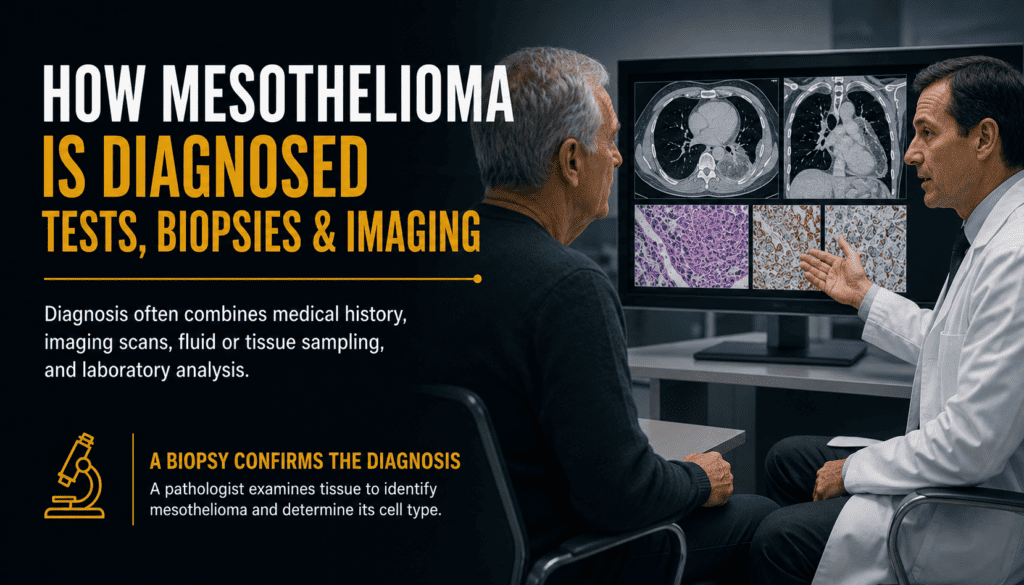
🩺 How Mesothelioma Is Diagnosed: Tests, Biopsies & Imaging
Mesothelioma can be difficult to diagnose because its symptoms resemble other lung or abdominal diseases.
Doctors rely on a combination of imaging scans, fluid tests, and biopsies to confirm the presence of cancer cells caused by asbestos exposure.
📞 If you’ve been exposed to asbestos and suspect symptoms, call 800.291.0963 today to discuss your next medical steps.
🧬 Step 1: The Importance of Early and Accurate Diagnosis
Early diagnosis can make a major difference in treatment options and survival rates.
Because mesothelioma grows slowly and often appears decades after exposure, doctors use several diagnostic tools to detect and confirm the disease with precision.
Goals of diagnosis include:
-
Confirming the presence of malignant cells.
-
Determining the type of mesothelioma (pleural, peritoneal, pericardial, or testicular).
-
Measuring how far the cancer has spread (staging).
-
Guiding doctors toward the most effective treatment plan.
💡 Accurate diagnosis ensures personalized care and avoids unnecessary or incorrect treatments.
🩻 Step 2: Imaging Tests Used to Detect Mesothelioma
Imaging scans are usually the first step in identifying abnormal tissue growth.
Common imaging tests include:
-
CT Scan (Computed Tomography):
Creates detailed cross-sectional images of the chest or abdomen to reveal tumors, fluid buildup, or thickening. -
MRI (Magnetic Resonance Imaging):
Uses magnetic fields to visualize soft tissue and help determine tumor spread and surgical options. -
PET Scan (Positron Emission Tomography):
Tracks metabolic activity of cells, showing where cancer may have spread in the body. -
X-Ray:
Often used initially to identify fluid buildup (pleural effusion) or abnormal lung shapes.
🧠 Imaging alone cannot confirm mesothelioma, but it helps doctors decide where to perform biopsies.
🧫 Step 3: Laboratory and Fluid Tests
Doctors may test fluid from the chest or abdomen to detect cancer cells.
Procedures include:
-
Thoracentesis: Removes fluid from the chest cavity.
-
Paracentesis: Removes fluid from the abdomen.
-
Pericardiocentesis: Removes fluid from around the heart.
These fluids are analyzed under a microscope for signs of malignant mesothelial cells.
💡 While helpful, fluid cytology alone is not definitive — a tissue biopsy is usually required for confirmation.
🧪 Step 4: Biopsies — The Gold Standard for Diagnosis
A biopsy is the only way to confirm mesothelioma with certainty.
It involves collecting a tissue sample from the affected area for pathological examination.
Common biopsy types:
-
🔬 Needle Biopsy (Fine-Needle Aspiration or Core): Minimally invasive; removes small tissue samples using a needle guided by imaging.
-
🩺 Thoracoscopy or Laparoscopy: Uses a camera and surgical tools to collect larger samples directly from the chest or abdomen.
-
🧍 Open Surgical Biopsy: Done when less invasive methods don’t provide enough tissue.
Once collected, tissue samples undergo immunohistochemistry (IHC) and molecular testing to identify mesothelioma cell types — epithelioid, sarcomatoid, or biphasic.
🧬 The cell type determines prognosis and treatment approach.
⚖️ Step 5: Staging After Diagnosis
After confirming the diagnosis, doctors assign a stage (I–IV) based on tumor size, location, and whether cancer has spread.
| Stage | Description | Typical Findings |
|---|---|---|
| I | Localized | Tumor limited to one area. |
| II | Regional | Nearby lymph nodes or tissues affected. |
| III | Advanced | Tumor spreads to one side of the chest or abdomen. |
| IV | Metastatic | Cancer spreads to distant organs. |
📈 Staging helps oncologists design tailored treatment plans such as surgery, chemotherapy, or immunotherapy.
🧠 Step 6: Understanding Accuracy and Next Steps
Even with advanced testing, mesothelioma can sometimes be misdiagnosed as lung cancer or pneumonia.
For best accuracy:
-
🧾 Always request a pathology review from a mesothelioma specialist.
-
🧫 Keep copies of all imaging and biopsy reports.
-
🧬 Consider genetic and biomarker testing to guide personalized treatment.
💡 Second opinions from mesothelioma-focused medical centers often confirm or clarify results.
📞 Where to Get Help
If you’ve been diagnosed or suspect asbestos-related illness, our advocates can connect you with top mesothelioma doctors and testing centers nationwide.
We’ll help you understand which tests are recommended and what your next medical steps should be.
👉 Call 800.291.0963 today to speak with a specialist who understands mesothelioma diagnosis and treatment.
🧾 Summary
Mesothelioma diagnosis involves several key steps — imaging scans, fluid testing, and tissue biopsies.
Each method contributes to accuracy, helping doctors identify cell type, stage, and treatment options.
Early testing leads to better outcomes — don’t wait to confirm your diagnosis.
📞 Call 800.291.0963 today to begin your diagnostic journey.