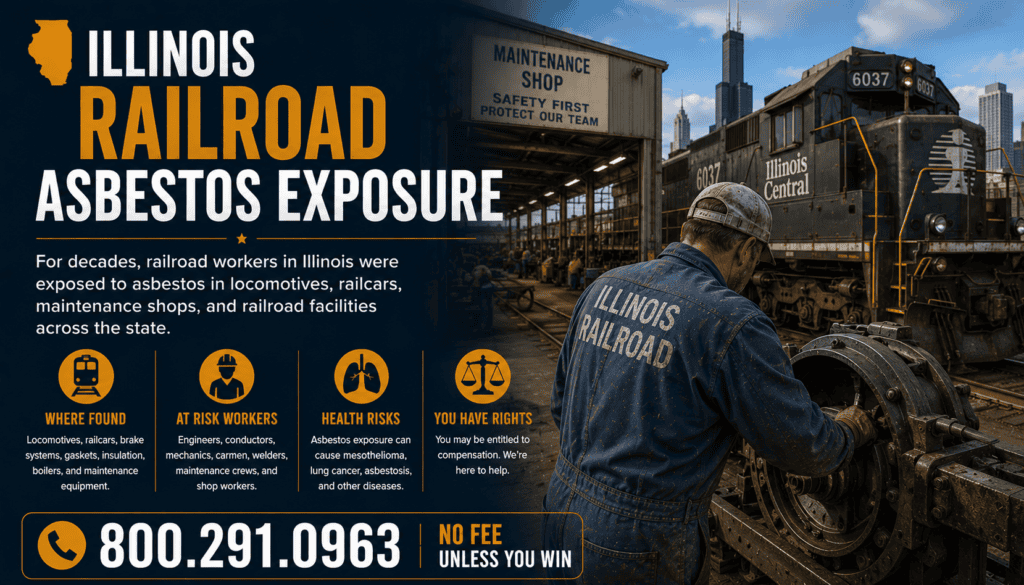
🚂 Illinois Railroad Asbestos Exposure
Illinois has played a vital role in the American railroad industry for more than 150 years. From the earliest steam locomotives to modern freight and passenger rail systems, thousands of railroad workers helped move people, raw materials, manufactured goods, coal, steel, agricultural products, and military equipment throughout the state and across the nation.
Chicago became one of the largest railroad hubs in the United States, while communities throughout Illinois depended on railroads for employment and economic growth. Railroad companies built extensive networks of rail yards, switching terminals, freight depots, passenger stations, roundhouses, repair shops, and maintenance facilities across the state.
For much of the twentieth century, asbestos was considered an essential material throughout the railroad industry. Because it resisted heat, insulated steam systems, reduced fire hazards, and withstood constant vibration, asbestos was incorporated into locomotives, passenger cars, freight cars, maintenance buildings, repair shops, roundhouses, and railroad equipment.
Railroad workers often handled asbestos-containing materials every day without knowing that inhaling microscopic asbestos fibers could eventually lead to life-threatening diseases. Mechanics, machinists, engineers, conductors, electricians, pipefitters, boilermakers, welders, car inspectors, and maintenance crews routinely worked around asbestos insulation, locomotive boilers, brake systems, steam pipes, electrical equipment, gaskets, pumps, valves, and other components containing asbestos.
Today, many former Illinois railroad employees have been diagnosed with mesothelioma, lung cancer, asbestosis, and other asbestos-related diseases decades after their occupational exposure. Because these illnesses usually develop 20 to 50 years after asbestos exposure, many retirees are only now discovering that their years working on the railroad may have placed them at risk.
If you or a loved one worked for a railroad in Illinois and later developed an asbestos-related disease, you may have legal options. Learn more by visiting our Illinois Mesothelioma Lawsuits page.
🚂 Illinois Railroad History
Illinois has been one of America’s most important railroad states since the mid-1800s. As the nation’s railroad network expanded westward, Illinois became the central connection between the eastern United States and the growing Midwest, Great Plains, and western territories.
Railroads transported millions of passengers while moving steel, coal, grain, livestock, automobiles, machinery, petroleum products, construction materials, military supplies, and manufactured goods across the country. The railroad industry helped Illinois become a major center for manufacturing, agriculture, trade, and heavy industry.
Chicago quickly developed into one of the nation’s busiest railroad centers, with numerous rail lines converging throughout the city. Major railroad companies constructed extensive networks of:
- Locomotive repair shops
- Railroad roundhouses
- Rail yards
- Switching terminals
- Passenger stations
- Freight depots
- Machine shops
- Maintenance buildings
- Bridge repair shops
- Equipment storage facilities
These operations employed thousands of workers responsible for building, maintaining, repairing, inspecting, and operating railroad equipment. Employees rebuilt locomotives, repaired passenger coaches, serviced freight cars, maintained steam systems, replaced brake components, repaired electrical equipment, and performed heavy mechanical maintenance.
Many of these railroad facilities operated during the decades when asbestos-containing products were widely used throughout the transportation industry. Workers routinely repaired locomotives, replaced insulation, serviced steam systems, rebuilt engines, maintained brake systems, and performed heavy repairs around asbestos-containing materials.
Many railroad employees also worked in nearby factories, steel mills, power plants, refineries, and manufacturing facilities during different periods of their careers. Learn more by visiting our Illinois Industrial Asbestos Exposure page.
Workers may also have encountered asbestos at locations listed in our Illinois Asbestos Exposure Sites guide.
🔥 Why Illinois Railroads Used Asbestos
For decades, asbestos was considered one of the most valuable industrial materials available. Railroad companies depended on equipment that generated tremendous heat and operated under extreme temperatures and pressure, making fire-resistant insulation essential for safe and efficient operation.
Railroad manufacturers selected asbestos because it provided several important advantages:
- Excellent heat resistance
- Strong fire protection
- Effective thermal insulation
- Resistance to friction
- High durability
- Resistance to chemicals and corrosion
- Long service life
- Affordable manufacturing costs
Because of these qualities, asbestos became a standard component in thousands of railroad products. It was commonly installed in locomotive boilers, steam pipes, engine compartments, brake systems, electrical panels, passenger cars, freight cars, pumps, valves, gaskets, packing materials, floor coverings, wall panels, and maintenance equipment.
Asbestos materials helped prevent heat from escaping from steam systems. They also protected workers and nearby equipment from hot surfaces. Fire-resistant asbestos panels were installed in locomotives and railroad cars to reduce the danger of fires spreading through enclosed areas.
Even after diesel locomotives began replacing steam-powered engines, asbestos remained widely used throughout the railroad industry. Diesel engines, exhaust systems, brakes, electrical equipment, gaskets, and heat shields continued to contain asbestos because manufacturers valued its resistance to heat and friction.
Railroad companies and workers often had no warning that disturbing these materials could release dangerous fibers. As a result, employees continued cutting, sanding, scraping, drilling, replacing, and removing asbestos products for many years.
👷 How Illinois Railroad Workers Were Exposed
Most Illinois railroad workers were never told that they were working around asbestos. Instead of handling raw asbestos, employees were usually exposed while repairing, maintaining, replacing, or removing equipment that contained asbestos products.
Common work activities that released asbestos fibers included:
- Replacing brake shoes and brake linings
- Repairing locomotive boilers
- Removing pipe insulation
- Rebuilding diesel engines
- Servicing steam systems
- Replacing pumps and valves
- Installing or removing gaskets
- Replacing packing materials
- Grinding brake components
- Cutting insulation
- Scraping old sealing materials
- Sweeping repair shops
- Cleaning locomotive engine compartments
- Removing damaged fireproof panels
- Repairing insulated electrical equipment
These routine maintenance activities often released microscopic asbestos fibers into the surrounding air. Workers performing the repairs could inhale the fibers, but nearby employees were also placed at risk.
A mechanic replacing asbestos brake components, for example, could create dust that spread throughout the shop. A pipefitter removing old insulation could expose machinists, electricians, welders, laborers, and supervisors working nearby.
Because asbestos fibers are extremely small, workers could not always see or smell the hazard. The fibers could remain suspended in the air and settle on machinery, floors, workbenches, clothing, tools, and equipment.
Employees working inside enclosed railroad shops, maintenance buildings, and locomotive repair facilities frequently experienced repeated exposure because asbestos dust accumulated over many years of daily operations.
Workers may have also carried asbestos fibers home on their work clothes, shoes, hair, jackets, and tools. This created the possibility of secondary exposure among spouses and children who handled or washed contaminated clothing.
🚂 Steam Locomotives and Asbestos Exposure
Steam locomotives represented one of the largest sources of occupational asbestos exposure throughout the railroad industry. These powerful engines operated under extremely high temperatures and pressures, requiring extensive insulation throughout the locomotive.
Asbestos was commonly used in:
- Boiler insulation
- Steam pipes
- Fireboxes
- Heat shields
- Pipe coverings
- Gaskets
- Packing materials
- Pumps
- Valves
- Insulating cement
- Turbine components
- Boiler doors
- Steam fittings
Boilermakers, machinists, mechanics, pipefitters, welders, electricians, and laborers routinely repaired these components while performing scheduled maintenance and complete locomotive rebuilds.
Boiler insulation could deteriorate because of heat, vibration, moisture, age, and repeated repairs. Workers often removed damaged insulation by cutting, scraping, pulling, or breaking it away from the boiler surface. These activities could release large amounts of asbestos dust.
Steam pipes were commonly wrapped with asbestos-containing insulation. Before repairing leaking pipes or replacing damaged sections, workers often had to remove the old insulation. Dry and brittle pipe covering could break apart easily, allowing asbestos fibers to spread through the locomotive or repair shop.
Gaskets and packing materials were also used throughout steam locomotive systems. Mechanics frequently scraped old gaskets from flanges, pumps, valves, and access panels. Hardened gasket material sometimes had to be ground or chipped away, creating additional asbestos dust.
Workers repairing steam locomotives often performed these tasks inside enclosed roundhouses and repair shops. Limited ventilation allowed asbestos fibers to remain airborne and spread beyond the immediate work area.
🚆 Diesel Locomotives and Asbestos Exposure
Although diesel locomotives eventually replaced most steam-powered engines, asbestos continued to be widely used throughout locomotive construction and maintenance. Manufacturers relied on asbestos because it could withstand high temperatures produced by diesel engines while helping reduce the risk of fire.
Many diesel locomotives contained asbestos in:
- Engine insulation
- Exhaust systems
- Brake systems
- Electrical panels
- Pipe insulation
- Gaskets
- Packing materials
- Floor insulation
- Heat shields
- Fire-resistant barriers
- Clutch components
- Engine compartment panels
Mechanics rebuilding diesel locomotives often removed deteriorated insulation, replaced engine gaskets, repaired exhaust systems, serviced brake assemblies, and maintained electrical equipment. These routine repairs frequently disturbed asbestos-containing materials and released fibers into the work environment.
Diesel engine gaskets were frequently exposed to heat, oil, pressure, and vibration. Over time, the gaskets could become brittle and difficult to remove. Mechanics often scraped, wire-brushed, or ground gasket material from engine surfaces before installing replacements.
Exhaust systems also required heat-resistant insulation and gaskets. Workers repairing exhaust manifolds, pipes, mufflers, and other hot components could disturb asbestos-containing materials.
Diesel locomotives also used asbestos in brake and friction products. Mechanics replacing worn brake components could release dust while removing, cleaning, sanding, or installing parts.
Even when a worker did not directly handle asbestos, exposure could occur from nearby maintenance activities. Dust released during engine rebuilding or brake repair could spread across the shop and settle on clothing, tools, equipment, and work surfaces.
🏭 Illinois Railroad Repair Shops
Railroad repair shops were among the highest-risk workplaces for occupational asbestos exposure. These busy facilities handled everything from routine inspections to complete locomotive overhauls.
Workers rebuilt engines, repaired boilers, serviced steam systems, replaced insulation, maintained electrical equipment, repaired brakes, and fabricated replacement parts. Many shops operated around the clock to keep locomotives and railroad cars in service.
Employees commonly worked around asbestos-containing:
- Boilers
- Steam piping
- Brake components
- Engine insulation
- Pumps
- Valves
- Compressors
- Electrical equipment
- Gaskets
- Pipe coverings
- Furnaces
- Industrial machinery
- Fireproof building materials
Because many repair shops operated inside large enclosed buildings, asbestos fibers released during cutting, grinding, sanding, drilling, scraping, and insulation removal often remained suspended in the air long after maintenance work had been completed.
Shop floors and workbenches could become covered with asbestos dust. Laborers and maintenance workers sometimes cleaned these areas using dry brooms or compressed air, causing settled fibers to become airborne again.
Railroad shop employees could also be exposed to asbestos used in the buildings themselves. Older repair facilities often contained asbestos pipe insulation, boiler insulation, floor tile, ceiling materials, roofing products, wall panels, fireproofing, and electrical equipment.
Workers who also spent time in factories or heavy industrial facilities may have experienced exposure from several sources during their careers. Additional information is available in our Illinois Industrial Asbestos Exposure guide.
🚦 Illinois Rail Yards and Switching Facilities
Illinois rail yards served as busy centers for inspecting, assembling, switching, storing, servicing, and repairing locomotives and railroad cars. Daily operations involved switching freight cars, inspecting wheels and brakes, servicing engines, replacing worn parts, and preparing trains for continued operation.
Maintenance crews frequently encountered asbestos-containing insulation, brakes, electrical equipment, pumps, valves, steam pipes, gaskets, and mechanical components during routine repairs.
Rail yard workers could be exposed while:
- Inspecting locomotive brakes
- Replacing brake shoes
- Repairing leaking steam lines
- Servicing engine compartments
- Removing damaged insulation
- Repairing pumps and valves
- Cleaning mechanical equipment
- Performing emergency repairs
- Sweeping work areas
- Handling contaminated tools and clothing
Rail yards were often noisy, dusty, and crowded workplaces. Several maintenance activities could take place at the same time, allowing asbestos fibers from one repair job to spread into nearby work areas.
Employees who were not directly involved in repair work could still inhale asbestos dust released by mechanics, machinists, pipefitters, electricians, and car repair crews.
Large railroad hubs throughout Chicago and other Illinois communities handled thousands of locomotives and railcars. Workers assigned to these facilities often accumulated years or even decades of asbestos exposure.
Former workers searching for possible job-site exposure can also review our Illinois Asbestos Exposure Sites page.
🏠 Illinois Railroad Roundhouses
Roundhouses were specialized railroad buildings designed to inspect, store, service, and repair locomotives. These facilities usually included multiple service bays arranged around a central turntable that directed locomotives into individual work areas.
Roundhouse employees performed a wide range of maintenance duties, including:
- Boiler repairs
- Steam pipe maintenance
- Brake replacement
- Engine rebuilding
- Electrical repairs
- Pump and valve maintenance
- Insulation replacement
- Welding and metalwork
- Cleaning and inspection
- Emergency repairs
Steam locomotives entering roundhouses often contained damaged or deteriorating asbestos insulation. Heat, vibration, and years of service could cause insulation to crack, crumble, or separate from equipment.
Workers repairing boilers and steam systems frequently removed old asbestos insulation before reaching the damaged components beneath it. Other employees working in nearby service bays could inhale fibers released into the shared air.
Roundhouses also contained stationary boilers, steam pipes, heating systems, electrical panels, fireproof walls, roofing materials, and other building products that may have contained asbestos.
Because roundhouses were enclosed structures, airborne dust could remain trapped inside the building. Poor ventilation and repeated repair work increased the potential for ongoing exposure.
Employees who worked in Illinois roundhouses for many years may have experienced regular contact with asbestos-containing locomotive parts, building materials, insulation, gaskets, brakes, and maintenance equipment.
🧤 Secondary Asbestos Exposure Among Railroad Families
Illinois railroad workers were not the only people placed at risk. Asbestos fibers could cling to work clothing, jackets, shoes, hair, skin, lunch containers, and tools.
Workers often returned home wearing the same clothing used in repair shops, rail yards, and roundhouses. Family members could be exposed when they:
- Hugged a worker returning home
- Shook out dusty clothing
- Washed contaminated uniforms
- Cleaned work shoes
- Handled work jackets
- Entered vehicles containing asbestos dust
- Cleaned areas where work clothes were stored
Spouses who regularly washed contaminated railroad uniforms may have inhaled asbestos fibers over many years. Children could also be exposed through contact with a parent’s clothing or work equipment.
Secondary exposure has been linked to mesothelioma and other asbestos-related diseases. Family members may develop symptoms decades after the original household exposure occurred.
Anyone diagnosed with an asbestos-related illness after living with a railroad worker should document the employee’s job title, railroad company, work location, years of employment, and typical duties.
Information about possible Illinois exposure locations is available through our Illinois Asbestos Exposure Sites guide.
⚠️ Why Railroad Asbestos Exposure Remains Important Today
Most railroad asbestos exposure occurred decades ago, but the health effects continue today because asbestos-related diseases have a long latency period.
A worker exposed during the 1950s, 1960s, 1970s, or 1980s may not receive a diagnosis until many years after retirement. Symptoms such as shortness of breath, chest pain, persistent coughing, fatigue, or unexplained weight loss may be mistaken for other health problems.
Former railroad workers should tell their doctors about their complete employment history, including:
- Railroad company names
- Job titles
- Repair shop locations
- Rail yard assignments
- Roundhouse work
- Locomotive maintenance duties
- Brake repair work
- Boiler or steam system repairs
- Insulation removal
- Diesel engine rebuilding
A detailed work history may help medical providers evaluate whether asbestos exposure contributed to a respiratory illness or cancer diagnosis.
Railroad workers diagnosed with mesothelioma or another asbestos-related disease may also have legal options involving railroad companies, equipment manufacturers, product manufacturers, or asbestos bankruptcy trusts.
Learn more about statewide legal options by visiting our Illinois Mesothelioma Lawsuits page.
⚙️ Railroad Equipment That Contained Asbestos
For decades, railroads across Illinois relied on asbestos-containing equipment to help locomotives, passenger cars, freight cars, and maintenance facilities operate safely under extreme heat and heavy use. Manufacturers considered asbestos an ideal industrial material because it resisted fire, insulated against high temperatures, reduced friction, and helped equipment last longer.
Unfortunately, the same asbestos fibers that protected railroad equipment also placed thousands of workers at risk of developing mesothelioma, lung cancer, asbestosis, and other serious asbestos-related diseases. Every time mechanics removed worn insulation, replaced brakes, scraped gaskets, rebuilt engines, or repaired boilers, microscopic asbestos fibers could become airborne and remain suspended in the air for hours.
Many Illinois railroad employees never realized the dust they breathed each day contained asbestos. Workers often handled these materials without respirators, protective clothing, or warnings from their employers.
Common railroad equipment that frequently contained asbestos included:
- Steam locomotive boilers
- Diesel engine insulation
- Steam pipes
- Pipe insulation
- Boiler insulation
- Fireboxes
- Exhaust systems
- Brake shoes
- Brake linings
- Clutches
- Gaskets
- Packing materials
- Pumps
- Valves
- Compressors
- Turbines
- Electrical panels
- Generator insulation
- Passenger car heating systems
- Freight car brake systems
- Machine shop equipment
- Fireproof wall panels
- Electrical insulation
- Furnace insulation
Many railroad employees also worked in factories, steel mills, refineries, and power plants where they encountered the same asbestos-containing products. Learn more about these occupations by visiting our Illinois Industrial Asbestos Exposure page.
🔥 Steam Locomotive Boilers
Steam locomotive boilers represented one of the largest sources of asbestos exposure throughout the railroad industry. Boilers operated under tremendous pressure while producing the steam needed to power locomotives across Illinois.
Because boiler temperatures could exceed several hundred degrees, manufacturers surrounded them with thick layers of asbestos insulation to reduce heat loss and protect workers from burns.
Asbestos products commonly used around locomotive boilers included:
- Pipe covering
- Block insulation
- Insulating cement
- Boiler blankets
- Fireproof cloth
- Boiler jackets
- Rope insulation
- Gaskets
- Packing materials
During routine maintenance, boilermakers and mechanics removed damaged insulation to inspect boilers for corrosion, leaks, or cracks. The insulation often became brittle after years of exposure to heat and vibration. Simply pulling away old insulation could release large amounts of asbestos dust.
Boiler repairs frequently required workers to:
- Remove insulation
- Chip away insulation cement
- Scrape boiler surfaces
- Replace worn gaskets
- Install new insulation
- Repair steam fittings
- Replace valves
- Clean boiler compartments
Each of these tasks disturbed asbestos-containing materials.
Employees working nearby—including machinists, electricians, welders, laborers, supervisors, and helpers—could also inhale airborne fibers released during boiler maintenance.
💨 Steam Pipes and Pipe Insulation
Steam locomotives depended on an extensive network of high-pressure pipes that carried steam from the boiler throughout the locomotive.
To reduce heat loss, nearly every steam line was covered with asbestos insulation.
Common insulation materials included:
- Molded pipe covering
- Asbestos cloth
- Asbestos tape
- Insulating cement
- Pipe blocks
- Fire-resistant blankets
- Lagging
- Rope insulation
Pipefitters and steamfitters routinely removed insulation before repairing leaking pipes, valves, elbows, tees, or flanges.
Old insulation often crumbled apart during removal. Workers frequently swept debris from shop floors without realizing asbestos fibers had become airborne.
Steam leaks also damaged insulation over time. Water-soaked insulation eventually dried, cracked, and broke apart whenever maintenance crews returned to repair the system.
Pipe insulation was not limited to locomotives.
Illinois railroad facilities commonly insulated:
- Roundhouses
- Machine shops
- Maintenance buildings
- Passenger terminals
- Heating plants
- Steam tunnels
- Maintenance garages
- Repair shops
Workers assigned to maintain railroad buildings often experienced many of the same asbestos exposures as locomotive repair crews.
🛑 Railroad Brake Systems
Brake systems created enormous amounts of heat every time a train slowed or stopped. Manufacturers added asbestos fibers to brake shoes and brake linings because asbestos could withstand high temperatures while reducing wear.
Brake repairs became one of the most common sources of asbestos exposure throughout the railroad industry.
Mechanics routinely performed work such as:
- Removing brake shoes
- Replacing brake linings
- Grinding replacement brakes
- Sanding brake surfaces
- Drilling mounting holes
- Inspecting brake assemblies
- Cleaning brake housings
- Sweeping brake dust
Brake dust accumulated around:
- Wheels
- Axles
- Brake drums
- Shop floors
- Repair pits
- Maintenance equipment
Many shops used compressed air to clean brake assemblies. Today, experts recognize this practice could spread asbestos fibers throughout an entire repair facility.
Even employees who never touched brake components could inhale asbestos fibers drifting through enclosed maintenance shops.
Brake repairs occurred on:
- Steam locomotives
- Diesel locomotives
- Passenger cars
- Freight cars
- Maintenance vehicles
- Railroad cranes
- Switching locomotives
Workers who spent decades repairing brakes could experience repeated asbestos exposure throughout their careers.
⚙️ Clutches and Other Friction Materials
Many railroad machines contained asbestos-based friction products beyond brake systems.
Clutches, industrial machinery, maintenance equipment, cranes, hoists, compressors, and shop machinery frequently relied on asbestos because it resisted friction and heat.
Workers servicing these systems often:
- Opened clutch housings
- Removed worn friction discs
- Cleaned accumulated dust
- Sanded replacement parts
- Ground worn surfaces
- Installed new clutch components
Dust released during clutch repairs often remained trapped inside enclosed equipment until mechanics opened the housing.
Machine shop employees could perform these repairs hundreds of times over a career.
Although many replacement components manufactured today no longer contain asbestos, older locomotives and maintenance equipment may still contain original asbestos products or residual contamination from earlier repairs.
🚂 Railroad Gaskets
Thousands of asbestos-containing gaskets were installed throughout railroad locomotives and maintenance equipment.
Gaskets created tight seals capable of withstanding:
- High temperatures
- Steam pressure
- Engine vibration
- Fuel systems
- Lubrication systems
- Air systems
Railroad workers routinely replaced gaskets found on:
- Boilers
- Steam pipes
- Diesel engines
- Exhaust manifolds
- Compressors
- Pumps
- Valves
- Air compressors
- Turbines
- Fuel systems
Old gaskets often became baked tightly onto metal surfaces.
Mechanics typically removed them by:
- Scraping
- Grinding
- Wire brushing
- Sanding
- Chiseling
- Using power tools
These activities could create fine asbestos dust that spread across work benches, clothing, tools, and shop floors.
Many mechanics also cut replacement gaskets from large asbestos gasket sheets, producing additional dust while trimming each gasket to fit.
🚰 Pumps, Valves, and Packing Materials
Railroad locomotives relied on hundreds of pumps and valves to move steam, water, oil, fuel, lubricants, and compressed air throughout the engine.
Many of these systems used asbestos packing around valve stems and rotating shafts to prevent leaks while allowing moving parts to operate normally.
Maintenance crews regularly removed worn packing before installing new material.
Common maintenance procedures included:
- Pulling old packing
- Scraping valve chambers
- Cleaning pump housings
- Cutting replacement packing
- Pressing new packing into place
- Reassembling valves
- Testing for leaks
Packing often resembled braided rope containing asbestos fibers.
As it aged, the material became dry and brittle, making it easier to break apart during removal.
Pump and valve repairs were performed throughout:
- Steam locomotives
- Diesel locomotives
- Passenger rail cars
- Freight cars
- Roundhouses
- Railroad maintenance shops
- Heating plants
- Water systems
- Compressor rooms
Because pumps and valves required continual maintenance, railroad mechanics could perform these repairs thousands of times during their working lives.
Workers researching where they may have encountered asbestos can also explore our Illinois Asbestos Exposure Sites guide, which identifies many Illinois locations where asbestos-containing materials were historically used.
🚆 Passenger Rail Cars
Passenger rail cars carried millions of travelers across Illinois for decades. To improve passenger safety and comfort, manufacturers installed asbestos throughout these rail cars because it resisted fire, insulated against heat, and reduced noise and vibration. Asbestos was considered an ideal material for passenger coaches, dining cars, sleeping cars, baggage cars, and commuter rail equipment.
Common asbestos-containing materials found in passenger rail cars included:
- Floor insulation
- Ceiling insulation
- Wall panels
- Pipe insulation
- Steam heating systems
- Boiler insulation
- Brake linings
- Brake shoes
- Gaskets
- Valve packing
- Electrical panels
- Fire-resistant wallboard
- Fire doors
- Adhesives
- Flooring materials
Passenger rail cars required continual maintenance throughout their service lives. Railroad mechanics regularly removed old flooring, replaced heating equipment, repaired steam lines, rebuilt brake systems, and upgraded electrical components. These projects frequently disturbed asbestos-containing materials that had become brittle with age.
Workers commonly exposed during passenger car repairs included:
- Carmen
- Electricians
- Pipefitters
- Steamfitters
- Carpenters
- Mechanics
- Welders
- Laborers
- Painters
- Maintenance supervisors
Renovating older passenger cars often required cutting walls, drilling ceilings, replacing insulation, removing flooring, and rebuilding heating systems. These activities could release microscopic asbestos fibers throughout the enclosed rail car, exposing everyone working nearby.
🚃 Freight Rail Cars
Freight rail cars transported agricultural products, automobiles, machinery, chemicals, petroleum products, military equipment, steel, lumber, and manufactured goods throughout Illinois and across the United States.
Although freight cars varied in design, many contained asbestos products that helped protect mechanical systems from heat and friction.
Asbestos-containing products commonly found in freight rail cars included:
- Brake shoes
- Brake linings
- Gaskets
- Packing materials
- Pipe insulation
- Electrical insulation
- Fire-resistant panels
- Heating systems
- Refrigeration components
- Mechanical controls
Freight car repair crews routinely inspected, rebuilt, and repaired these components as part of scheduled maintenance. Brake replacements represented one of the most common repair procedures and frequently generated asbestos dust inside repair facilities.
Workers repairing refrigerated rail cars could also encounter asbestos in insulation surrounding cooling equipment, steam pipes, compressors, and refrigeration systems.
Railroad car repair facilities often serviced dozens of freight cars at the same time. Grinding, welding, insulation removal, and brake repairs occurring simultaneously could expose employees working throughout the building.
🏭 Railroad Machine Shops
Machine shops served as the heart of many Illinois railroad maintenance operations. These large industrial facilities rebuilt locomotives, repaired rail cars, fabricated replacement parts, restored worn machinery, and maintained essential railroad equipment.
Machine shops commonly employed:
- Machinists
- Mechanics
- Boilermakers
- Welders
- Millwrights
- Electricians
- Pipefitters
- Steamfitters
- Laborers
- Supervisors
Workers maintained numerous pieces of industrial equipment that themselves contained asbestos materials.
Common asbestos-containing equipment included:
- Air compressors
- Pumps
- Boilers
- Furnaces
- Industrial ovens
- Valves
- Turbines
- Lathes
- Presses
- Generators
- Electrical switchgear
- Steam systems
Machine shop employees frequently replaced asbestos gaskets, packing materials, brake components, clutch materials, pipe insulation, and thermal insulation while rebuilding equipment.
Welders sometimes used asbestos blankets and fire-resistant curtains to protect nearby workers from sparks. As these materials aged, they could release asbestos fibers during handling or storage.
Because machine shops were enclosed industrial environments, dust created in one work area often spread throughout the building. Employees who never directly handled asbestos products could still inhale airborne fibers generated by nearby repairs.
Many Illinois machine shops also repaired equipment used in factories, steel mills, refineries, and power plants. Learn more by visiting our Illinois Industrial Asbestos Exposure page.
⚡ Railroad Electrical Equipment
Railroad electrical systems relied on asbestos because it provided excellent heat resistance and electrical insulation. Electrical equipment generated heat during normal operation, making asbestos a common component in many electrical products manufactured throughout much of the twentieth century.
Electrical components that commonly contained asbestos included:
- Switchgear
- Electrical panels
- Fuse boxes
- Generator insulation
- Motor insulation
- Arc chutes
- Insulating boards
- Wiring insulation
- Electrical cabinets
- Fireproof barriers
Railroad electricians frequently removed covers, replaced wiring, serviced electrical motors, and repaired generators. These repairs sometimes required drilling, cutting, sanding, or replacing asbestos-containing insulating materials.
Electricians often worked alongside mechanics rebuilding engines, pipefitters replacing insulation, and welders performing repairs. As a result, electrical workers could experience both direct asbestos exposure and bystander exposure from other maintenance activities occurring nearby.
👷 High-Risk Illinois Railroad Occupations
Numerous railroad occupations exposed workers to asbestos over many decades. Some employees handled asbestos products directly every day, while others inhaled airborne fibers released by nearby repair work.
High-risk railroad occupations included:
- Boilermakers
- Machinists
- Railroad mechanics
- Diesel mechanics
- Steamfitters
- Pipefitters
- Electricians
- Welders
- Millwrights
- Carmen
- Car inspectors
- Brake repair workers
- Roundhouse workers
- Shop laborers
- Maintenance workers
- Engineers
- Firemen
- Conductors
- Brakemen
- Switchmen
- Yard workers
- Signal maintainers
- Equipment operators
- Bridge and building workers
- Maintenance-of-way employees
Workers often performed several different jobs during long railroad careers. An employee might begin as a laborer, later become a mechanic, and eventually supervise maintenance operations. Each position could involve different asbestos-containing products and additional opportunities for exposure.
👕 Take-Home Asbestos Exposure
Many Illinois railroad companies did not provide changing rooms or laundry facilities during the years asbestos products were widely used. Workers often left repair shops with asbestos dust covering their clothing, boots, gloves, hats, hair, and tools.
Family members could unknowingly inhale asbestos fibers when they:
- Washed work uniforms
- Shook dusty clothing
- Cleaned work boots
- Vacuumed family vehicles
- Stored contaminated jackets
- Hugged workers returning home
Spouses who routinely laundered contaminated work clothing sometimes developed mesothelioma decades later despite never working for a railroad.
Children could also be exposed after riding in contaminated vehicles or playing near dusty work clothing brought into the home.
Secondary exposure has been documented in numerous occupations where workers unknowingly carried asbestos fibers home after work.
📋 Documenting Railroad Asbestos Exposure
Many former railroad employees do not remember the names of every asbestos-containing product they handled decades ago. Fortunately, exposure can often be established using employment records, job descriptions, maintenance records, coworker testimony, and historical evidence showing asbestos was commonly used throughout the railroad industry.
Helpful information may include:
- Railroad company name
- Employment dates
- Job titles
- Departments worked
- Rail yard locations
- Roundhouse assignments
- Machine shop duties
- Locomotive types repaired
- Passenger cars serviced
- Freight cars repaired
- Boiler maintenance
- Brake repairs
- Pipe insulation removal
- Gasket replacement
- Pump and valve repairs
- Coworker names
- Union membership
Former workers should describe the work they performed rather than focusing only on specific product names. Daily job duties often provide valuable evidence of asbestos exposure.
Railroad Retirement Board records, Social Security employment records, union documents, company personnel files, and coworker statements may also help reconstruct an employee’s work history.
Many former railroad employees worked at facilities already identified as historical asbestos exposure locations. Our Illinois Asbestos Exposure Sites guide identifies many of these locations throughout the state.
If you or a family member has been diagnosed with mesothelioma, asbestos lung cancer, or another asbestos-related disease after working for an Illinois railroad, you can also learn about your legal options by visiting our Illinois Mesothelioma Lawsuits page.
🩺 Asbestos-Related Diseases Among Illinois Railroad Workers
Thousands of Illinois railroad workers were exposed to asbestos while repairing locomotives, passenger cars, freight cars, boilers, brakes, steam systems, and other railroad equipment. Because asbestos-related diseases often take decades to develop, many former railroad employees were not diagnosed until long after retiring.
The most common asbestos-related diseases include:
- Mesothelioma
- Asbestos lung cancer
- Asbestosis
- Pleural plaques
- Pleural thickening
- Other asbestos-related respiratory diseases
Most diseases develop 20 to 50 years after asbestos exposure. Even workers with brief or intermittent exposure may later develop serious illnesses.
Former railroad employees who worked in roundhouses, machine shops, repair facilities, rail yards, maintenance departments, or locomotive repair operations should inform their physician about their history of asbestos exposure.
🎗️ Mesothelioma
Mesothelioma is a rare and aggressive cancer caused almost exclusively by asbestos exposure. The disease develops in the lining surrounding the lungs, abdomen, heart, or testes after microscopic asbestos fibers become trapped inside the body.
Former Illinois railroad workers diagnosed with mesothelioma often worked as:
- Boilermakers
- Machinists
- Pipefitters
- Steamfitters
- Electricians
- Mechanics
- Carmen
- Welders
- Laborers
- Roundhouse workers
Symptoms may include:
- Shortness of breath
- Persistent cough
- Chest pain
- Fatigue
- Unexplained weight loss
- Fluid around the lungs
Because symptoms resemble many other illnesses, diagnosis often occurs years after the disease begins.
Learn more by visiting our Mesothelioma Symptoms and Mesothelioma Diagnosis pages.
🫁 Asbestos Lung Cancer
Asbestos exposure also increases the risk of lung cancer, especially among workers who were exposed over many years. Smoking and asbestos exposure together greatly increase this risk.
Symptoms may include:
- Chronic cough
- Chest pain
- Coughing up blood
- Wheezing
- Shortness of breath
- Fatigue
- Weight loss
Many Illinois railroad workers encountered asbestos throughout their careers while repairing boilers, brakes, engines, steam systems, and insulated equipment.
🌬️ Asbestosis
Asbestosis is a chronic lung disease caused by inhaling asbestos fibers over many years. The fibers create permanent scarring within the lungs, making breathing increasingly difficult.
Common symptoms include:
- Progressive shortness of breath
- Dry cough
- Chest tightness
- Fatigue
- Reduced exercise tolerance
Although there is no cure, early diagnosis and medical treatment may help manage symptoms and improve quality of life.
📋 Proving Railroad Asbestos Exposure
Former railroad workers often worry they cannot remember the names of specific asbestos products they handled decades ago. Fortunately, successful claims frequently rely on employment history, job duties, maintenance records, coworker testimony, and historical evidence showing asbestos was commonly used throughout the railroad industry.
Helpful documentation may include:
- Railroad company names
- Employment records
- Railroad Retirement Board records
- Social Security records
- Union membership records
- Job descriptions
- Department assignments
- Coworker statements
- Maintenance records
Workers should describe the equipment they repaired and the work they performed rather than focusing only on product names.
Many former railroad employees also worked at facilities identified in our Illinois Asbestos Exposure Sites guide.
⚖️ Illinois Railroad Mesothelioma Lawsuits
Illinois railroad workers diagnosed with mesothelioma or another asbestos-related disease may have legal options depending on their work history and the products that caused their exposure.
Compensation may be available through:
- Asbestos lawsuits
- Asbestos bankruptcy trust funds
- Wrongful death claims
- Other available legal remedies
Each claim is unique. An experienced asbestos attorney can review employment records, identify asbestos-containing products, and determine which sources of compensation may be available.
Learn more by visiting our Illinois Mesothelioma Lawsuits page.
💰 Asbestos Trust Funds
Many manufacturers that supplied asbestos-containing railroad products later filed for bankruptcy and established asbestos trust funds to compensate workers diagnosed with asbestos-related diseases.
Depending on a worker’s employment history, claims may be filed with one or more trust funds in addition to pursuing other legal options.
Evidence commonly used includes employment records, medical documentation, pathology reports, union records, and witness testimony.
❓ Frequently Asked Questions
Can railroad workers develop mesothelioma decades after exposure?
Yes. Mesothelioma typically develops 20 to 50 years after asbestos exposure.
Which railroad jobs had the greatest asbestos exposure?
Boilermakers, machinists, mechanics, pipefitters, steamfitters, electricians, welders, carmen, brake repair workers, laborers, and roundhouse employees experienced some of the highest exposure risks.
Can family members develop mesothelioma?
Yes. Family members may develop mesothelioma after repeated exposure to asbestos fibers carried home on contaminated work clothing.
Can former railroad workers still file claims?
Many workers diagnosed years after retirement may still have legal options. Eligibility depends on individual circumstances and applicable laws.
📞 Free Case Evaluation
If you or a loved one worked for an Illinois railroad and has been diagnosed with mesothelioma, asbestos lung cancer, or another asbestos-related disease, you may be entitled to financial compensation.
Our experienced legal team can help determine whether you may qualify by reviewing your:
- Employment history
- Railroad job duties
- Medical diagnosis
- Potential asbestos exposure sources
- Available trust fund claims
- Legal options
📞 Call 800-291-0963 to speak with an asbestos case specialist or complete our free online case evaluation.
There are no upfront costs, and you pay nothing unless compensation is recovered.