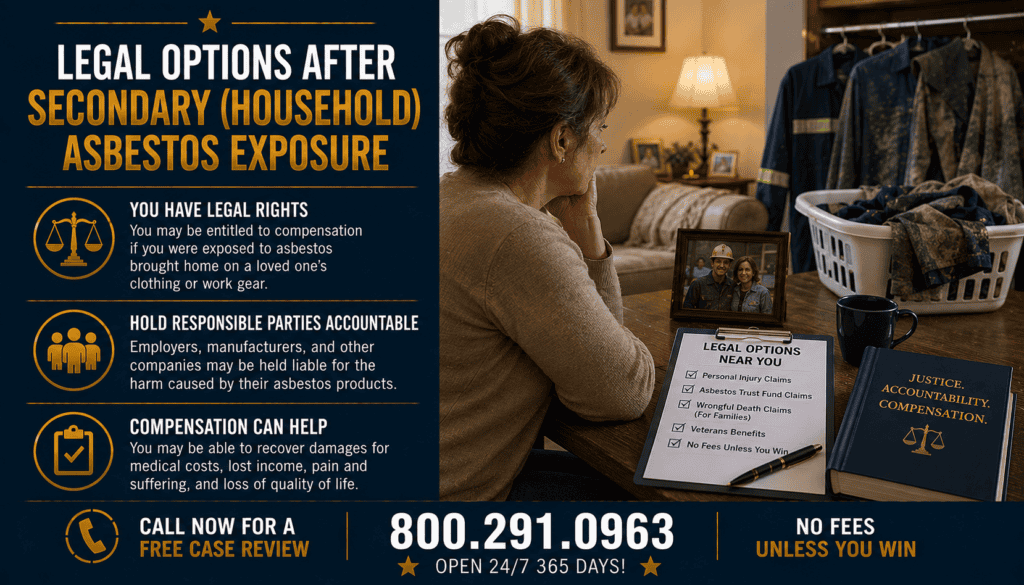
🏡 Legal Options After Secondary (Household) Asbestos Exposure
See how spouses or family members exposed via contaminated clothing can claim compensation for secondary exposure.
Secondary asbestos exposure — also called household exposure, take-home exposure, or bystander exposure — occurs when asbestos fibers are carried home on a worker’s clothing, hair, skin, boots, or tools. For decades, family members of mechanics, shipyard workers, construction crews, industrial laborers, and military personnel unknowingly inhaled these microscopic fibers inside their own homes.
Many of these spouses, children, and caregivers later developed mesothelioma, lung cancer, or asbestosis despite never working directly with asbestos. Today, the law recognizes their right to compensation.
This guide explains how secondary exposure happens, what legal rights families have, and how to pursue financial recovery from negligent manufacturers, employers, and premises owners.
For immediate help, call 800.291.0963.
🧥 How Secondary Asbestos Exposure Happens Inside the Home
Asbestos fibers are incredibly small, sharp, and durable. Once attached to clothing or hair, they can remain in place for days. When workers arrived home after a shift, fibers transferred into the household environment.
Common take-home pathways include:
-
Work uniforms or coveralls
-
Boots and work shoes
-
Jackets and gloves
-
Hair and facial hair
-
Tools or tool bags
-
Lunch pails
-
Car seats and upholstery
-
Laundry baskets and hampers
Exposure often occurred through:
-
Doing laundry for an asbestos-exposed worker
-
Hugging a spouse upon their return from work
-
Shaking out dusty clothing
-
Sweeping or vacuuming floors containing asbestos dust
-
Riding in contaminated vehicles
-
Sharing living space with work gear or tools
For decades, most families never suspected a risk — especially since employers often failed to provide shower rooms, changing stations, or warnings about contamination.
👨👩👧 Who Qualifies for Secondary Exposure Claims?
You may qualify if you developed an asbestos-related disease despite never personally working with asbestos, but lived with someone who did.
Eligible individuals often include:
-
Spouses who washed asbestos-contaminated clothes
-
Children exposed during routine household activities
-
Live-in relatives caring for an exposed worker
-
Domestic workers or caregivers who handled laundry
-
Roommates who shared living quarters with an industrial worker
Victims only need to show that:
-
A household member regularly worked around asbestos.
-
Fibers were likely carried home through clothing or equipment.
-
You developed an illness caused by asbestos exposure.
Courts across the U.S. have ruled that companies can be held responsible for foreseeable household contamination.
⚖️ Legal Theories That Support Secondary Exposure Cases
Attorneys use several legal principles to hold companies accountable for take-home exposure.
1. Negligence
Employers and manufacturers failed to warn workers about contamination risks or provide proper safety measures.
2. Premises Liability
Companies controlling the job site allowed asbestos to escape through workers, creating danger for their families.
3. Product Liability
Manufacturers who supplied asbestos-containing machinery, insulation, brakes, or gaskets can be sued for creating a dangerous product.
4. Failure to Warn
Companies knew or should have known asbestos fibers could be carried home.
5. Direct Liability for Contamination
Courts have ruled that asbestos dust carried home on clothing constitutes a foreseeable hazard, making companies responsible.
📄 Evidence Used to Prove Secondary Asbestos Exposure
Lawyers use extensive evidence to connect your illness to a family member’s occupational exposure.
Common documentation includes:
-
Employment records of the exposed worker
-
Pay stubs or union membership cards
-
Job descriptions and worksite locations
-
Coworker and supervisor testimony
-
Product identification at the worksite
-
Laundry routines and household duties
-
Medical records confirming mesothelioma or asbestos disease
-
Pathology and imaging results
-
Dust studies or industrial hygiene reports
-
Expert testimony linking home contamination to workplace fibers
Even if the worker passed away decades ago, attorneys can still reconstruct exposure history through archives and witness interviews.
👩⚕️ Medical Requirements for a Strong Claim
To succeed, victims must show a direct connection between:
-
Their illness (mesothelioma, lung cancer, or asbestosis), and
-
Exposure to asbestos fibers inside the home brought from another person’s workplace.
Diagnoses are confirmed through:
-
CT scans
-
PET imaging
-
Biopsies
-
Immunohistochemistry (IHC) testing
-
Pathology analysis
Mesothelioma is especially associated with even very low-dose exposure, making secondary cases medically credible.
💰 Financial Compensation Available to Secondary Exposure Victims
Secondary asbestos exposure victims may qualify for substantial compensation through:
Lawsuits Against:
-
Employers who allowed take-home contamination
-
Manufacturers of asbestos products
-
Premises owners who operated unsafe facilities
-
Contractors or shipyards responsible for high-dust environments
Asbestos Trust Funds
Many bankrupt asbestos companies created trusts specifically to compensate victims — including those harmed by household exposure.
Possible compensation includes:
-
Medical expenses
-
Lost wages and reduced earning ability
-
Travel expenses for treatment
-
Caregiving and home-support costs
-
Pain and suffering
-
Funeral and wrongful-death damages
-
Punitive damages (in cases of extreme corporate misconduct)
Some families receive compensation from multiple defendants, significantly increasing total recovery.
📢 Can Families File Wrongful-Death Claims?
Yes. If a family member passed away from mesothelioma due to secondary exposure, spouses, children, and dependents can file wrongful-death claims.
Damages may include:
-
Loss of companionship
-
Loss of household services
-
Loss of financial support
-
Funeral costs
-
Emotional suffering
Wrongful-death claims also help preserve justice for future generations by holding companies accountable.
📅 Filing Deadlines for Secondary Exposure Cases
Every state has a statute of limitations — usually:
-
1–3 years after diagnosis
-
1–3 years after death for wrongful-death claims
These deadlines matter because exposure may have occurred 40–60 years ago, but the clock begins when the disease is discovered, not when the exposure happened.
Victims should consult an asbestos attorney immediately to avoid losing legal rights.
🛡️ What to Do if You Suspect Secondary Exposure
If you believe your illness may be linked to a spouse or family member’s workplace:
Steps to take immediately:
-
Seek medical evaluation from a mesothelioma specialist
-
Gather your loved one’s employment history
-
Write down your household duties (especially laundry routines)
-
Locate old uniforms, tools, or photographs if available
-
Review state workers’ compensation or union records
-
Speak with an asbestos attorney who handles household exposure cases
Do not attempt to investigate old job sites on your own — attorneys will gather the needed evidence.
📞 Get Legal Help for Secondary Asbestos Exposure
Companies that allowed asbestos-covered workers to return home without warnings or protective measures put entire families at risk. If you developed mesothelioma or another asbestos-related disease due to secondary exposure, you may be entitled to compensation from multiple sources — including trust funds and lawsuits.
Our legal team specializes in take-home exposure cases, reconstructs work histories, and builds strong claims for victims and families.
Call 800.291.0963 today for free legal guidance.