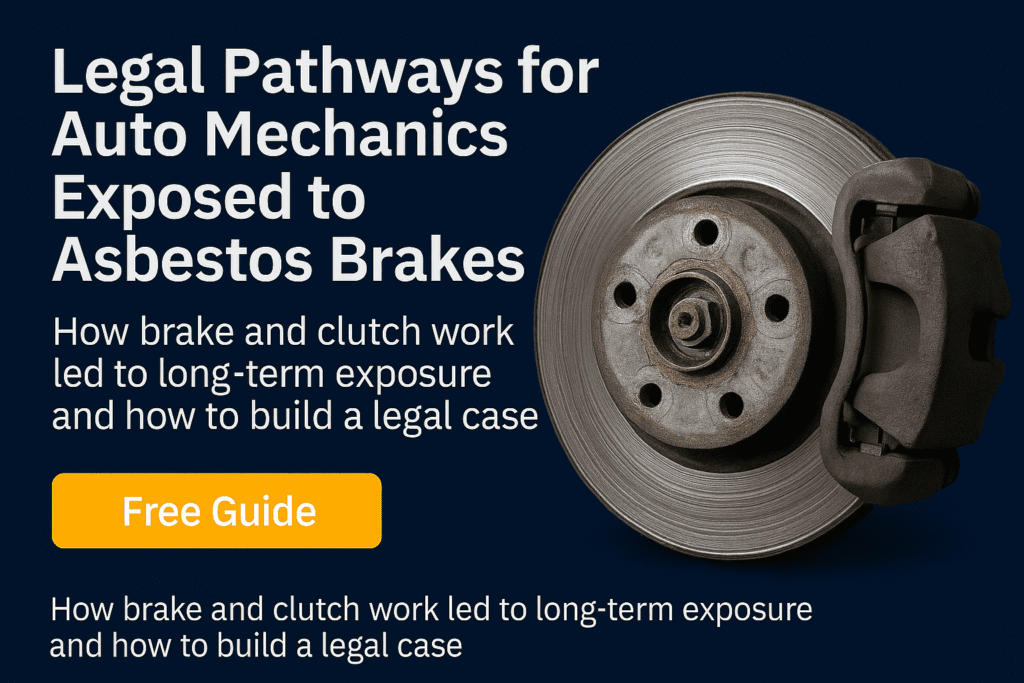
🔧 Legal Pathways for Auto Mechanics Exposed to Asbestos Brakes
Understand how brake and clutch work led to long-term exposure and how to build a successful legal case.
For decades, auto mechanics, brake technicians, and garage workers routinely handled asbestos-containing brake pads, linings, and clutches without any warning about the dangers. Each brake job could release millions of microscopic fibers into the air, creating a dangerous cloud that settled on workbenches, uniforms, and garage floors. Because asbestos fibers are invisible and odorless, mechanics often inhaled them daily without knowing the long-term health consequences.
Today, thousands of former mechanics have been diagnosed with mesothelioma, lung cancer, and other asbestos-related diseases directly linked to brake and clutch dust. Fortunately, multiple legal options exist for auto technicians and their families — even if exposure happened 20, 30, or 40 years ago.
This guide explains how exposure occurred, how attorneys prove these claims, and the legal pathways available for full compensation.
If you need immediate help, call 800.291.0963.
🚗 How Auto Mechanics Were Exposed to Asbestos
Asbestos was widely used in the automotive industry due to its heat resistance and durability. By the mid-20th century, nearly all major car manufacturers used asbestos in:
-
Brake pads and brake shoes
-
Clutch facings
-
Gaskets and heat shields
-
Transmission components
-
Drum brakes
-
Disc brakes
-
Engine parts requiring heat protection
Why brake and clutch work was especially dangerous
When mechanics performed tasks such as:
-
Blowing out brake drums
-
Sanding brake linings
-
Using air hoses to clean brake assemblies
-
Grinding or machining brake shoes
-
Removing old clutches
-
Cleaning brake dust from work areas
…massive amounts of asbestos fibers were released into the air.
The “blowout” method — once the standard for clearing brake dust — created the highest levels of airborne asbestos ever recorded in small garages.
Because these tasks were repeated daily, mechanics experienced continuous, long-term exposure.
👨🔧 Workers at Highest Risk
While all vehicle-repair workers faced some degree of exposure, certain job roles encountered asbestos dust more often and in higher concentrations.
High-risk positions include:
-
Auto mechanics
-
Transmission technicians
-
Brake specialists
-
Clutch and driveline repair technicians
-
Dealership mechanics
-
Fleet maintenance workers
-
Bus and truck repair mechanics
-
Diesel mechanics
-
Machine shop workers
-
Garage helpers and apprentices
-
Tire and brake shop employees
Even office workers or counter staff who spent time inside dusty garages may have been exposed.
🧰 Automotive Products Known to Contain Asbestos
Law firms often match exposure histories to specific brands. Many auto-parts manufacturers used asbestos in their products, including:
-
Bendix
-
Raybestos
-
Wagner
-
Ferodo
-
Maremont
-
Abex
-
BorgWarner
-
GM, Ford, and Chrysler OE brake components
-
Napa and CarQuest aftermarket brakes
These product lines create a direct link between a mechanic’s work history and known asbestos-containing parts.
📜 How Attorneys Prove Asbestos Exposure for Auto Mechanics
Unlike some industries, automotive exposure leaves a strong trail of evidence. Skilled attorneys use multiple documentation sources to build powerful cases.
1. Work-history reconstruction
Legal teams collect:
-
Employer lists
-
Shop names
-
Dealership records
-
Fleet maintenance logs
-
Union or trade-school records
This establishes where the mechanic worked and what tasks were performed.
2. Parts and product identification
Attorneys identify the exact brands of:
-
Brake pads
-
Brake shoes
-
Clutches
-
Gaskets
This directly ties exposure to specific asbestos-containing products.
3. Witness interviews
Co-workers confirm:
-
The use of air hoses
-
Daily blowouts of brake dust
-
Machining of brake linings
-
Visible dust clouds during repairs
These testimonies are extremely persuasive in court.
4. Shop-condition evidence
Historical industry studies show extremely high asbestos levels inside repair shops — often hundreds of times higher than OSHA limits.
5. Medical documentation
Attorneys gather:
-
Pathology reports
-
Biopsy results
-
Imaging scans
-
Pulmonary-function tests
This proves the diagnosis is asbestos-related.
6. Expert-witness analysis
Industrial hygienists testify about:
-
How brake dust travels
-
How fibers become airborne during common tasks
-
How contamination persists in shops for years
Combined, this evidence forms a clear causal chain between brake work and disease.
⚖️ Legal Options Available to Auto Mechanics
Mechanics exposed to asbestos have multiple legal pathways depending on their work history, diagnosis, and the companies involved.
1. Product-liability lawsuits
Mechanics can sue the manufacturers of asbestos-containing brakes, clutches, or gaskets.
These claims argue that companies knew their products were dangerous but failed to warn workers.
2. Asbestos trust-fund claims
Many auto-parts manufacturers declared bankruptcy and now pay victims through established trusts.
Trust claims do not require going to court and often pay faster than lawsuits.
3. Workers’ compensation (in some cases)
Some mechanics employed by large fleets, city transit systems, or government garages may qualify for workers’ compensation benefits.
4. Wrongful-death claims for families
If a loved one passed away from mesothelioma or lung cancer, spouses or adult children can file claims.
5. Veterans’ claims (for military vehicle mechanics)
Many military mechanics worked on brake systems heavily packed with asbestos.
VA disability benefits may apply.
Most mechanics qualify for multiple forms of compensation at once.
💰 Compensation Available for Auto Mechanics
Financial recovery can be significant, especially for mesothelioma cases.
Compensation may cover:
-
All medical treatment
-
Lost wages and future earnings
-
Pain and suffering
-
In-home care
-
Travel for treatment
-
Loss of consortium
-
Funeral and burial expenses
-
Punitive damages in cases of corporate misconduct
Mechanics exposed over decades often qualify for multiple settlements from multiple companies, increasing total compensation.
📅 Statute of Limitations: Don’t Wait to File
Time limits vary by state, but mechanics usually have:
-
1–3 years from diagnosis to file a personal-injury claim
-
1–3 years from death for families to file a wrongful-death claim
Because many mechanics worked in small shops that have since closed, the earlier the claim begins, the better the evidence preservation.
🛠️ Why Auto-Mechanic Asbestos Cases Are So Strong
Mechanic cases are often very successful because:
-
Brake dust exposure is well-documented in scientific literature
-
Manufacturers admitted in internal memos that brake dust was dangerous
-
High asbestos levels were found in old shop air samples
-
Product-identification evidence is easier to trace than in many industries
These advantages give workers and families a strong foundation for legal action.
📚 Landmark Cases Involving Auto Mechanics
Courts have repeatedly ruled in favor of mechanics in asbestos litigation.
Examples include:
-
Large verdicts against brake manufacturers like Raybestos and Bendix
-
Settlements for dealership mechanics who handled OE parts daily
-
Cases proving that grinding brake linings released dangerous fiber levels
-
Wrongful-death awards to families of long-term garage workers
These decisions set a powerful precedent for future claims.
📝 What Auto Mechanics Should Do Now
If you or a loved one worked as a mechanic and later developed asbestos-related illness, take the following steps:
-
Write down every shop you worked for
-
List brands of brakes, clutches, or gaskets you used
-
Gather old W-2s, pay stubs, or union records
-
Contact former co-workers
-
Request copies of diagnostic records
-
Speak with a mesothelioma-focused attorney
The more detailed your exposure history, the stronger your claim.
📞 Get Legal Help for Auto-Mechanic Asbestos Exposure
Auto mechanics were never warned about the dangers of brake dust.
If you or a family member now face a diagnosis of mesothelioma, lung cancer, or asbestosis, powerful legal options exist.
Our team specializes in:
-
Brake-dust evidence
-
Manufacturer product tracing
-
Trust-fund claims
-
Wrongful-death cases
-
Occupational exposure reconstruction
Call 800.291.0963 today to speak with a specialist who understands auto-mechanic asbestos exposure.