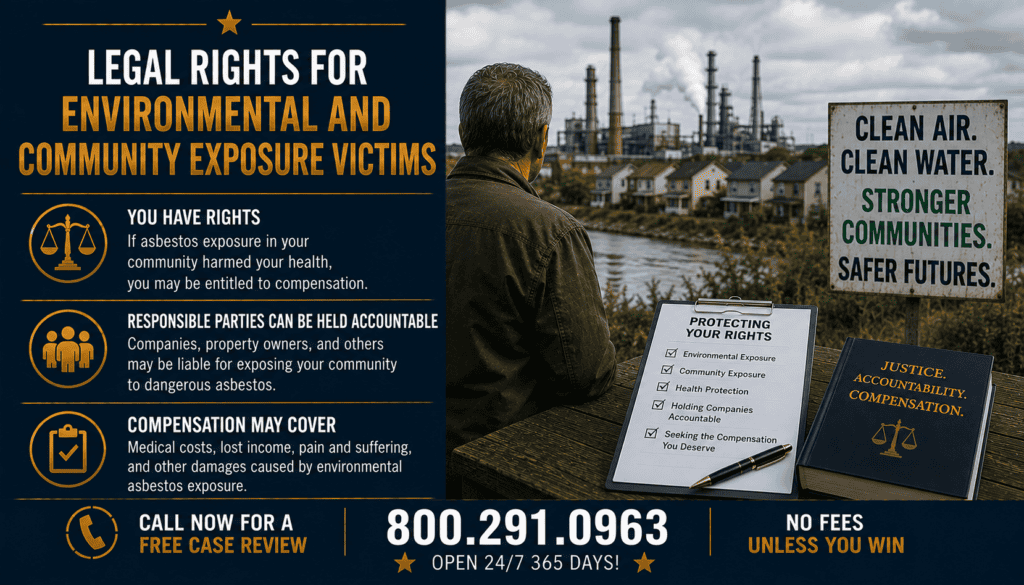
⚖️ Legal Rights for Environmental and Community Exposure Victims
Discover how environmental lawsuits and class actions hold polluters accountable for widespread asbestos hazards.
Environmental and community asbestos exposure affects people who never directly worked with asbestos — yet still inhaled dangerous fibers from nearby factories, shipyards, power plants, older buildings, landfills, and demolition sites. These exposures often occur silently over decades, leaving neighborhoods vulnerable to life-threatening diseases such as mesothelioma, lung cancer, and asbestosis.
When entire communities are harmed, victims have powerful legal rights. This guide explains how environmental asbestos exposure occurs, how the law protects residents, and how lawsuits and class actions hold polluters accountable.
If you or your loved ones were exposed in your community, call 800.291.0963 for immediate help.
🌫️ What Counts as Environmental or Community Asbestos Exposure?
Environmental exposure occurs when asbestos fibers escape into the air, soil, or water beyond a worksite and contaminate surrounding neighborhoods.
Common sources include:
-
Old industrial plants using asbestos
-
Power stations, oil refineries, or chemical plants
-
Shipyards and maritime repair zones
-
Demolition of aging buildings
-
Renovation projects that disturb hidden asbestos
-
Poorly regulated landfills or illegal dumping
-
Natural disasters destroying older structures
-
Contaminated soil at former manufacturing properties
-
Mining operations and processing areas
These exposures affect residents, students, visitors, and nearby businesses, often without warning.
Asbestos fibers are incredibly light and remain airborne for hours. Once inhaled, they lodge in the lungs and can cause cancer decades later.
🏘️ Who Has Legal Rights After Community Asbestos Exposure?
Any individual exposed through community contamination may be legally protected under premises liability, environmental law, and product-liability principles.
You may have rights if you:
-
Lived near an industrial facility using asbestos
-
Attended a school built with asbestos materials
-
Lived in an apartment or public housing with deteriorating asbestos
-
Worked or lived near demolition, remodeling, or abatement sites
-
Were exposed to dust from contaminated soil
-
Lived near old shipyards, mills, or factories
-
Resided near a landfill that accepted asbestos waste
-
Were exposed during natural disasters like fires or hurricanes
Even individuals with brief or low-dose exposure may qualify for compensation if they later developed an asbestos-related disease.
🏛️ What Laws Protect Community Exposure Victims?
Several federal and state laws regulate asbestos safety and give victims legal rights.
Major protections include:
-
Clean Air Act (CAA) — regulates asbestos emissions from factories and demolition sites.
-
EPA NESHAP Rules — require safe handling, removal, and disposal.
-
CERCLA / Superfund — holds polluters financially responsible for contamination cleanup.
-
State environmental regulations — often stricter than federal standards.
-
Premises liability laws — require property owners to keep occupants and neighbors safe.
-
Product liability laws — allow lawsuits against manufacturers of asbestos products.
When companies violate these laws, they can be sued individually or through broader community claims.
📑 How Lawyers Prove Environmental Asbestos Exposure
Environmental cases rely on extensive documentation and scientific analysis.
Evidence typically includes:
-
EPA and state environmental agency violation reports
-
Air-monitoring data from contamination zones
-
Historical environmental health studies
-
Property inspection findings
-
School district asbestos reports
-
Industrial permits and engineering documents
-
City demolition and construction records
-
Old maps or photos of asbestos-handling facilities
-
Witness statements from neighbors, teachers, or workers
-
Expert testimony from environmental hygienists and industrial scientists
Lawyers build a timeline showing where fibers originated, how they spread, and who was responsible.
👨⚕️ Medical Requirements for Legal Claims
To file a claim, victims must show that:
-
They were exposed to asbestos in their community.
-
They developed a related disease, such as mesothelioma, lung cancer, or asbestosis.
-
A company or property owner is responsible for releasing asbestos into the environment.
Medical documentation — including imaging, pathology, and diagnosis reports — connects the exposure to the illness.
💰 Types of Compensation Available to Environmental Exposure Victims
Community exposure victims may qualify for compensation through individual lawsuits, class actions, environmental claims, or asbestos trust funds.
Financial recovery may include:
-
Medical treatment costs
-
Lost income or reduced earning ability
-
Home-care or caregiving expenses
-
Pain and suffering
-
Travel for cancer treatment
-
Wrongful-death compensation for family members
-
Punitive damages in cases of extreme negligence
In many situations, multiple companies or agencies share responsibility, significantly increasing potential compensation.
👥 Class Actions and Mass-Tort Lawsuits for Community Exposure
Some asbestos contamination cases affect entire neighborhoods, schools, or apartment complexes. In these situations, attorneys may file:
1. Class-Action Lawsuits
Used when hundreds or thousands of residents suffered the same exposure and share similar damages.
2. Mass-Tort Claims
Each victim files an individual case, but evidence is shared among the group to streamline litigation.
3. Property-Damage Claims
Communities may seek compensation for:
-
Home cleaning
-
Air-quality testing
-
Soil remediation
-
Forced relocation
-
Diminished property value
These group actions pressure companies into major settlements and cleanup agreements.
🧭 How Attorneys Identify the Responsible Parties
Environmental exposure cases often involve multiple defendants, such as:
-
Former factory owners
-
Real estate developers
-
Demolition contractors
-
Landlords and property management companies
-
Waste-disposal businesses
-
Municipal or county entities
-
Manufacturers of asbestos-containing materials
Law firms use industrial records, permits, and expert analysis to pinpoint exactly who released asbestos and when.
📅 Statute of Limitations: Why Timing Matters
Every state has strict filing deadlines—usually 1 to 3 years from the date of diagnosis, not from the time exposure occurred.
This is especially important because asbestos diseases take 20–60 years to appear.
Victims should contact an attorney immediately to:
-
Preserve evidence
-
Request environmental records
-
Document old home locations
-
Secure witness statements
-
Access historic contamination data
Delaying can permanently forfeit your rights.
🛡️ What Victims Should Do Right Now
If you believe community or environmental exposure may have contributed to illness:
Take these steps immediately:
-
Seek medical evaluation
-
Request imaging tests for early signs of disease
-
Document all past addresses
-
Note proximity to factories, schools, or demolition sites
-
Save any letters, notices, or news about contamination
-
Photograph dust, debris, or unsafe conditions
-
Speak to neighbors or former residents
-
Contact an asbestos attorney for a free review
Your legal rights depend on strong documentation — even small details matter.
📞 Get Help for Environmental and Community Asbestos Exposure
Companies and public agencies that allowed asbestos to contaminate neighborhoods must be held accountable. Whether exposure came from a factory, demolition project, school building, or waste site, victims have the right to seek justice and financial compensation.
Our legal team specializes in community exposure cases and can help determine exactly how exposure occurred and which legal options offer the strongest path forward.
Call 800.291.0963 for free legal help today.