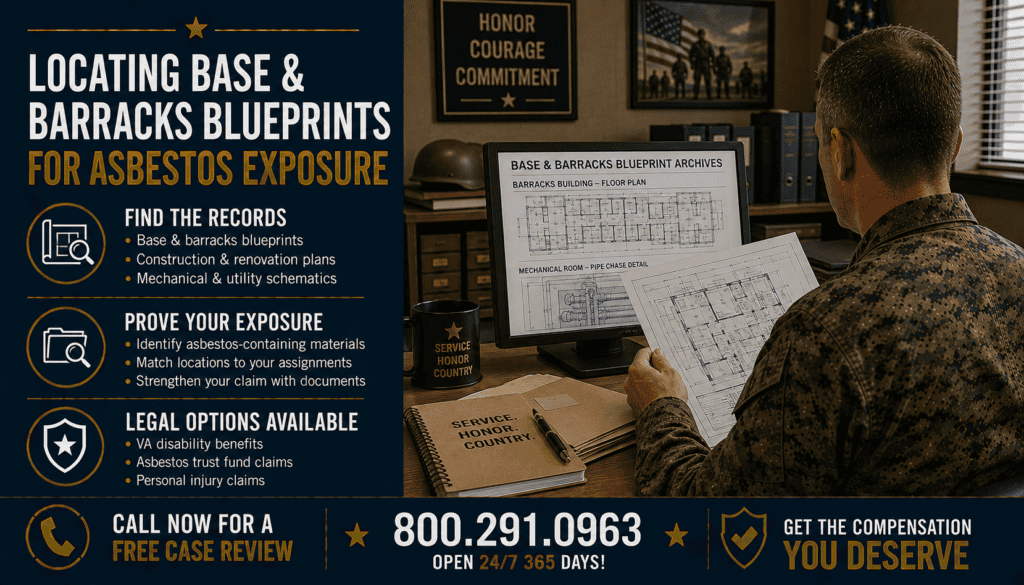
🏠 Locating Base and Barracks Blueprints for Materials Proof
Architectural Plans That Confirm Asbestos in Living and Work Areas
For veterans who lived or worked in military housing, hangars, or maintenance buildings, base and barracks blueprints provide powerful proof of asbestos exposure. These detailed architectural plans identify the exact construction materials, insulation types, and ventilation systems used — often including asbestos-based compounds. By obtaining these blueprints, veterans can confirm that their daily living and work spaces were built with asbestos products, strengthening both VA disability and trust-fund claims.
📞 Need help finding historical military blueprints or building specs? Call 800.291.0963 for free expert assistance.
🧭 Step 1 – Why Base Blueprints Are Crucial Evidence
Blueprints serve as physical proof that asbestos materials were installed in specific military facilities.
These documents can:
-
🧱 Identify asbestos-laced materials (insulation, floor tiles, ceiling panels).
-
⚙️ Confirm asbestos in barracks, boiler rooms, hangars, and workshops.
-
💬 Support exposure claims when service records alone aren’t enough.
-
🧾 Establish the time period and building contractor responsible.
Goal: Verify asbestos exposure by proving its presence in your living or work environment.
📁 Step 2 – Types of Blueprints and Building Plans to Request
Blueprints often include layers of information about a base’s layout and materials.
Key document types:
-
🏗️ Architectural Plans: Wall, floor, and ceiling material callouts.
-
⚙️ Mechanical Drawings: Pipe and duct systems using asbestos insulation.
-
💨 HVAC Diagrams: Ventilation systems lined with asbestos boards.
-
🧾 Electrical and Utility Plans: Wiring and insulation compositions.
-
🧰 As-Built Drawings: Show renovations or asbestos removal projects.
Goal: Collect multiple drawing types to confirm asbestos use across systems.
🏛️ Step 3 – Where to Locate Base and Barracks Blueprints
Many construction and engineering files are preserved in federal archives.
Best sources include:
-
🏛️ Naval Facilities Engineering Systems Command (NAVFAC): Construction and maintenance archives.
-
⚙️ U.S. Army Corps of Engineers (USACE): Building plans and materials lists.
-
✈️ Air Force Civil Engineer Center (AFCEC): Hangar and base facility records.
-
📜 National Archives and Records Administration (NARA): Declassified military blueprints and site plans.
-
🧾 Defense Technical Information Center (DTIC): Engineering specs and asbestos studies.
Goal: Obtain architectural and materials records for your assigned installation.
🧱 Step 4 – Bases and Barracks Known for Asbestos Use
Hundreds of U.S. military installations were built during the height of asbestos construction.
Notable high-risk sites:
-
⚓ Norfolk Naval Base (VA): Shipyard barracks and power plants.
-
🪖 Fort Bragg (NC): Housing, classrooms, and boiler facilities.
-
✈️ Wright-Patterson AFB (OH): Hangars and maintenance shops.
-
⚙️ Camp Lejeune (NC): Dormitories and insulation-heavy utility tunnels.
-
🧾 Pearl Harbor (HI): Barracks with asbestos insulation in ceilings and walls.
Goal: Match your base or housing assignment to a known asbestos exposure location.
💼 Step 5 – Reading Blueprints for Asbestos References
Blueprints may list asbestos by code or abbreviation.
Common notations:
-
🧾 “ASB” or “ASBST” – asbestos insulation or sheeting.
-
🧱 “AC” – asbestos cement materials.
-
⚙️ “AFB” – asbestos fiber board.
-
💨 “Mastic” or “Lagging” – adhesives or wraps containing asbestos.
Goal: Identify asbestos designations in building material legends or notes.
🩺 Step 6 – Using Blueprints in VA and Trust-Fund Claims
For VA Claims:
-
🧾 Submit blueprint copies with your claim showing asbestos in your duty housing or work facility.
-
💬 Ask your physician to cite the blueprint in your medical nexus letter.
-
⚖️ Combine with unit rosters to prove assignment to affected buildings.
For Trust-Fund Claims:
-
🏦 Use manufacturer names or material codes from blueprints to identify responsible companies.
-
⚙️ File claims with trusts linked to those brands (e.g., Johns-Manville, Owens Corning).
Goal: Leverage blueprints to prove both exposure and manufacturer responsibility.
🧠 Step 7 – When Blueprints Are Missing or Restricted
If building plans are unavailable or classified, you can reconstruct exposure using alternate evidence.
Alternatives include:
-
🧾 Asbestos abatement project reports (NAVFAC or USACE archives).
-
💬 Maintenance logs listing replacement materials.
-
⚙️ Environmental audits conducted before building demolition.
-
🧱 Eyewitness statements from maintenance staff or facility engineers.
Goal: Replace missing blueprints with other material evidence of asbestos use.
🌈 Step 8 – Cross-Referencing Blueprints With MOS and Duty Logs
Blueprint evidence gains strength when matched with your job duties.
Examples:
-
🧰 Boiler Technician: Assigned to barracks mechanical room using asbestos-wrapped pipes.
-
⚓ Electrician’s Mate: Worked in asbestos-lined generator housing.
-
✈️ Aircraft Mechanic: Maintained hangars insulated with asbestos boards.
Goal: Connect blueprint-identified asbestos materials to your exact workspace.
💬 Step 9 – Organizing Blueprint Evidence for Submission
Tips for filing:
-
🗂️ Highlight or color-code asbestos sections on copies.
-
🧾 Include a cover sheet identifying the base name and building number.
-
⚙️ Cross-reference pages to your service records and unit rosters.
-
📞 Call 800.291.0963 for help assembling your document packet.
Goal: Present blueprints as clear, traceable proof of asbestos presence.
🕊️ Step 10 – How Attorneys Use Blueprint Data
Experienced mesothelioma attorneys use blueprint data to:
-
🧱 Confirm asbestos product brands used in construction.
-
⚙️ File against multiple asbestos trust funds.
-
💬 Strengthen exposure narratives with visual documentation.
-
🏗️ Identify contractors responsible for installation or removal.
Goal: Transform technical blueprints into actionable legal evidence.
🤝 Where to Get Help
Our advocates help veterans locate and interpret base and barracks blueprints to verify asbestos use and strengthen their claims.
📞 Call 800.291.0963 today for free archival and documentation support.
🧭 Summary
Military base and barracks blueprints are critical for proving asbestos exposure in living quarters, hangars, and mechanical spaces. These documents reveal the materials used in your daily environment, allowing your legal and medical teams to link asbestos directly to your diagnosis. Combined with MOS codes, unit rosters, and FOIA records, blueprints build a powerful foundation for compensation.
The walls that sheltered you may also hold the proof that wins your case.
800.291.0963