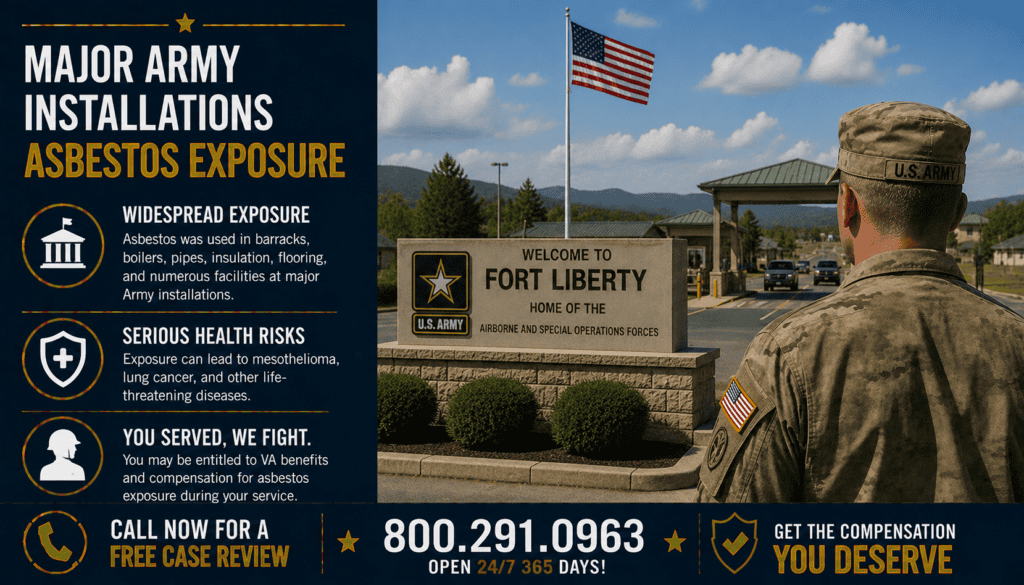
🎖️ Major Army Installations Asbestos Exposure
Asbestos Exposure: Fort Bragg, Benning, Knox & Hood (Legacy Names)
From the 1940s through the 1980s, U.S. Army bases across the country were built and maintained with asbestos insulation, ceiling tiles, floor coverings, brake linings, and boiler materials. Soldiers, mechanics, and base workers encountered asbestos daily in barracks, motor pools, mess halls, and power plants. Many of these installations — including Fort Bragg (now Fort Liberty), Fort Benning (now Fort Moore), Fort Knox, and Fort Hood (now Fort Cavazos) — remain key sites for asbestos-related compensation claims.
This guide explains where exposure occurred, who was affected, and how veterans and their families can pursue VA, trust-fund, and legal compensation.
📞 Need help proving Army base asbestos exposure? Call 800.291.0963 for free case support today.
🧭 Step 1: Asbestos Use in Army Base Construction & Operations
Army facilities relied heavily on asbestos for durability and fire resistance.
Common sources of exposure:
-
⚙️ Boiler and steam line insulation in barracks and dining halls.
-
🧱 Roof tiles, wall panels, and vinyl flooring.
-
💨 HVAC ducts and mechanical chases filled with asbestos insulation.
-
🔧 Brake pads and gaskets in vehicle maintenance shops.
-
🪖 Fireproof materials in training centers and shooting ranges.
Goal: Identify base structures and systems containing asbestos during your service period.
📁 Step 2: Major Army Installations With Documented Asbestos Contamination
Several large Army bases have confirmed asbestos hazards in environmental reports.
Key exposure sites:
-
🪖 Fort Bragg (Liberty), NC: Barracks, steam tunnels, and housing insulation.
-
⚙️ Fort Benning (Moore), GA: Training facilities, boiler plants, and vehicle shops.
-
🧱 Fort Knox, KY: Mechanical rooms and armored vehicle maintenance hangars.
-
🔩 Fort Hood (Cavazos), TX: Powerhouses, dormitories, and motor pools.
-
💨 Fort Campbell, KY: Asbestos in housing and administrative buildings.
Goal: Match your duty location to confirmed asbestos-use sites.
🏗️ Step 3: Who Was Exposed
Asbestos exposure affected nearly every occupational group on Army bases.
High-risk personnel:
-
🧰 Mechanics, electricians, and boiler operators.
-
⚙️ Construction engineers and Seabees-style support crews.
-
🧱 Custodial and maintenance workers.
-
🪖 Recruits and soldiers living in aging barracks.
-
💬 Family members residing in base housing.
Goal: Determine your role and duration of exposure on base.
💼 Step 4: How Exposure Happened in Daily Base Operations
Even basic maintenance or living conditions could create asbestos contact.
Exposure scenarios:
-
🔧 Working in vehicle repair or engine overhaul shops.
-
💨 Cleaning or repairing HVAC or steam systems.
-
🧱 Demolishing or renovating old barracks and offices.
-
🧺 Living in base housing with deteriorating insulation.
Goal: Document tasks or housing areas where asbestos dust was released.
🩺 Step 5: Health Risks From Army Base Asbestos Exposure
Inhaled fibers can remain dormant for decades before symptoms develop.
Common illnesses:
-
💀 Pleural and peritoneal mesothelioma.
-
🫁 Asbestosis and pulmonary fibrosis.
-
💬 Pleural plaques and effusions.
-
🩺 Lung, laryngeal, and stomach cancers.
Goal: Connect medical diagnoses to your documented exposure site.
⚖️ Step 6: VA Benefits for Army Veterans
Army veterans diagnosed with mesothelioma or related diseases qualify for 100% VA disability compensation.
Available VA programs:
-
💰 Tax-free monthly compensation.
-
🏥 Access to VA mesothelioma specialty centers.
-
🕊️ DIC benefits for surviving family members.
-
⚖️ Additional recovery from asbestos trust funds.
Goal: File both VA and trust-fund claims to secure maximum recovery potential.
🧱 Step 7: Civilian Worker and Family Member Claims
Thousands of civilian employees and dependents were also exposed through work or shared housing.
Compensation options:
-
⚖️ Asbestos trust-fund claims (over $32 billion available).
-
💵 Civil lawsuits against product manufacturers.
-
🧾 Workers’ compensation and SSDI.
-
🕊️ Wrongful-death claims for survivors.
Goal: Include both military and civilian evidence for dual-exposure claims.
🧠 Step 8: Evidence That Strengthens Army Base Claims
Base and personnel documentation can prove asbestos contact.
Key evidence:
-
🧾 Service records showing base assignments.
-
⚙️ Base engineering or maintenance logs listing asbestos materials.
-
💬 Statements from coworkers or fellow soldiers.
-
🧱 Environmental abatement and EPA cleanup reports.
Goal: Support your claim with verified base and medical documentation.
🌈 Step 9: Cleanup and Modernization at Major Bases
Most major Army bases have undergone asbestos removal since the early 2000s.
Recent cleanup activity:
-
🏗️ Asbestos abatement in barracks and mechanical buildings.
-
⚙️ Replacement of steam pipe and HVAC insulation.
-
🧾 Ongoing EPA and Army Corps of Engineers remediation reports.
Goal: Use federal cleanup documentation to establish exposure timeframes.
💬 Step 10: Getting Professional Legal Help
Asbestos exposure claims require coordination between VA-accredited attorneys and exposure investigators.
Next steps:
-
🧭 Identify your base, MOS, and years of service.
-
⚙️ Gather diagnosis and service documentation.
-
🧾 File VA, trust-fund, or civil claims promptly.
-
📞 Call 800.291.0963 for free case assistance.
Goal: Preserve your rights and secure full compensation before time limits expire.
🤝 Where to Get Help
Our advocates assist Army veterans and civilian workers exposed to asbestos across major U.S. installations.
📞 Call 800.291.0963 now to review your service history and eligibility.
🧭 Summary
From Fort Bragg to Fort Hood, asbestos exposure was widespread across Army bases for decades. Soldiers, contractors, and family members exposed during their service may qualify for VA, trust-fund, and civil compensation. Filing early ensures access to full benefits and vital medical support.
Protect your health and your rights — act today.
800.291.0963