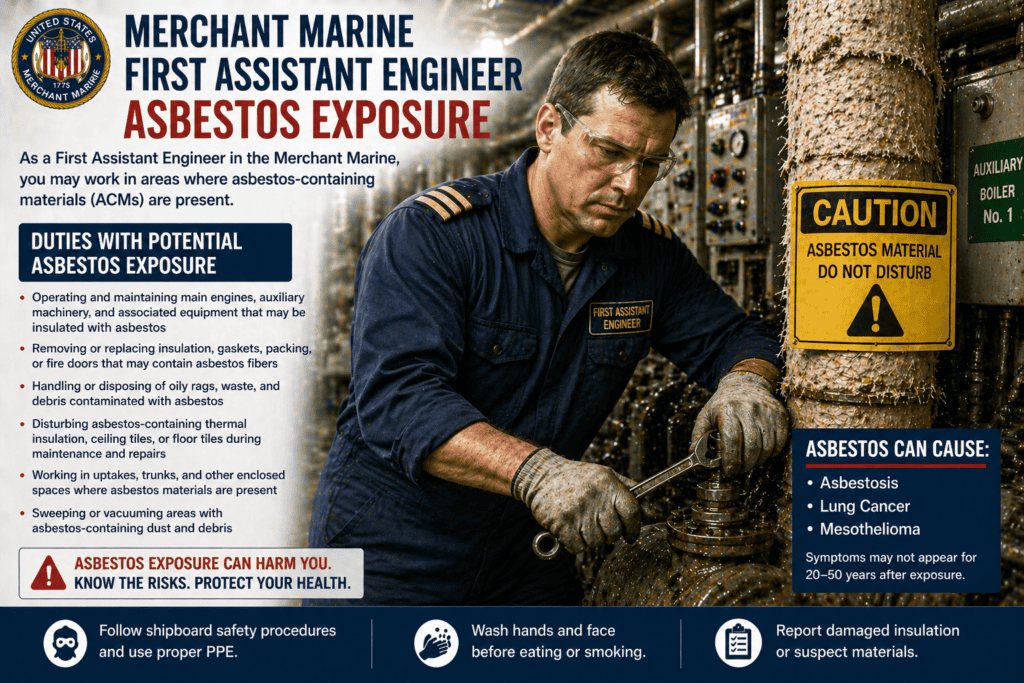
Merchant Marine First Assistant Engineer Asbestos Exposure
⚠️ Asbestos Risks for Merchant Marine First Assistant Engineers
The First Assistant Engineer (also known as the 1st Assistant or 1 A/E) was the second-highest–ranking engineering officer aboard Merchant Marine vessels during WWII, Korea, Vietnam, and Cold War commercial shipping. Responsible for supervising boiler operations, steam lines, condensers, fuel systems, auxiliary machinery, and engine-room personnel, First Assistants worked for decades inside the most asbestos-contaminated environment on the ship.
Before asbestos restrictions began in the late 1980s, nearly every shipboard engineering component contained friable ACM, including:
-
boiler access insulation
-
steam line lagging
-
condenser casings
-
pump packing
-
burner linings
-
evaporators
-
electrical panels
-
generator housings
-
high-heat gaskets and seals
Because First Assistants were accountable for every system that generated, transferred, or controlled heat, they had unavoidable daily exposure to dust released from deteriorating asbestos insulation and routine mechanical repairs.
This 1,200-word guide outlines your duties, exposure sources, and how Merchant Marine First Assistant Engineers today prove their asbestos exposure for compensation.
🛠️ Typical Duties of a Merchant Marine First Assistant Engineer
🔧 Supervises Entire Engine Room Operations
The First Assistant served as the direct manager of all engineering functions, including:
-
boiler operation and maintenance
-
steam pressure regulation
-
auxiliary machinery oversight
-
equipment troubleshooting
-
daily mechanical logs
-
staff supervision
-
safety procedures
All of these responsibilities required working inside the engine room, an enclosed space lined with asbestos insulation.
🔥 Boiler Access & Burner Oversight
As second-in-command in the engineering department, the First Assistant supervised:
-
burner assemblies
-
firebrick linings
-
refractory insulation
-
boiler tube maintenance
-
air preheaters
-
steam drum inspections
-
superheater and economizer equipment
Boilers were constructed with:
-
asbestos block insulation
-
asbestos-cement refractory
-
braided asbestos seals
-
woven asbestos blankets
Inspecting, repairing, or opening boiler access points released heavy clouds of asbestos fibers.
⚙️ Steam Line & Condenser Maintenance
Steam distribution systems covered nearly every inch of the engineering spaces. The First Assistant routinely monitored:
-
main steam lines
-
auxiliary steam lines
-
condensers
-
reduction gears
-
feedwater heaters
-
steam traps
-
expansion joints
All steam lines were protected with:
-
thick ACM lagging
-
pipe-wrap insulation
-
asbestos cloth
-
thermal barriers
Any adjustment, leak detection, wrenching, or maintenance around these components disturbed friable insulation.
🛠 Oversight of Asbestos-Protected Machinery
The First Assistant supervised the maintenance of:
-
pumps
-
air compressors
-
turbines
-
generators
-
evaporators
-
refrigeration compressors
-
fuel and lube oil purifiers
Most had:
-
asbestos gaskets
-
asbestos rope packing
-
asbestos liner sheets
-
insulation blankets
Opening a pump casing or removing old gasket residue created airborne fibers.
📘 Administrative & Leadership Duties
The First Assistant:
-
trained junior engineers
-
prepared maintenance plans
-
logged boiler water tests
-
reviewed fuel consumption
-
inspected repair work
Every inspection took place near machinery built with asbestos shielding.
🧱 Asbestos Exposure Risks for Merchant Marine First Assistant Engineers
1. Boiler Access Areas
The highest exposure source for First Assistants came from:
-
boiler manholes
-
inspection hatches
-
refractory linings
-
burner fronts
-
firebrick removal
-
access panel insulation
When boilers were opened—hot or cold—insulation crumbled into dust instantly.
2. Steam Lines, Joints & Valves
Heavy ACM insulation covered:
-
high-pressure steam lines
-
auxiliary steam distribution
-
valve stems
-
valve wheels
-
pipe flanges
Adjusting valves or tightening bolts shook loose insulation.
3. Condenser & Heat Exchanger Units
Condensers used:
-
asbestos gaskets
-
asbestos cement expansion joints
-
insulated housings
Scraping condenser gaskets was one of the most dangerous tasks due to direct exposure.
4. Pumps, Turbines & Auxiliary Machinery
Machinery contained:
-
woven asbestos packing
-
high-heat asbestos gaskets
-
insulated casings
-
asbestos friction materials
Every pump rebuild or turbine inspection disturbed layers of asbestos.
5. Electrical Switchboards & Control Panels
Engine-room electrical systems used:
-
asbestos-backed arc chutes
-
asbestos sheet insulation
-
cable insulation with ACM
Heat caused these materials to deteriorate into fine dust.
6. General Engine Room Environment
The engine room contained:
-
constant vibration
-
continual heat cycling
-
airborne dust from lagging
-
poor ventilation
Exposure was unavoidable for anyone working inside, especially officers overseeing operations.
7. Shipyard Repairs & Overhauls
Dry-dock periods exposed First Assistants to:
-
full lagging removal
-
boiler rebuilds
-
condenser tear-downs
-
turbine casing removal
-
sandblasting of insulated bulkheads
These events created extreme, ship-wide contamination.
📊 Why First Assistant Engineers Have Strong Asbestos Claims
1. Documented daily presence in high-heat mechanical areas
Their assigned workspace contained ACM on all sides.
2. Direct involvement in boiler & steam system inspections
These are legally recognized high-exposure tasks.
3. Continuous supervision of repairs involving ACM
Even oversight—without direct handling—meets claim thresholds.
4. Robust historical vessel & engineering documentation
Ship blueprints and maintenance manuals confirm ACM materials.
📂 Evidence Used for First Assistant Engineer Claims
📄 Merchant Mariner Credentials
-
Merchant Mariner Document
-
MMC
-
Ship discharge records
-
Engineering department assignments
🛠 Engineering Logs & Repair Records
These confirm:
-
boiler maintenance
-
steam line work
-
condenser access
-
auxiliary machinery repairs
📘 Technical & Blueprint Evidence
Historic ship plans show:
-
insulation layouts
-
refractory linings
-
machinery insulation
-
ACM product manufacturers
👨🔧 Witness Statements
Common witnesses include:
-
Chief Engineers
-
Second Assistants
-
Oilers
-
Firemen/Water Tenders
💼 Sample Compensation Results
📌 Case 1 — First Assistant Engineer on 1950s Freighters
Boiler refractory and steam-line gasket exposures.
Compensation: $4.8M
📌 Case 2 — 1960s Tanker First Assistant
Condenser and turbine insulation exposure.
Compensation: $4.5M
📌 Case 3 — 1970s Cargo Ship First Assistant
Shipyard overhaul exposure.
Compensation: $4.1M
💙 Benefits Available to First Assistant Engineers
💵 Asbestos Trust Funds
Over $30 billion is still available.
⚖ Maritime Asbestos Lawsuits
Claims are filed against manufacturers—not the Merchant Marine.
❤️ Survivor Benefits
Spouses and dependents may also qualify.
❓ Frequently Asked Questions
🟦 Is supervising boiler work enough to prove exposure?
Yes—proximity alone is considered exposure.
🟦 Did condensers contain asbestos?
Yes—gaskets and housing insulation frequently contained ACM.
🟦 Do I need to recall specific product names?
No. Engineers’ roles are already recognized as high-exposure occupations.
📞 Get Help Identifying Your Engine-Room Asbestos Exposure
First Assistant Engineers faced extreme and repeated exposure inside boiler rooms, steam-line corridors, condenser flats, and auxiliary machinery spaces.
📞 Call 800.291.0963 for a free case review.