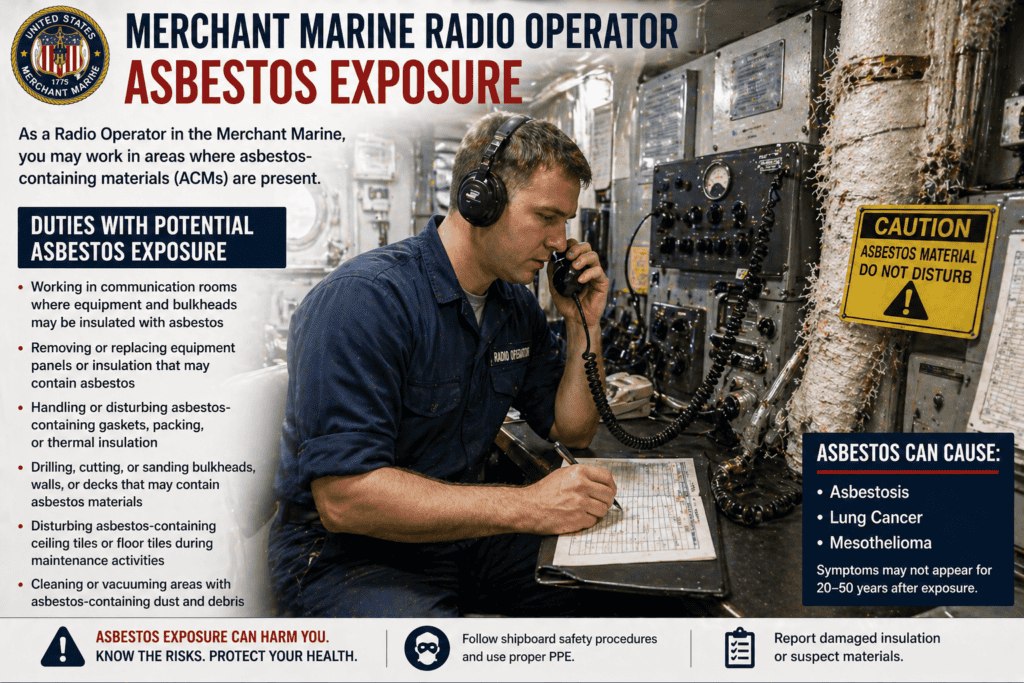
Merchant Marine Radio Operator Asbestos Exposure
⚠️ Asbestos Risks for Merchant Marine Radio Operators
The Radio Operator (also called the Sparks, RO, or Communications Officer) served as the primary communications specialist aboard U.S. Merchant Marine vessels, including tankers, freighters, break-bulk ships, passenger liners, bulk carriers, and offshore supply vessels. Although the Radio Operator worked primarily in the radio room near the bridge, they were required to move throughout the ship for maintenance, inspections, emergency duties, and lifeboat assignments—placing them in multiple asbestos-contaminated compartments.
From the 1940s through the late 1990s, commercial ships contained massive quantities of asbestos in:
-
communications equipment insulation
-
electrical panels & switchboards
-
cable penetrations in bulkheads
-
fireproofing behind radio consoles
-
deck and bulkhead insulation
-
ventilation ducts
-
radar and power-supply insulation
-
emergency generator rooms
-
bridge equipment panels
-
lifeboat engine housings
While Radio Operators were not part of the engineering crew, their proximity to asbestos-insulated electronics, participation in emergency drills, required ship inspections, and time spent in generator rooms created constant asbestos exposure. Many RO duties brought them near deteriorating ACM (asbestos-containing materials) in areas such as:
bridge wings
wheelhouse
chart room
radio transmitter spaces
switchgear rooms
electrical shops
emergency power stations
Dozens of Radio Operators later developed mesothelioma, asbestos lung cancer, and pleural diseases due to chronic exposure to airborne fibers during routine shipboard operations.
🛠️ Typical Duties of a Merchant Marine Radio Operator
📡 Primary Radio Communication Operations
Radio Operators were responsible for:
-
maintaining continuous watch on required frequencies
-
handling ship-to-shore and ship-to-ship messages
-
operating high-powered transmitters and emergency systems
-
maintaining backup batteries and power converters
-
logging all communications
Much of this equipment—transmitters, receivers, power transformers, spark arrestors, capacitor banks—contained asbestos insulation, wiring insulation, and fireproof board, especially on pre-1980 vessels.
🧰 Maintenance of Radio Room Equipment
Radio Operators performed routine upkeep, including:
-
cleaning transmitter cabinets
-
replacing fuses and inspecting wiring
-
checking ventilation fans
-
maintaining radar and direction-finding gear
-
tightening panel components
These tasks exposed them to:
-
asbestos dust inside older radio cabinets
-
insulation behind communications consoles
-
soundproofing materials containing asbestos
-
heat shields around power supplies
⚡ Work Near Electrical Panels & Switchboards
Although engineering electricians handled major repairs, Radio Operators frequently worked around:
-
ship switchboards
-
emergency generator rooms
-
high-voltage junction boxes
-
cable runs through asbestos-packed penetrations
Opening or accessing these spaces released fibers from deteriorating insulation and fireproofing.
🚨 Emergency Duties & Drills
Radio Operators were required to participate in:
-
fire drills
-
abandon-ship drills
-
emergency generator start-ups
-
watertight door operations
-
coordination during machinery failures
Fire-response stations and emergency equipment were typically surrounded by asbestos fireproof boards, insulated electrical panels, and heat-resistant barriers.
🔧 Interaction With Deck & Engine Personnel
ROs frequently worked alongside officers and crew when:
-
assisting with radar troubleshooting
-
checking gyrocompass repeaters on machinery decks
-
reviewing cable routes for maintenance
-
confirming antenna feed line integrity
These tasks placed Radio Operators into:
-
machinery spaces
-
passageways lined with asbestos
-
ventilator rooms
-
emergency generator compartments
📡 Antenna, Mast, and Cabling Work
Radio Operators often climbed masts or accessed deck areas to:
-
check antenna tuning units
-
inspect cables
-
maintain weather fax and radar antennas
-
assist during heavy weather damage
Deckhouses and mast bases commonly contained asbestos-insulated wireways and ACM sealants.
🧱 Asbestos Exposure Risks for Merchant Marine Radio Operators
1️⃣ Asbestos in Radio & Electronic Equipment
Pre-1980 maritime electronics used:
-
asbestos-lined control boxes
-
heat shields
-
fireproof insulation
-
wiring insulation
-
capacitor and transformer insulation
Cleaning or opening panels released fibers directly into the small radio room.
2️⃣ Switchboard & Generator Room Exposure
High-voltage areas contained:
-
asbestos arc-chutes
-
fireproof board
-
breaker insulation
-
transformer coverings
Radio Operators frequently entered these spaces during outages or inspections.
3️⃣ Ventilation System Contamination
Radio rooms were near:
-
asbestos-insulated ducting
-
ACM soundproofing
-
insulated bulkheads
Engine room air often circulated upward, carrying fibers throughout the ship.
4️⃣ Bridge & Chart Room Insulation
Bridge structures contained:
-
asbestos deck tiles
-
bulkhead panel insulation
-
cable-run penetrations sealed with ACM
Routine inspections exposed ROs to deteriorating materials.
5️⃣ Emergency Drill Exposure
Fire doors, fireproof panels, extinguishing systems, and emergency stations were built using heavy asbestos components.
6️⃣ Cable Penetrations & Electrical Shops
Radio Operators routinely accessed cable runs packed with:
-
asbestos rope
-
asbestos putty
-
ACM sealing compounds
These materials crumbled easily.
7️⃣ Shipyard Overhauls
During drydock periods, ROs were exposed to:
-
insulation tear-outs
-
dust from panel replacements
-
welding/boiler repairs nearby
-
massive airborne ACM from open machinery spaces
📊 Why Radio Operator Asbestos Claims Are Strong
-
Equipment-based ACM exposure
Radio gear, power supplies, and switchboards had clear asbestos components. -
Confined workspace
Radio rooms were small, poorly ventilated, and dust accumulated easily. -
Bridge-level contamination
Older ships used asbestos everywhere throughout upper decks. -
Documented ACM in blueprints
Ship plans specify asbestos behind control panels and consoles. -
Regular access to hazardous spaces
ROs routinely entered generator rooms, mast bases, and electrical compartments.
📂 How Merchant Marine Radio Operators Prove Asbestos Exposure
📄 Coast Guard Merchant Mariner Documents
Sea service records confirm the Radio Operator position and vessel assignments.
📘 Ship Blueprints & Specifications
Show asbestos insulation behind:
-
transmitters
-
power cabinets
-
bridge panels
-
cable penetrations
🛠 Electrical & Communications Logs
Detail equipment maintenance involving ACM.
👥 Witness Statements
From:
-
Masters
-
Mates
-
Electricians
-
Engineers
-
Radar technicians
confirm the presence of asbestos dust in electronic spaces.
💼 Real-World Compensation Examples for Radio Operators
📌 Case 1 — Radio Operator on 1960s Cargo Ship
Exposure from transmitter insulation and switchboards.
Compensation: $3.8M
📌 Case 2 — Radio Operator on Tanker
Asbestos behind bridge panels and generator rooms.
Compensation: $3.5M
📌 Case 3 — Radio Operator on Passenger Liner
ACM in radar, wiring penetrations, and ventilation.
Compensation: $3.2M
💙 Benefits Available to Merchant Marine Radio Operators
💵 Asbestos Trust Fund Claims
Over $30 billion remains available.
⚖ Personal Injury & Wrongful Death Lawsuits
Filed against asbestos manufacturers—not the Merchant Marine.
❤️ Survivor Benefits
Families may qualify for financial compensation.
❓ Frequently Asked Questions
🟦 Did Radio Operators really face asbestos exposure?
Yes—radio rooms, bridge spaces, and electrical compartments used numerous ACM components.
🟦 I only worked on radios. Does that count as exposure?
Yes. Electronic insulation and fireproofing contained asbestos.
🟦 Do I need proof I handled asbestos directly?
No—being in contaminated compartments is sufficient.
📞 Get Help Identifying Your Asbestos Exposure as a Merchant Marine Radio Operator
If you served as a Radio Operator or Communications Officer on a pre-1980 merchant vessel, you were likely exposed to asbestos from radio insulation, electrical panels, wiring systems, and ship ventilation. Specialists can help confirm the exact exposure sources and pursue compensation.