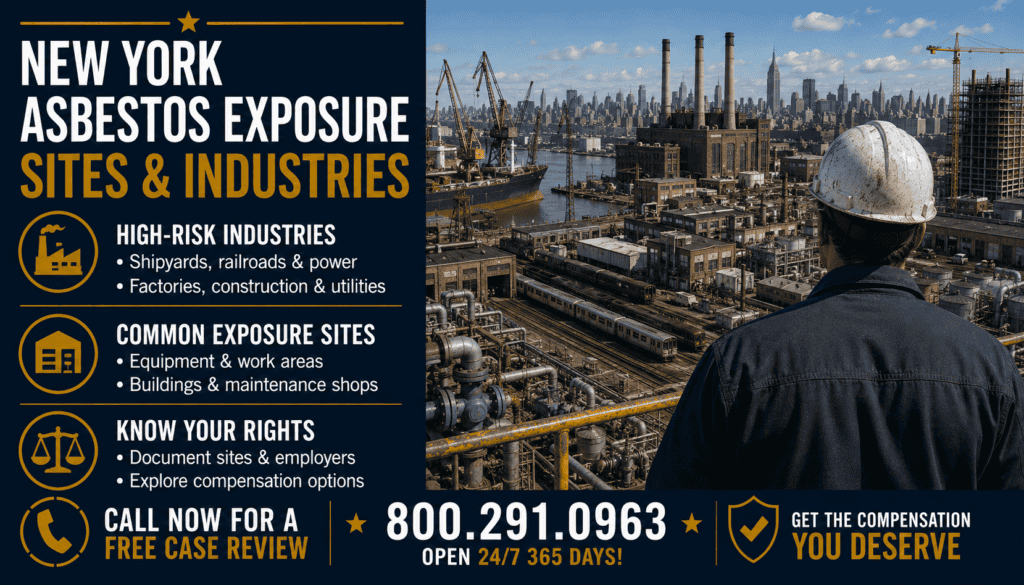
New York Asbestos Exposure Sites & Industries
New York has a long history of construction, manufacturing, power generation, shipbuilding, ports, subway and transit operations, railroads, utilities, public infrastructure, and large-scale commercial development. Workers in these industries could encounter older asbestos-containing materials used for insulation, heat protection, fire resistance, friction control, sealing, and mechanical applications.
The New York Asbestos Exposure Sites & Industries hub organizes historical exposure research by worksite and industry. It helps workers, retirees, veterans, residents, and families move from a general New York exposure history to a specific employer, facility, occupation, equipment system, product, contractor, or period of work.
Current child pages include New York Asbestos Exposure Sites, New York Industrial Asbestos Exposure, New York Power Plant Asbestos Exposure, New York Construction Asbestos Exposure, New York Transit & Railroad Asbestos Exposure, New York Shipyard & Port Asbestos Exposure, and New York Public & Government Buildings Asbestos Exposure.
This page should serve as the primary jobsite and industry hub beneath the New York asbestos exposure silo.
New York Asbestos Exposure Sites
A historical asbestos investigation often begins with a remembered employer, facility, building, transit system, railroad shop, shipyard, or construction project.
Potential New York exposure environments include:
- Manufacturing plants
- Power plants
- Construction sites
- Subway facilities
- Railroad shops
- Shipyards
- Ports
- Industrial plants
- Utility facilities
- Public buildings
- Schools
- Hospitals
- Commercial buildings
- Mechanical rooms
- Maintenance facilities
A facility name alone does not establish asbestos exposure.
Research should narrow the history to the worker’s:
- Employer
- Facility
- City or county
- Employment dates
- Department
- Occupation
- Work duties
- Equipment
- Products
- Contractors
- Maintenance activities
Why New York Worksite Research Matters
Mesothelioma and other asbestos-related diseases may develop decades after the original exposure.
By the time someone begins investigating a New York worksite:
- The employer may have closed.
- A building may have been renovated.
- An industrial facility may have been demolished.
- A railroad shop may have changed ownership.
- Transit equipment may have been replaced.
- Machinery may no longer exist.
- Contractors may have gone out of business.
- Products may no longer be manufactured.
- Coworkers may have retired.
Historical research therefore often requires combining several sources.
A useful sequence is:
Industry → Employer → Facility → Dates → Department → Occupation → Equipment → Product → Manufacturer
This moves the investigation from a broad industry to a more specific exposure pathway.
New York Industrial Asbestos Exposure
Industrial workplaces frequently contained mechanical systems operating under high temperatures, pressure, steam, friction, and heavy loads.
Potential equipment includes:
- Boilers
- Furnaces
- Industrial ovens
- Pumps
- Valves
- Compressors
- Turbines
- Motors
- Generators
- Production machinery
- Steam piping
- Electrical systems
Certain historical materials associated with this equipment could contain asbestos.
Potential product categories include certain:
- Thermal insulation
- Pipe insulation
- Boiler insulation
- Gaskets
- Packing
- Refractory materials
- Fireproofing
- Electrical insulation
- Heat-resistant products
Not every product in these categories contained asbestos.
Manufacturer, product line, application, worksite, and time period should be investigated whenever possible.
New York Industrial Maintenance Exposure
Maintenance work can be especially important because workers often opened, dismantled, repaired, and rebuilt equipment.
Potential activities include:
- Opening boilers
- Repairing pumps
- Repacking valves
- Scraping gaskets
- Removing insulation
- Replacing piping
- Servicing furnaces
- Rebuilding machinery
- Removing refractory materials
- Repairing electrical systems
Maintenance employees could encounter components hidden inside machinery that production employees rarely handled directly.
New York Industrial Shutdowns and Overhauls
Major shutdowns could create concentrated maintenance activity.
During an outage, workers might simultaneously:
- Remove insulation
- Open boilers
- Replace valves
- Rebuild pumps
- Overhaul turbines
- Repair piping
- Remove refractory materials
- Replace machinery
- Upgrade electrical systems
Workers from several trades could share the same work area.
This can make both direct and nearby exposure relevant to historical research.
New York Power Plant Asbestos Exposure
Power plants are an important historical exposure category because electricity generation relied on large high-temperature and steam systems.
Potential equipment includes:
- Boilers
- Turbines
- Generators
- Pumps
- Valves
- Condensers
- Heat exchangers
- Steam piping
- Electrical systems
- Auxiliary machinery
Certain historical asbestos-containing materials could be associated with insulation, gaskets, packing, refractory systems, and electrical applications.
New York Power Plant Boiler Exposure
Boilers generated steam and required extensive heat protection.
Potential historical materials could include certain:
- Boiler insulation
- Pipe insulation
- Insulating cement
- Gaskets
- Packing
- Refractory materials
Workers could encounter these materials during:
- Boiler repair
- Insulation removal
- Gasket replacement
- Valve maintenance
- Pipe repair
- Shutdowns
- Boiler overhauls
New York Power Plant Turbine Exposure
Steam turbines required periodic inspection, maintenance, and overhaul.
Potential exposure research can involve:
- Turbine insulation
- Gaskets
- Packing
- Steam piping
- Pumps
- Valves
- Auxiliary machinery
Workers performing turbine overhauls could include:
- Millwrights
- Mechanics
- Pipefitters
- Insulators
- Electricians
- Maintenance employees
Several trades could work in the turbine area at the same time.
New York Construction Asbestos Exposure
New York experienced decades of residential, commercial, industrial, institutional, and public construction.
Potential historical asbestos-containing building products could include certain:
- Pipe insulation
- Boiler insulation
- Flooring
- Roofing
- Cement products
- Joint compounds
- Fireproofing
- Ceiling materials
- Mechanical insulation
- HVAC materials
Exposure could occur during original installation but is often particularly relevant during renovation and demolition of older structures.
New York City Construction Exposure
New York City has undergone continuous construction, renovation, demolition, and redevelopment.
Potential workplaces include:
- Office towers
- Apartment buildings
- Public housing
- Hospitals
- Schools
- Government buildings
- Transit facilities
- Commercial properties
- Industrial buildings
Potentially relevant workers include:
- Electricians
- Pipefitters
- Plumbers
- Insulators
- HVAC technicians
- Carpenters
- Flooring workers
- Roofers
- Laborers
- Demolition workers
The building, contractor, occupation, product, and project dates should be identified whenever possible.
Renovation and Remodeling Exposure
Renovation can disturb materials installed decades earlier.
Potential activities include:
- Opening walls
- Removing ceilings
- Replacing flooring
- Removing insulation
- Replacing piping
- Modernizing HVAC systems
- Repairing boilers
- Performing electrical upgrades
Workers could therefore encounter products installed long before the renovation occurred.
New York Demolition Asbestos Exposure
Demolition could disturb multiple materials at the same time.
Potential materials include:
- Pipe insulation
- Boiler insulation
- Fireproofing
- Flooring
- Roofing
- Cement materials
- Mechanical systems
- Ceiling products
The structure, demolition contractor, worker duties, materials disturbed, and project period should be documented.
New York Transit & Railroad Asbestos Exposure
New York’s transportation history creates one of the state’s most distinctive occupational exposure categories.
Potential workplaces include:
- Subway tunnels
- Subway stations
- Transit maintenance facilities
- Rail yards
- Locomotive shops
- Roundhouses
- Mechanical shops
- Electrical facilities
- Power systems
Potential workers include:
- Transit workers
- Railroad workers
- Mechanics
- Machinists
- Electricians
- Brake workers
- Pipefitters
- Maintenance employees
New York Subway Asbestos Exposure
Subway systems contain extensive mechanical, electrical, structural, and transportation equipment.
Potential historical exposure research could involve:
- Electrical systems
- Brake equipment
- Mechanical systems
- Utility piping
- Fire-resistant materials
- Insulation
- Maintenance facilities
Transit workers could perform duties in tunnels, stations, repair shops, substations, and other infrastructure.
The specific job, work location, equipment, and dates should be identified.
Transit Workers and Mechanical Systems
Transit maintenance could involve:
- Motors
- Electrical equipment
- Brake systems
- Pumps
- Compressors
- Mechanical equipment
- Utility systems
Potential historical asbestos-containing or asbestos-associated products could include certain:
- Friction materials
- Electrical materials
- Gaskets
- Packing
- Insulation
- Fire-resistant products
New York Railroad Asbestos Exposure
Railroad operations can involve:
- Locomotives
- Railcars
- Boilers
- Brake systems
- Electrical equipment
- Mechanical machinery
- Repair facilities
Potentially relevant workers include:
- Mechanics
- Machinists
- Electricians
- Brake workers
- Pipefitters
- Maintenance employees
- Shop workers
Railroad employer, facility, occupation, equipment, and employment dates should be documented whenever possible.
Railroad Brake and Friction Materials
Certain historical railroad brake and friction products contained asbestos.
Potential maintenance could involve:
- Brake removal
- Brake repair
- Replacement
- Cleaning
- Mechanical servicing
Not every historical brake product contained asbestos.
The specific equipment, manufacturer, product, and time period matter.
New York Shipyard & Port Asbestos Exposure
New York’s maritime history makes shipyard and port exposure another important category.
Potential workplaces include:
- Shipyards
- Vessel repair facilities
- Ports
- Marine terminals
- Waterfront maintenance facilities
- Mechanical shops
Potential shipboard systems include:
- Boilers
- Steam piping
- Pumps
- Valves
- Turbines
- Engine-room machinery
- Electrical systems
Shipboard Asbestos Exposure
Potential historical asbestos-containing materials aboard ships could include certain:
- Pipe insulation
- Boiler insulation
- Gaskets
- Packing
- Fireproofing
- Electrical insulation
- Heat-resistant materials
Potentially relevant trades include:
- Pipefitters
- Boilermakers
- Insulators
- Electricians
- Machinists
- Mechanics
- Welders
- Maintenance workers
The vessel, shipyard, trade, equipment, and work period should be identified.
New York Port and Waterfront Exposure
Port facilities could include:
- Warehouses
- Maintenance shops
- Mechanical facilities
- Utility systems
- Boiler rooms
- Piping
- Electrical infrastructure
Workers could move between vessels, waterfront facilities, warehouses, and mechanical shops during the same career.
New York Public & Government Buildings Asbestos Exposure
Historical asbestos exposure was not limited to factories and industrial sites.
Older public and institutional buildings could contain asbestos-containing materials in construction and mechanical systems.
Potential buildings include:
- Government offices
- Courthouses
- Schools
- Hospitals
- Municipal buildings
- Public housing
- Transit facilities
- Utility buildings
- Institutional facilities
Potential historical materials could include certain:
- Floor tiles
- Ceiling materials
- Pipe insulation
- Boiler insulation
- Fireproofing
- Roofing
- Cement materials
- Mechanical insulation
New York School Asbestos Exposure
Older schools could contain asbestos-containing materials in:
- Flooring
- Ceilings
- Boiler rooms
- Steam piping
- HVAC systems
- Roofing
- Fireproofing
Potentially relevant workers include:
- Custodians
- Maintenance employees
- Electricians
- Plumbers
- Pipefitters
- HVAC technicians
- Construction contractors
Routine occupancy and direct maintenance exposure are different exposure circumstances and should not be treated as identical.
New York Hospital and Institutional Exposure
Hospitals and large institutional buildings could contain extensive:
- Boilers
- Piping
- Mechanical equipment
- HVAC systems
- Electrical systems
- Fireproofing
- Flooring
Maintenance and renovation workers could encounter older materials when these systems were repaired or replaced.
New York Government Building Exposure
Government buildings could contain older:
- Pipe insulation
- Boiler insulation
- Flooring
- Fireproofing
- Ceiling materials
- Roofing
- Mechanical systems
Renovation and modernization could disturb materials that had remained in place for decades.
New York Manufacturing and Factory Exposure
Manufacturing facilities could contain both production machinery and building systems.
Potential equipment includes:
- Boilers
- Furnaces
- Industrial ovens
- Pumps
- Valves
- Compressors
- Motors
- Production machinery
- Steam piping
Potential workers include:
- Factory workers
- Millwrights
- Mechanics
- Electricians
- Pipefitters
- Machinists
- Welders
- Maintenance employees
New York Factory Maintenance Exposure
Maintenance workers could encounter older materials while:
- Rebuilding pumps
- Repairing valves
- Scraping gaskets
- Replacing packing
- Removing insulation
- Repairing boilers
- Servicing furnaces
- Rebuilding machinery
The actual equipment and component should be identified whenever possible.
New York Utility Facilities
Utilities can combine industrial equipment exposure with public infrastructure exposure.
Potential settings include:
- Power facilities
- Water treatment plants
- Wastewater facilities
- Pump stations
- Electrical facilities
- Utility maintenance buildings
Potential equipment includes:
- Boilers
- Pumps
- Valves
- Compressors
- Electrical systems
- Piping
Maintenance employees could encounter older gaskets, packing, insulation, and mechanical components.
Boilers at New York Exposure Sites
Boilers could be found in:
- Power plants
- Factories
- Schools
- Hospitals
- Commercial buildings
- Public buildings
- Industrial facilities
- Ships
Potential historical asbestos-containing or asbestos-associated materials could include certain:
- Boiler insulation
- Pipe insulation
- Refractory materials
- Gaskets
- Packing
- Insulating cement
Maintenance and demolition of older boiler systems can be important exposure pathways.
Pumps and Valves at New York Jobsites
Pumps and valves were common throughout:
- Power plants
- Factories
- Shipyards
- Utilities
- Commercial mechanical systems
- Public buildings
Potential historical components could include certain:
- Pump packing
- Valve packing
- Gaskets
- Flange materials
- Pipe insulation
Pipefitters, mechanics, millwrights, and maintenance workers could encounter these products while repairing equipment.
Furnaces and Industrial Ovens
Furnaces and ovens could be used in manufacturing and other industrial operations.
Potential historical materials could include certain:
- Refractory products
- Thermal insulation
- Insulating cement
- Fireproofing
- Gaskets
- Heat-resistant materials
Workers could encounter these products during repair, lining replacement, maintenance, modernization, or demolition.
New York Electrical Systems
New York industrial sites, transit facilities, power plants, commercial buildings, and public facilities required extensive electrical infrastructure.
Potential equipment includes:
- Motors
- Generators
- Transformers
- Switchgear
- Electrical panels
- Control systems
Certain historical electrical and fire-resistant products could contain asbestos.
Electricians could also encounter dust generated by nearby mechanical or insulation work.
New York Workers at Asbestos Exposure Sites
Potentially relevant occupations include:
- Construction workers
- Factory workers
- Transit workers
- Railroad workers
- Shipyard workers
- Electricians
- Pipefitters
- Boilermakers
- Insulators
- Millwrights
- Mechanics
- Machinists
- Welders
- HVAC technicians
- Maintenance employees
Occupation helps explain how a person could have encountered asbestos.
The worksite helps establish where the potential exposure occurred.
Direct Asbestos Exposure at New York Worksites
Potential direct exposure could occur when a worker personally:
- Removed insulation
- Scraped old gaskets
- Replaced packing
- Opened boilers
- Rebuilt pumps
- Repaired valves
- Removed refractory materials
- Worked on brakes
- Cut older building materials
- Demolished mechanical systems
The specific product, task, frequency, and work period should be documented whenever possible.
Nearby Asbestos Exposure
Workers could potentially encounter asbestos even when they did not personally handle the material.
Nearby exposure could occur while another trade:
- Removed pipe insulation
- Repaired boilers
- Scraped gaskets
- Rebuilt machinery
- Replaced piping
- Removed refractory products
- Repaired brakes
- Performed demolition
Coworker and contractor activities can therefore be important parts of exposure research.
Take-Home Exposure From New York Jobsites
Historical workplace dust could potentially leave a jobsite on:
- Work clothing
- Shoes
- Jackets
- Tools
- Personal belongings
Family exposure research generally begins by identifying the worker’s:
- Employer
- Worksite
- Occupation
- Department
- Job duties
- Products
- Employment dates
The individual exposure circumstances should be investigated rather than assumed.
New York Equipment Manufacturer vs. Product Manufacturer
The manufacturer of a boiler, pump, valve, turbine, compressor, furnace, or other machine may not have manufactured every asbestos-containing product used with it.
Separate companies could supply:
- Gaskets
- Packing
- Insulation
- Refractory materials
- Seals
- Replacement components
This distinction can become important when reconstructing historical exposure.
Original Equipment vs. Replacement Components
Industrial equipment could remain in service for decades.
During that time, workers might repeatedly replace:
- Gaskets
- Packing
- Insulation
- Valves
- Seals
- Refractory materials
The replacement products encountered during later maintenance could differ from those installed when the equipment was new.
Employment and maintenance dates therefore matter.
Contractors at New York Asbestos Exposure Sites
Outside contractors could perform specialized work at industrial, commercial, transportation, and public facilities.
Potential contractor activities include:
- Insulation
- Boiler repair
- Piping
- Refractory work
- Electrical work
- Machinery maintenance
- Roofing
- Renovation
- Demolition
A facility employee could potentially encounter dust generated by contractor work nearby.
Contractor names and project periods can therefore be useful evidence.
New York Exposure Sites by County
County information can help narrow a statewide worksite history.
Current county resources include:
- New York County
- Bronx County
- Queens County
- Richmond County
- Westchester County
- Nassau County
- Suffolk County
- Erie County
- Monroe County
County information can then be combined with employer, occupation, equipment, and product research.
Records That May Help Identify New York Asbestos Exposure Sites
Potential records include:
- Employment records
- Social Security earnings history
- Union records
- Pension records
- Military records
- Work orders
- Maintenance records
- Contractor records
- Equipment manuals
- Engineering drawings
- Purchasing records
- Product catalogs
- Business directories
- Historical photographs
- Coworker statements
Several sources may need to be combined to reconstruct a detailed exposure history.
Building a New York Worksite Exposure Timeline
A useful sequence is:
Industry → Employer → Facility → Dates → Department → Occupation → Equipment → Product → Manufacturer
For example, a worker may remember working in New York’s transit system.
Research could then identify:
- Employer.
- Transit division or facility.
- Work location.
- Employment years.
- Occupation.
- Equipment serviced.
- Maintenance activities.
- Materials disturbed.
- Contractors or coworkers present.
- Product or manufacturer information.
This creates a stronger exposure history than identifying transportation employment alone.
New York Exposure Sites and Mesothelioma
A mesothelioma diagnosis may lead a worker or family to investigate exposure that occurred decades earlier.
Potential New York exposure settings include:
- Construction sites
- Manufacturing plants
- Power plants
- Subway and transit systems
- Railroad facilities
- Shipyards
- Ports
- Industrial plants
- Public buildings
- Utility facilities
A diagnosis alone does not establish the historical exposure source.
The worksite history should be reconstructed as specifically as possible.
New York Exposure Sites and Asbestos Lung Cancer
Historical asbestos exposure can also be relevant to certain lung cancer histories.
Research can involve:
- Employers
- Facilities
- Industries
- Occupations
- Equipment
- Products
- Manufacturers
- Contractors
- Employment periods
Smoking history and other lung cancer risk factors should also be documented rather than ignored.
New York Mesothelioma Lawsuits
A mesothelioma diagnosis may lead a New York worker or family to investigate whether historical exposure can be connected to particular products, companies, worksites, or other potentially responsible parties.
Potential evidence can include:
- Employment history
- Worksites
- Occupations
- Equipment
- Products
- Manufacturers
- Suppliers
- Contractors
- Exposure periods
- Medical evidence
The availability and outcome of any legal claim depend on the individual facts and applicable law.
New York Asbestos Trust Fund Claims
Some companies associated with asbestos-containing products later entered bankruptcy proceedings and established asbestos trusts.
Employment at a New York factory, power plant, transit facility, railroad shop, shipyard, or construction site does not automatically establish trust eligibility.
Trust research generally requires connecting the worker to exposure satisfying the medical, product, worksite, documentation, and filing requirements of a particular trust.
New York Mesothelioma Statute of Limitations
New York asbestos-related legal claims are subject to filing deadlines.
The applicable deadline can depend on:
- Claim type
- Diagnosis
- Discovery or accrual circumstances
- Date of death when applicable
- Jurisdiction
- Applicable law
- Other procedural circumstances
The original exposure date should not automatically be assumed to be the date the filing period began.
New York Wrongful Death Mesothelioma Lawsuits
When someone dies from mesothelioma or another asbestos-related disease, family members may need to reconstruct exposure that occurred decades earlier.
Potential evidence can include:
- Medical records
- Employment records
- Social Security history
- Union files
- Military records
- Worksite information
- Equipment records
- Product evidence
- Contractor records
- Coworker statements
The availability of a wrongful death claim and applicable deadline depend on New York law and the individual circumstances.
Frequently Asked Questions About New York Asbestos Exposure Sites & Industries
Which New York industries are important for asbestos exposure research?
Potentially relevant industries include construction, manufacturing, power generation, transit, railroads, shipyards, ports, utilities, public infrastructure, and other industrial operations.
Is New York transit an important asbestos exposure category?
Potentially.
Historical transit work could involve certain friction materials, electrical products, insulation, fire-resistant materials, gaskets, packing, and mechanical systems.
Could New York power plant workers encounter asbestos?
Potentially.
Certain historical boiler insulation, pipe insulation, turbine insulation, gaskets, packing, refractory products, and electrical materials contained asbestos.
Could New York railroad workers encounter asbestos?
Potentially.
Historical exposure research can involve brake materials, insulation, boilers, gaskets, packing, electrical systems, and mechanical equipment.
Could New York shipyard workers encounter asbestos?
Potentially.
Certain historical shipboard insulation, gaskets, packing, fireproofing, electrical products, and boiler materials contained asbestos.
Could construction workers encounter asbestos?
Potentially.
Certain historical flooring, roofing, insulation, fireproofing, cement products, joint compounds, ceiling materials, and mechanical materials contained asbestos.
Does working at an older facility prove asbestos exposure?
No.
The employer, facility, department, occupation, duties, equipment, product, and employment dates should be identified.
What if the facility has closed?
Historical research may still be possible through employment records, union files, pension records, corporate histories, government records, equipment documents, contractor files, photographs, and coworkers.
What if the worker remembers the worksite but not the product?
Begin with the employer, facility, occupation, department, equipment, contractors, coworkers, and employment dates. Those details may help narrow product identification.
Can New York worksite exposure be relevant to asbestos trust claims?
Potentially, but qualification depends on the requirements of the particular asbestos bankruptcy trust and documented exposure to a qualifying product or company.
Explore New York Asbestos Exposure Sites & Industries
Current child pages for this hub include:
New York Asbestos Exposure Sites
New York Industrial Asbestos Exposure
New York Power Plant Asbestos Exposure
New York Construction Asbestos Exposure
New York Transit & Railroad Asbestos Exposure
New York Shipyard & Port Asbestos Exposure
New York Public & Government Buildings Asbestos Exposure
These pages divide New York’s exposure history by specific industry and worksite search intent while keeping them within one clear state-level topical branch.
Related New York Asbestos Resources
Continue New York research through the other major state hubs:
New York Mesothelioma Lawsuits & Asbestos Exposure
New York Counties Asbestos Exposure & Lawsuits
New York Workers & Occupational Asbestos Exposure
New York Equipment & Machinery Asbestos Exposure
New York Asbestos Products
New York Mesothelioma Lawsuits & Claims
Together, these sections allow readers to move from a New York worksite or industry to the county, occupation, equipment, product, or legal topic most relevant to the historical exposure.
Call 800.291.0963 — Open 24/7, 365 Days
MesotheliomaHelp.Center provides legal and medical information to help New York workers, veterans, residents, and families research historical asbestos exposure sites, industries, occupations, equipment, products, mesothelioma claims, filing deadlines, and possible next steps.