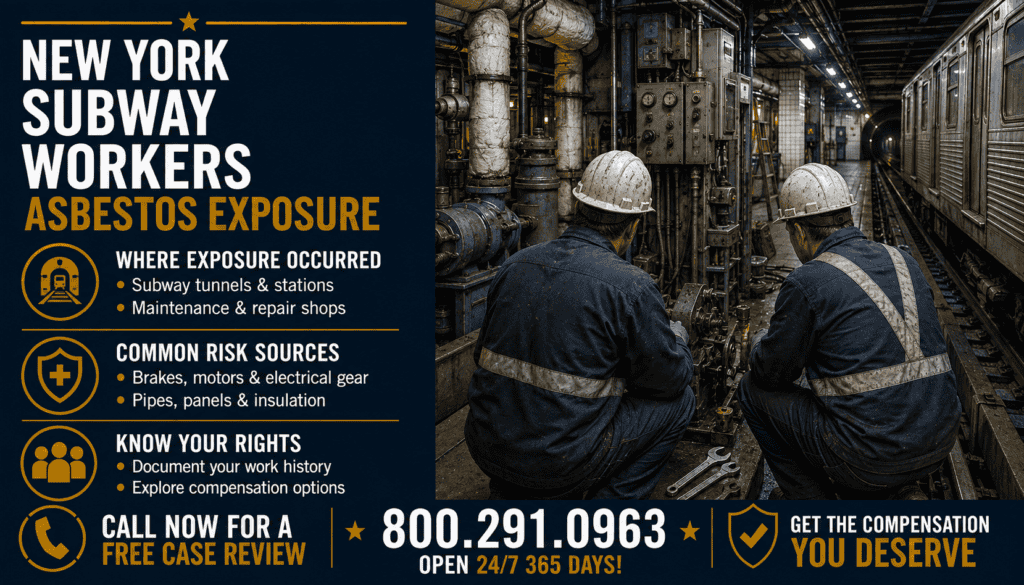
New York Subway Workers Asbestos Exposure
New York subway workers spent decades operating, maintaining, repairing, and modernizing one of the largest and most complex transit systems in the world. Their work could place them around subway cars, brake systems, electrical equipment, mechanical machinery, power systems, ventilation equipment, utility piping, insulation, and older building materials used throughout stations, tunnels, maintenance shops, and transit facilities.
Certain asbestos-containing materials were historically used in transportation, electrical, friction, insulating, and fire-resistant applications because of their resistance to heat, fire, friction, and deterioration.
The New York Subway Workers Asbestos Exposure page focuses on how subway employees could encounter asbestos during train maintenance, brake repair, electrical work, mechanical servicing, station renovation, tunnel construction, power-system work, insulation disturbance, and demolition.
This page should be a child of the New York Workers & Occupational Asbestos Exposure hub.
New York Subway Occupational Asbestos Exposure
Subway work involved many different occupations and work environments.
Potentially relevant workers include:
- Subway mechanics
- Electricians
- Brake workers
- Machinists
- Track workers
- Maintenance workers
- Power-system workers
- Signal workers
- Construction workers
- HVAC workers
- Pipefitters
- Laborers
- Station maintenance employees
A subway job title alone does not establish asbestos exposure.
Research should identify the specific:
- Employer
- Transit division
- Maintenance facility
- Station or tunnel
- Occupation
- Department
- Work duties
- Equipment
- Products
- Employment dates
Why New York Subway Workers Could Encounter Asbestos
Subway systems required materials capable of performing under demanding conditions involving:
- Heat
- Electrical loads
- Friction
- Fire risk
- Vibration
- Mechanical wear
- Steam and utility systems
- Confined underground environments
Potential historical asbestos-containing product categories could include certain:
- Brake friction materials
- Electrical insulation
- Fire-resistant materials
- Gaskets
- Packing
- Pipe insulation
- Boiler insulation
- Mechanical insulation
- Cement products
- Heat-resistant barriers
Not every product in these categories contained asbestos.
The specific component, manufacturer, application, facility, and time period should be investigated whenever possible.
New York Subway Car Maintenance
Subway cars required regular inspection, repair, component replacement, and overhaul.
Potential systems could include:
- Brake systems
- Motors
- Compressors
- Electrical equipment
- Control systems
- Mechanical components
- Doors
- Heating and ventilation equipment
Workers maintaining subway cars could encounter older components directly or dust generated by coworkers working on nearby systems.
Subway Brake Systems
Brake systems are one of the most important historical friction-product categories in transit exposure research.
Certain older brake materials could contain asbestos because friction components needed to tolerate heat and repeated wear.
Potential worker activities include:
- Brake inspection
- Brake removal
- Brake replacement
- Cleaning assemblies
- Adjusting components
- Mechanical repair
Not every historical subway brake product contained asbestos.
The railcar, component, manufacturer, replacement period, and maintenance activity should be investigated.
Brake Dust and Subway Maintenance
Brake maintenance could produce accumulated dust within mechanical assemblies.
Workers could potentially encounter dust while:
- Opening brake systems
- Removing worn components
- Cleaning equipment
- Replacing friction materials
- Servicing railcars
Research should focus on actual work practices and component history rather than assuming asbestos exposure based solely on brake work.
New York Subway Mechanics
Subway mechanics could work on:
- Brake systems
- Motors
- Compressors
- Pumps
- Mechanical drives
- Door systems
- Ventilation equipment
- Other railcar machinery
Potential historical asbestos-associated components could include certain:
- Friction materials
- Gaskets
- Packing
- Seals
- Electrical materials
- Heat-resistant components
Mechanics could encounter these products while dismantling equipment during routine or major repairs.
New York Subway Electricians
Electricians maintained extensive subway electrical systems.
Potential equipment includes:
- Motors
- Switchgear
- Control panels
- Electrical cabinets
- Transformers
- Power-distribution systems
- Wiring
- Signal equipment
Certain historical electrical or fire-resistant products could contain asbestos.
Electricians could also work near mechanical systems where insulation, gaskets, or other products were being disturbed.
Subway Power Systems
New York’s subway system required major electrical infrastructure to power trains, stations, signals, ventilation, lighting, and maintenance facilities.
Potential work areas could include:
- Substations
- Electrical rooms
- Power facilities
- Control rooms
- Mechanical spaces
Potential historical exposure research can involve:
- Electrical insulation
- Fire-resistant barriers
- Panels
- Mechanical insulation
- Nearby piping
The specific equipment and work period should be documented.
Subway Signal Workers
Signal workers could work throughout tunnels, stations, track areas, and electrical facilities.
Potential duties could involve:
- Signal equipment
- Electrical cabinets
- Wiring
- Control systems
- Trackside equipment
Potential exposure might involve electrical materials themselves or older building, fireproofing, or insulation products disturbed during nearby maintenance.
New York Subway Track Workers
Track workers could spend much of their time in tunnels, stations, yards, and other infrastructure areas.
Potential nearby exposure could involve:
- Construction work
- Utility piping
- Electrical systems
- Fireproofing
- Station renovation
- Mechanical maintenance
- Demolition
Track work alone does not establish asbestos exposure.
The specific location, surrounding activities, and materials should be investigated.
Subway Tunnel Workers
Tunnel environments could contain multiple utility and mechanical systems.
Potential exposure research could involve:
- Utility piping
- Electrical systems
- Ventilation systems
- Fire-resistant materials
- Mechanical equipment
- Construction materials
Workers could encounter older products during maintenance, repair, modernization, or demolition.
New York Subway Station Workers
Stations could contain older building materials as well as transit infrastructure.
Potential historical materials could include certain:
- Flooring
- Ceiling materials
- Fireproofing
- Pipe insulation
- Boiler insulation
- Mechanical insulation
- Cement products
- Electrical materials
Potentially relevant workers include:
- Maintenance employees
- Electricians
- Construction workers
- HVAC workers
- Plumbers
- Pipefitters
- Laborers
Routine passenger use and occupational disturbance of older materials are different exposure circumstances and should not be treated as identical.
Subway Maintenance Facilities
Maintenance shops could concentrate multiple types of transit equipment in one location.
Potential equipment includes:
- Subway cars
- Brake systems
- Motors
- Compressors
- Pumps
- Electrical machinery
- Shop equipment
- Mechanical systems
Potential worker activities could involve:
- Disassembly
- Cleaning
- Component replacement
- Rebuilding
- Testing
- Overhaul
Maintenance facilities can therefore be important when reconstructing detailed occupational exposure histories.
Subway Rail Yards
Rail yards could involve:
- Train storage
- Inspections
- Mechanical repairs
- Brake maintenance
- Electrical work
- Equipment servicing
Workers could move between yards, shops, tunnels, stations, and other transit facilities during a long career.
Each location should be considered separately.
Subway Compressors
Compressors could be used in transit and railcar systems.
Potential historical components could include certain:
- Gaskets
- Packing
- Seals
- Heat-resistant materials
Mechanics could encounter these components while:
- Opening compressors
- Replacing seals
- Removing gaskets
- Cleaning parts
- Rebuilding equipment
The compressor manufacturer and component manufacturer could be different companies.
Subway Motors and Mechanical Equipment
Electric motors powered numerous transit systems.
Potential maintenance could involve:
- Motor removal
- Rebuilding
- Electrical repair
- Bearing replacement
- Mechanical alignment
Historical exposure research may involve electrical materials, nearby mechanical products, or work performed by other trades in the same shop.
Pumps in Subway Facilities
Pumps could be used for:
- Drainage
- Water removal
- Utility systems
- Mechanical systems
- Maintenance facilities
Certain historical pump applications could involve certain:
- Packing
- Gaskets
- Seals
- Flange materials
Workers rebuilding pumps could encounter worn internal components.
Valves and Utility Piping
Transit facilities could contain utility systems involving:
- Steam
- Water
- Heating
- Mechanical services
Potential historical components could include certain:
- Valve packing
- Gaskets
- Pipe insulation
- Flange materials
Pipefitters and maintenance employees could encounter these products during repairs.
New York Subway Pipe Insulation
Older stations, mechanical rooms, maintenance buildings, and utility facilities could contain insulated piping.
Potential exposure could occur during:
- Pipe repair
- Valve replacement
- Mechanical upgrades
- Boiler work
- Renovation
- Demolition
Certain historical pipe insulation products contained asbestos.
The specific insulation product and work period should be identified.
Boiler and Heating Systems in Transit Facilities
Some subway facilities and maintenance buildings could use boilers and associated heating systems.
Potential equipment includes:
- Boilers
- Steam piping
- Pumps
- Valves
- Mechanical equipment
Potential historical asbestos-associated materials could include certain:
- Boiler insulation
- Pipe insulation
- Gaskets
- Packing
- Insulating cement
Maintenance workers could encounter these products during repairs or replacement.
Ventilation Equipment and Mechanical Systems
Subway tunnels and stations require significant ventilation and mechanical infrastructure.
Potential equipment could include:
- Fans
- Motors
- Duct systems
- Mechanical controls
- Electrical systems
Potential exposure research can involve older insulation, fire-resistant products, electrical materials, and nearby construction systems.
Subway Fire-Resistant Materials
Transit systems require extensive fire protection.
Potential historical materials could include certain:
- Fireproofing
- Electrical barriers
- Heat-resistant panels
- Mechanical insulation
- Construction materials
Renovation or modernization could disturb older products.
The specific material and manufacturer should be identified whenever possible.
New York Subway Construction Workers
Subway construction and expansion projects could involve:
- Tunnels
- Stations
- Electrical facilities
- Utility systems
- Ventilation systems
- Mechanical rooms
Potential historical asbestos-containing construction products could include certain:
- Pipe insulation
- Fireproofing
- Cement materials
- Electrical products
- Mechanical insulation
Construction exposure should be investigated by project, trade, product, and date.
Subway Renovation and Modernization
New York’s transit system has undergone repeated modernization.
Potential projects could include:
- Station renovations
- Electrical upgrades
- Mechanical replacements
- Track improvements
- Ventilation upgrades
- Utility-system replacement
- Railcar modernization
Modernization could disturb older materials hidden behind walls, ceilings, mechanical equipment, or utility systems.
Subway Demolition and Removal Work
Demolition or removal work can expose materials that remained relatively undisturbed during routine operations.
Potential activities could include:
- Removing walls
- Opening ceilings
- Removing old piping
- Removing mechanical equipment
- Removing insulation
- Replacing electrical systems
- Demolishing utility rooms
The project, material, contractor, and worker duties should be documented.
New York Subway Workers and Insulators
Insulators could work around:
- Utility piping
- Boilers
- Mechanical systems
- Transit buildings
- Maintenance facilities
Subway workers could potentially work nearby while insulation was removed or replaced.
New York Subway Workers and Electricians
Electrical work was central to subway operation.
Electricians could maintain:
- Power systems
- Motors
- Signals
- Switchgear
- Panels
- Controls
Mechanical employees could work nearby on brakes, compressors, pumps, and other equipment.
Shared maintenance facilities can therefore be important exposure environments.
New York Subway Workers and Pipefitters
Pipefitters could service:
- Utility piping
- Pumps
- Valves
- Heating systems
- Mechanical equipment
Potential historical products could include certain:
- Pipe insulation
- Gaskets
- Packing
- Flange materials
Transit employees could potentially work near these activities.
Direct Asbestos Exposure for New York Subway Workers
Potential direct exposure could occur when a worker personally:
- Serviced older brake components
- Scraped gaskets
- Removed packing
- Repaired insulated piping
- Removed older electrical materials
- Disturbed fire-resistant products
- Removed insulation
- Demolished older mechanical systems
The specific product, task, equipment, facility, and period should be documented whenever possible.
Nearby Asbestos Exposure
Subway workers could potentially encounter dust generated by other employees or contractors.
Potential nearby work could include:
- Insulation removal
- Boiler repair
- Pipe repair
- Fireproofing removal
- Brake servicing
- Electrical renovation
- Demolition
Work location and proximity can therefore matter when reconstructing exposure.
Take-Home Exposure From Subway Work
Historical workplace dust could potentially leave transit facilities on:
- Work clothing
- Shoes
- Jackets
- Tools
- Personal belongings
Family exposure research generally begins by reconstructing the worker’s:
- Employer
- Occupation
- Facility
- Department
- Duties
- Products
- Employment dates
The individual circumstances should be investigated rather than assumed.
Original Subway Equipment vs. Replacement Components
Subway cars and infrastructure could remain in service for many years while components were repeatedly replaced.
Replacement items could include:
- Brake materials
- Gaskets
- Packing
- Seals
- Electrical materials
- Mechanical components
Replacement products could come from different manufacturers.
Employment dates and maintenance history therefore matter.
Equipment Manufacturer vs. Product Manufacturer
The company that manufactured a subway car, motor, compressor, pump, or other machine may not have manufactured every asbestos-containing component used with it.
Different companies could supply:
- Brake materials
- Gaskets
- Packing
- Seals
- Electrical materials
- Insulation
- Replacement components
This distinction can be important during historical exposure research.
Contractors Working in Subway Facilities
Outside contractors could perform:
- Station renovation
- Electrical upgrades
- Mechanical repairs
- Insulation work
- Pipe replacement
- Fireproofing removal
- Demolition
Transit employees could potentially work near contractor activities.
Contractor identity and project dates can therefore become useful evidence.
New York Subway Workers by County and Borough
Subway exposure research can involve several New York City boroughs.
Current county resources include:
- New York County — Manhattan
- Bronx County
- Queens County
- Richmond County
The subway system does not operate in Richmond County, but workers may have lived there while working elsewhere in the transit system.
Exposure research should focus on the actual facility or work location rather than residence alone.
Manhattan Subway Worker Exposure
New York County contains extensive subway infrastructure involving:
- Stations
- Tunnels
- Maintenance areas
- Mechanical systems
- Electrical facilities
Workers could have long careers moving among multiple facilities.
Bronx Subway Worker Exposure
The Bronx contains extensive:
- Subway lines
- Rail yards
- Stations
- Maintenance infrastructure
Exposure histories should identify specific yards, shops, stations, departments, and job duties whenever possible.
Queens Subway Worker Exposure
Queens includes substantial subway, rail, maintenance, and transportation infrastructure.
Potential exposure research could involve:
- Rail yards
- Maintenance facilities
- Stations
- Electrical systems
- Mechanical shops
Again, the actual occupation and work environment matter more than geographic location alone.
Records That May Help Reconstruct Subway Worker Exposure
Potential records include:
- Employment records
- Social Security earnings history
- Union records
- Pension records
- Transit employment records
- Maintenance records
- Work orders
- Equipment manuals
- Equipment inventories
- Product catalogs
- Contractor records
- Historical photographs
- Coworker statements
Several sources may need to be combined to reconstruct a complete occupational history.
Building a New York Subway Worker Exposure Timeline
A useful sequence is:
Employer → Facility → Dates → Department → Occupation → Equipment → Task → Product → Manufacturer
For example, a worker may remember servicing subway brakes.
Research could then identify:
- Employer.
- Maintenance facility.
- Employment years.
- Job title.
- Subway car or equipment type.
- Brake maintenance duties.
- Replacement components used.
- Cleaning procedures.
- Suppliers or manufacturers.
- Coworkers performing similar work.
This creates a stronger exposure history than simply identifying transit employment.
New York Subway Workers and Mesothelioma
A mesothelioma diagnosis may lead a former subway worker or family to investigate occupational exposure that occurred decades earlier.
Potential exposure sources can involve:
- Brake friction products
- Electrical materials
- Gaskets
- Packing
- Pipe insulation
- Mechanical insulation
- Fire-resistant materials
- Construction products
A diagnosis alone does not identify the historical exposure source.
The worker’s facility, occupation, duties, equipment, and products should be reconstructed as specifically as possible.
New York Subway Workers and Asbestos Lung Cancer
Historical asbestos exposure can also be relevant to certain lung cancer histories.
Research can involve:
- Employer
- Transit facility
- Occupation
- Equipment
- Products
- Contractors
- Employment records
Smoking history and other lung cancer risk factors should also be documented rather than ignored.
New York Subway Worker Mesothelioma Lawsuits
A mesothelioma or other asbestos-related diagnosis may lead a former subway worker or family to investigate potential legal claims.
Relevant research can involve:
- Transit employment
- Maintenance facilities
- Equipment
- Product manufacturers
- Equipment manufacturers
- Suppliers
- Contractors
- Exposure periods
- Medical evidence
- Filing deadlines
The availability and outcome of any legal claim depend on the individual facts and applicable law.
New York Asbestos Trust Fund Claims
Some companies associated with asbestos-containing friction, insulation, mechanical, or electrical products later entered bankruptcy proceedings and established asbestos trusts.
A subway worker does not qualify for a trust simply because they worked in New York transit.
Trust research generally requires connecting the worker to exposure satisfying the medical, product, worksite, documentation, and filing requirements of a particular trust.
A long transit career could potentially involve products associated with multiple companies.
New York Mesothelioma Statute of Limitations
New York asbestos-related legal claims are subject to filing deadlines.
The applicable deadline can depend on:
- Claim type
- Diagnosis
- Discovery or accrual circumstances
- Date of death when applicable
- Jurisdiction
- Applicable law
- Public-entity procedures
- Other procedural facts
The date a subway worker originally encountered asbestos should not automatically be treated as the filing-start date.
Claims Involving Transit or Public Authorities
Subway employment may involve public authorities or other governmental entities.
Claims involving a public entity can raise legal and procedural issues different from claims involving private companies, including potentially different notice or filing requirements.
The employer and potentially involved entity should therefore be identified early when evaluating a historical exposure claim.
New York Wrongful Death Mesothelioma Lawsuits
When a former subway worker dies from mesothelioma or another asbestos-related disease, family members may need to reconstruct decades of occupational exposure.
Potential evidence can include:
- Medical records
- Employment records
- Transit records
- Social Security history
- Union records
- Pension records
- Equipment information
- Product evidence
- Contractor records
- Coworker statements
The availability of a wrongful death claim and applicable deadline depend on New York law and the individual circumstances.
Frequently Asked Questions About New York Subway Workers Asbestos Exposure
Why could New York subway workers encounter asbestos?
Certain historical transit, electrical, friction, insulation, and fire-resistant products contained asbestos and could be encountered during maintenance, repair, construction, or modernization.
Which subway workers may have relevant exposure histories?
Potentially relevant workers include mechanics, electricians, machinists, brake workers, track workers, signal workers, maintenance employees, power-system workers, construction workers, and pipefitters.
Does working for the subway system prove asbestos exposure?
No.
The facility, occupation, equipment, products, duties, and employment period should be identified.
Could subway brake materials contain asbestos?
Certain historical friction products contained asbestos, but not every brake component did.
Could subway electricians encounter asbestos?
Potentially.
Certain historical electrical products could contain asbestos, and electricians could also work near disturbed insulation, fireproofing, or mechanical materials.
Could subway mechanics encounter asbestos gaskets and packing?
Potentially.
Certain older gaskets and packing products used in mechanical equipment contained asbestos, but the specific component and time period should be investigated.
Could workers encounter asbestos in stations and tunnels?
Potentially.
Older utility piping, fireproofing, insulation, mechanical systems, and construction materials could become relevant during maintenance, renovation, or demolition.
Could subway workers be exposed by nearby trades?
Potentially.
Workers could be nearby while contractors or coworkers removed insulation, repaired piping, serviced brakes, or performed demolition.
Does knowing the subway car manufacturer identify the asbestos product?
Not necessarily.
Brake materials, gaskets, packing, electrical components, insulation, and replacement parts could be supplied by other manufacturers.
Can replacement parts matter?
Yes.
Transit equipment could remain in service for many years while components were repeatedly replaced.
Can a New York subway worker qualify for an asbestos trust?
Potentially, but qualification depends on the requirements of the particular trust and documented exposure to a qualifying product or company.
Explore Related New York Occupational Exposure
Related New York worker pages can include:
New York Transit Workers Asbestos Exposure
New York Construction Workers Mesothelioma
New York Factory Workers Asbestos Exposure
New York Electricians Asbestos Exposure
New York Pipefitters Mesothelioma
New York Railroad Workers Asbestos Exposure
New York Shipyard Workers Asbestos Exposure
New York Boilermakers Asbestos Exposure
New York Insulators Asbestos Exposure
New York Millwrights Asbestos Exposure
These occupations can overlap with subway work during mechanical maintenance, electrical repairs, construction, utility work, station renovations, and major modernization projects.
Related New York Asbestos Resources
Continue New York research through the major state hubs:
New York Mesothelioma Lawsuits & Asbestos Exposure
New York Counties Asbestos Exposure & Lawsuits
New York Asbestos Exposure Sites & Industries
New York Workers & Occupational Asbestos Exposure
New York Equipment & Machinery Asbestos Exposure
New York Asbestos Products Asbestos Exposure
New York Mesothelioma Lawsuits & Claims
These resources allow readers to move from a subway worker’s occupational history to the New York worksite, equipment, products, county, industry, or legal topic most relevant to the exposure research.
Call 800.291.0963 — Open 24/7, 365 Days
MesotheliomaHelp.Center provides legal and medical information to help New York subway workers, retirees, and families understand historical transit asbestos exposure, equipment, products, worksites, mesothelioma claims, filing deadlines, and possible next steps.