🏭 Illinois Factory Workers and Asbestos Exposure
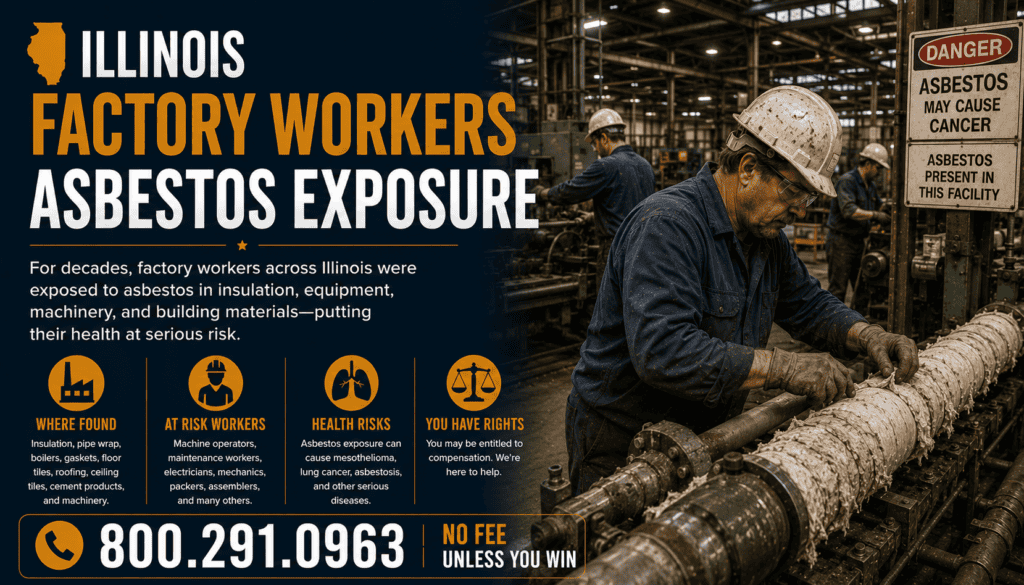
Illinois has long been one of America’s leading manufacturing states. For more than a century, factories across Illinois produced steel, machinery, automobiles, agricultural equipment, chemicals, food products, electrical equipment, paper products, glass, rubber, textiles, and countless other industrial goods. Throughout much of the twentieth century, asbestos was heavily used inside these factories because it resisted heat, prevented fires, insulated equipment, and protected machinery operating under extreme temperatures and pressure.
Unfortunately, thousands of Illinois factory workers were unknowingly exposed to asbestos while operating machinery, maintaining equipment, repairing boilers, servicing steam systems, replacing insulation, and performing routine maintenance. Many workers inhaled asbestos fibers daily without protective equipment or warnings about the long-term health risks.
Decades later, former factory workers have been diagnosed with mesothelioma, asbestos lung cancer, asbestosis, and other asbestos-related diseases linked to occupational asbestos exposure.
If you worked in manufacturing anywhere in Illinois, you may also find our Illinois Asbestos Exposure Sites guide helpful for identifying additional workplaces where asbestos exposure occurred.
🏭 Illinois Manufacturing History
Illinois has been a major manufacturing center since the late 1800s. Large factories operated throughout Chicago, Rockford, Peoria, Joliet, Decatur, East St. Louis, Aurora, Elgin, Moline, Springfield, and dozens of other communities.
Illinois factories manufactured products such as:
- Steel
- Heavy machinery
- Farm equipment
- Construction equipment
- Automobiles
- Railroad equipment
- Electrical equipment
- Paper products
- Chemicals
- Food products
- Glass
- Rubber products
- Metal products
- Industrial equipment
- Consumer goods
During the decades when asbestos use peaked, nearly every large manufacturing facility relied on steam, boilers, furnaces, ovens, turbines, compressors, and other heat-producing equipment insulated with asbestos-containing materials.
Many factories also manufactured products that contained asbestos or used asbestos-containing machinery throughout the production process.
🔥 Why Asbestos Was Used in Factories
Manufacturers relied on asbestos because it provided excellent protection against heat, fire, friction, and chemical damage.
Asbestos offered several advantages, including:
- Fire resistance
- Heat insulation
- Electrical insulation
- Chemical resistance
- Moisture resistance
- Reduced equipment wear
- Lower maintenance costs
- Long service life
Because of these properties, asbestos became one of the most widely used industrial materials during much of the twentieth century.
Common asbestos-containing factory products included:
- Pipe insulation
- Boiler insulation
- Furnace insulation
- Kiln insulation
- Turbine insulation
- Pump insulation
- Valve packing
- Gaskets
- Conveyor brake linings
- Electrical insulation
- Cement products
- Fireproof wall panels
- Ceiling tiles
- Floor tiles
- Adhesives
- Roofing materials
- Expansion joints
- Mechanical seals
- Fire blankets
- Protective clothing
As these materials aged or were disturbed during repairs, they released microscopic asbestos fibers into factory work areas.
👷 How Illinois Factory Workers Were Exposed
Factory workers often encountered asbestos during normal production and maintenance operations rather than during a single accident.
Common exposure activities included:
- Operating industrial machinery
- Repairing boilers
- Replacing insulation
- Servicing steam lines
- Rebuilding pumps
- Repairing valves
- Maintaining turbines
- Installing mechanical equipment
- Replacing gaskets
- Cleaning machinery
- Sweeping production areas
- Removing damaged insulation
- Welding around insulated equipment
- Performing shutdown maintenance
Many factories operated around the clock. Equipment vibrated continuously, causing asbestos insulation to deteriorate and release fibers into surrounding work areas.
Employees who never directly handled insulation could still inhale airborne asbestos while working nearby.
⚙️ Manufacturing Equipment Containing Asbestos
Factories depended on large industrial equipment capable of operating under extreme temperatures and pressure.
Common asbestos-containing equipment included:
- Industrial boilers
- Steam pipes
- Furnaces
- Kilns
- Ovens
- Turbines
- Compressors
- Pumps
- Valves
- Heat exchangers
- Generators
- Electrical switchgear
- Conveyor systems
- Industrial dryers
- Mixing equipment
- Industrial ovens
- Hydraulic presses
- Mechanical seals
Maintenance crews frequently removed insulation, replaced gaskets, repaired pumps, rebuilt valves, and serviced boilers, creating significant asbestos exposure throughout the facility.
Workers performing similar equipment maintenance in power plants, refineries, and commercial facilities should also review our Illinois Industrial Asbestos Exposure page.
🔧 Factory Maintenance and Shutdown Work
Scheduled maintenance shutdowns often created the greatest risk of asbestos exposure.
During shutdowns, maintenance crews commonly performed:
- Boiler overhauls
- Pipe replacement
- Pump rebuilding
- Valve repairs
- Turbine maintenance
- Insulation replacement
- Electrical upgrades
- Mechanical rebuilding
- Furnace repairs
- Equipment cleaning
Removing worn insulation, scraping old gaskets, and dismantling machinery frequently released large amounts of asbestos dust into confined workspaces.
Because multiple trades often worked simultaneously, electricians, pipefitters, welders, mechanics, millwrights, and laborers could all be exposed during the same maintenance project.
🏗️ Production Areas and Mechanical Rooms
Many production employees believed asbestos exposure occurred only inside boiler rooms, but asbestos-containing materials were commonly found throughout manufacturing facilities.
Areas where workers frequently encountered asbestos included:
- Production floors
- Mechanical rooms
- Boiler rooms
- Utility tunnels
- Equipment platforms
- Maintenance shops
- Machine rooms
- Loading areas
- Warehouse spaces
- Utility corridors
As equipment aged and insulation deteriorated, asbestos fibers could spread far beyond the original source.
👨🔧 High-Risk Factory Occupations
Many factory occupations involved repeated exposure to asbestos-containing products throughout a worker’s career.
Higher-risk occupations included:
- Machine operators
- Maintenance mechanics
- Millwrights
- Electricians
- Pipefitters
- Steamfitters
- Welders
- Boilermakers
- Machinists
- Instrument technicians
- Mechanics
- Laborers
- Supervisors
- Production workers
- Engineers
- Furnace operators
- Kiln operators
- Maintenance supervisors
- Utility workers
- Plant maintenance employees
Many workers spent decades employed in the same manufacturing facility, resulting in repeated occupational exposure.
👨👩👧 Secondary (Take-Home) Asbestos Exposure
Factory workers frequently carried asbestos fibers home on contaminated clothing, boots, gloves, hard hats, and tools.
Family members could be exposed while:
- Washing dusty work clothes
- Shaking uniforms
- Cleaning work boots
- Vacuuming personal vehicles
- Handling work tools
- Hugging workers returning home
Years later, some spouses and children developed mesothelioma despite never working inside a factory.
Families concerned about occupational exposure should also review our Illinois Mesothelioma Lawsuits page to learn more about available legal options.
🏭 Asbestos-Containing Equipment and Materials Used in Illinois Factories
For much of the twentieth century, asbestos was found throughout nearly every major manufacturing facility in Illinois. Factory owners relied on asbestos because it could withstand extreme temperatures, reduce fire hazards, insulate steam systems, protect machinery, and extend the life of industrial equipment.
As a result, factory workers were routinely exposed while operating equipment, performing maintenance, repairing machinery, replacing insulation, and renovating older manufacturing facilities.
Common asbestos-containing products found in Illinois factories included:
- Boiler insulation
- Steam pipe insulation
- Furnace insulation
- Kiln insulation
- Turbine insulation
- Pump insulation
- Valve packing
- Gaskets
- Mechanical seals
- Electrical insulation
- Fireproof wall panels
- Ceiling tiles
- Floor tiles
- Cement products
- Spray-applied fireproofing
- Roofing materials
- Pipe wrapping
- Expansion joints
- Adhesives
- Fire blankets
Many of these products deteriorated over time. Routine maintenance, equipment repairs, and plant modernization frequently released microscopic asbestos fibers into production areas.
Factory employees who also worked in commercial construction or industrial maintenance should review our Illinois Construction Workers Mesothelioma page for additional occupational exposure information.
🔥 Industrial Boilers
Industrial boilers were among the largest sources of asbestos exposure inside manufacturing facilities.
Factories depended on large boilers to produce steam for heating, manufacturing processes, and power generation. Because boilers generated extremely high temperatures, manufacturers surrounded them with thick layers of asbestos insulation.
Common asbestos-containing boiler products included:
- Block insulation
- Boiler cement
- Pipe insulation
- Thermal blankets
- Rope insulation
- Fireproof cloth
- Gaskets
- Packing materials
Maintenance crews frequently performed:
- Boiler overhauls
- Tube replacement
- Insulation removal
- Valve repairs
- Steam line repairs
- Boiler cleaning
Removing deteriorated insulation often released significant amounts of asbestos dust into boiler rooms and nearby work areas.
💨 Steam Systems and Pipe Insulation
Steam powered countless manufacturing processes throughout Illinois factories.
Nearly every steam line installed before the early 1980s contained asbestos insulation designed to reduce heat loss and protect workers from burns.
Common asbestos products included:
- Pipe covering
- Pipe lagging
- Asbestos cloth
- Molded insulation
- Thermal cement
- Elbow insulation
- Rope insulation
Pipefitters, steamfitters, plumbers, and maintenance mechanics routinely removed insulation while replacing leaking pipes, repairing valves, or upgrading steam systems.
As insulation aged, it became brittle and easily released airborne asbestos fibers.
⚙️ Pumps, Valves, Gaskets, and Packing
Industrial manufacturing equipment relied on pumps and valves to move steam, water, chemicals, oils, compressed air, and other production materials.
Many components contained asbestos because it tolerated heat, friction, and pressure.
Common asbestos-containing equipment included:
- Pumps
- Steam valves
- Pressure valves
- Water valves
- Compressors
- Heat exchangers
- Mechanical seals
- Gaskets
- Valve packing
- Pump packing
Maintenance workers frequently:
- Scraped gasket surfaces
- Removed packing
- Installed replacement gaskets
- Rebuilt pumps
- Repaired valves
- Serviced compressors
These repairs often produced asbestos dust throughout confined mechanical spaces.
🔥 Furnaces, Kilns, and Industrial Ovens
Many Illinois factories operated furnaces, kilns, ovens, and high-temperature processing equipment.
Because these systems generated intense heat, they required heavy asbestos insulation.
Common asbestos-containing equipment included:
- Industrial furnaces
- Heat-treatment furnaces
- Glass furnaces
- Metal melting furnaces
- Ceramic kilns
- Drying ovens
- Baking ovens
- Heat exchangers
Workers performing repairs frequently disturbed insulation surrounding these systems while replacing refractory materials, rebuilding equipment, or performing scheduled maintenance.
⚡ Electrical Equipment
Factories also relied on asbestos-containing electrical equipment because asbestos provided excellent electrical and heat insulation.
Common products included:
- Electrical panels
- Switchgear
- Generator insulation
- Motor insulation
- Fuse boxes
- Arc chutes
- Electrical boards
- Wiring insulation
Electricians performing repairs or equipment upgrades frequently disturbed these materials while servicing production equipment.
Electrical work often occurred during plant shutdowns alongside mechanical repairs, increasing exposure risks for nearby employees.
🏭 Production Machinery
Many manufacturing machines themselves contained asbestos products designed to withstand continuous heat and friction.
Common machinery included:
- Conveyor systems
- Hydraulic presses
- Milling machines
- Lathes
- Industrial mixers
- Packaging equipment
- Compressors
- Pumps
- Industrial dryers
- Assembly equipment
Maintenance mechanics routinely replaced asbestos-containing gaskets, seals, brake linings, clutch components, and insulation during equipment repairs.
Machine operators working nearby could also inhale asbestos fibers released during maintenance.
🚧 Plant Maintenance and Shutdowns
Scheduled maintenance shutdowns often created the highest asbestos exposure inside manufacturing plants.
Maintenance crews commonly performed:
- Boiler rebuilding
- Pipe replacement
- Turbine maintenance
- Pump rebuilding
- Valve replacement
- Furnace repairs
- Electrical modernization
- Machinery overhauls
- Insulation replacement
- Structural renovations
Because multiple trades worked simultaneously, asbestos fibers released by one crew frequently exposed workers throughout the plant.
👷 High-Risk Factory Occupations
Many manufacturing occupations involved repeated asbestos exposure over decades of employment.
Higher-risk occupations included:
- Maintenance mechanics
- Millwrights
- Machine operators
- Electricians
- Pipefitters
- Steamfitters
- Welders
- Boilermakers
- Machinists
- Furnace operators
- Kiln operators
- Production workers
- Utility workers
- Instrument technicians
- Plant engineers
- Laborers
- Maintenance supervisors
- Plant supervisors
- Industrial mechanics
- Equipment operators
Many workers remained employed at the same facility for decades, resulting in repeated exposure to asbestos-containing equipment and building materials.
👨👩👧 Secondary (Take-Home) Asbestos Exposure
Factory workers often unknowingly carried asbestos fibers home on:
- Work uniforms
- Boots
- Gloves
- Hard hats
- Tool bags
- Hand tools
- Personal vehicles
Family members could be exposed while:
- Washing dusty work clothes
- Shaking uniforms
- Cleaning boots
- Vacuuming vehicles
- Handling contaminated tools
Some spouses and children later developed mesothelioma despite never working inside a factory.
📋 Documenting Factory-Related Asbestos Exposure
Many former factory workers cannot remember every asbestos-containing product they encountered decades ago. Fortunately, successful asbestos claims frequently rely on employment records, maintenance logs, production records, coworker testimony, and historical evidence documenting asbestos use throughout manufacturing facilities.
Helpful documentation includes:
- Employer records
- Employment dates
- Job titles
- Factory name
- Department worked
- Maintenance records
- Union records
- Coworker statements
- Medical records
- Social Security employment history
Workers should focus on describing the machinery they operated, departments where they worked, and maintenance activities they performed rather than attempting to identify every asbestos-containing product by manufacturer.
🩺 Asbestos-Related Diseases Among Illinois Factory Workers
For decades, Illinois factory workers were exposed to asbestos while operating machinery, repairing boilers, maintaining steam systems, replacing insulation, rebuilding equipment, and working around aging industrial materials. Because asbestos-related diseases develop very slowly, many workers did not experience symptoms until 20 to 50 years after their occupational exposure.
The most common asbestos-related diseases include:
- Mesothelioma
- Asbestos lung cancer
- Asbestosis
- Pleural plaques
- Pleural thickening
- Other asbestos-related respiratory diseases
Even workers who experienced relatively brief or indirect exposure may later develop serious asbestos-related illnesses. Former factory workers should always tell their healthcare providers if they worked in manufacturing facilities where asbestos-containing products were used.
For additional medical information, visit our Mesothelioma Symptoms and Mesothelioma Diagnosis pages.
🎗️ Mesothelioma
Mesothelioma is a rare and aggressive cancer caused almost exclusively by asbestos exposure. The disease develops after microscopic asbestos fibers become trapped in the lining surrounding the lungs, abdomen, heart, or testes. Over many years, these fibers can cause inflammation, scarring, and cellular damage that may eventually lead to cancer.
Former Illinois factory workers diagnosed with mesothelioma often worked as:
- Machine operators
- Maintenance mechanics
- Millwrights
- Electricians
- Pipefitters
- Steamfitters
- Welders
- Boilermakers
- Machinists
- Furnace operators
- Kiln operators
- Plant engineers
- Utility workers
- Industrial mechanics
- Production workers
- Maintenance supervisors
- Equipment operators
- Plant laborers
- Instrument technicians
- Plant maintenance employees
Common symptoms include:
- Shortness of breath
- Persistent cough
- Chest pain
- Fatigue
- Unexplained weight loss
- Fluid around the lungs
Because these symptoms often resemble more common illnesses, mesothelioma is frequently diagnosed only after the disease has advanced.
🫁 Asbestos Lung Cancer
Long-term occupational asbestos exposure significantly increases the risk of developing lung cancer. Factory workers who spent years around boilers, furnaces, steam systems, turbines, insulation, and industrial equipment may have inhaled asbestos fibers on a daily basis.
Common symptoms include:
- Persistent cough
- Chest pain
- Wheezing
- Coughing up blood
- Shortness of breath
- Hoarseness
- Fatigue
- Unexplained weight loss
Workers who both smoked cigarettes and were exposed to asbestos generally face a much greater risk of developing lung cancer than workers exposed to either risk factor alone.
🌬️ Asbestosis
Asbestosis is a chronic lung disease caused by inhaling asbestos fibers over an extended period of time. Once the fibers become trapped inside the lungs, they can cause permanent scar tissue that makes breathing increasingly difficult.
Common symptoms include:
- Progressive shortness of breath
- Dry cough
- Chest tightness
- Fatigue
- Reduced exercise tolerance
Although there is no cure for asbestosis, early diagnosis and ongoing medical care may help manage symptoms and improve quality of life.
🏭 Factory Occupations with Increased Asbestos Exposure
Although many manufacturing jobs involved asbestos exposure, certain occupations experienced especially frequent contact with asbestos-containing materials.
Higher-risk occupations included:
- Machine operators
- Maintenance mechanics
- Millwrights
- Electricians
- Pipefitters
- Steamfitters
- Welders
- Boilermakers
- Industrial mechanics
- Machinists
- Furnace operators
- Kiln operators
- Plant engineers
- Utility workers
- Production workers
- Maintenance supervisors
- Plant laborers
- Equipment operators
- Instrument technicians
- Plant maintenance employees
Workers who maintained machinery or repaired steam systems often experienced greater exposure than employees who remained solely on production lines. However, asbestos fibers frequently traveled throughout the facility, exposing workers in many departments.
📋 Proving Factory-Related Asbestos Exposure
Many former factory workers cannot remember every asbestos-containing product they worked around decades ago. Fortunately, successful asbestos claims often rely on employment records, factory maintenance documents, coworker testimony, equipment records, and historical evidence showing asbestos was commonly used throughout manufacturing facilities.
Helpful documentation may include:
- Employer records
- Employment dates
- Job titles
- Factory name
- Department assignments
- Union records
- Maintenance records
- Coworker statements
- Medical records
- Social Security employment history
Workers should focus on describing the machinery they operated, the departments where they worked, maintenance duties they performed, and the equipment they regularly encountered.
Factory workers who also performed building maintenance or industrial repairs should review our Illinois Industrial Asbestos Exposure page for additional information.
⚖️ Illinois Factory Worker Mesothelioma Lawsuits
Former Illinois factory workers diagnosed with mesothelioma or another asbestos-related disease may have legal options depending on where they worked, the products they encountered, and their medical diagnosis.
Compensation may be available through:
- Mesothelioma lawsuits
- Asbestos bankruptcy trust fund claims
- Wrongful death lawsuits
- Other available legal remedies
Experienced asbestos attorneys can investigate employment histories, identify asbestos-containing products used within manufacturing facilities, and determine all available sources of compensation.
Learn more by visiting our Illinois Mesothelioma Lawsuits page.
💰 Asbestos Trust Fund Claims
Many manufacturers that supplied asbestos-containing insulation, industrial machinery, boilers, pumps, valves, gaskets, pipe insulation, cement products, roofing materials, and factory equipment later established asbestos bankruptcy trust funds.
Depending on a worker’s employment history, compensation may be available through one or more asbestos trust funds.
Evidence commonly includes:
- Employment records
- Medical records
- Pathology reports
- Factory work history
- Union records
- Witness statements
- Equipment and maintenance records
An experienced asbestos attorney can determine which asbestos trust funds may apply based on an individual’s work history and documented exposure.
Learn more by visiting our Asbestos Trust Fund Claims page.
👨👩👧 Wrongful Death Claims
Families who lose a loved one to mesothelioma or another asbestos-related disease may be eligible to pursue a wrongful death claim.
Compensation may help cover:
- Medical expenses
- Funeral and burial costs
- Loss of financial support
- Loss of companionship
- Other damages permitted by law
Eligibility depends on the family’s circumstances, work history, and applicable legal requirements.
Learn more by visiting our Wrongful Death Mesothelioma Lawsuit page.
❓ Frequently Asked Questions
How long after asbestos exposure can mesothelioma develop?
Mesothelioma usually develops 20 to 50 years after asbestos exposure, although some individuals may have an even longer latency period.
Which factory workers had the highest risk of asbestos exposure?
Maintenance mechanics, millwrights, electricians, pipefitters, steamfitters, welders, machinists, boilermakers, furnace operators, utility workers, and production employees working around boilers and steam systems experienced some of the highest occupational exposure risks.
Can factory workers develop mesothelioma without directly handling asbestos?
Yes. Many factory workers developed mesothelioma after inhaling asbestos fibers released by coworkers performing insulation removal, boiler repairs, equipment maintenance, or plant renovations.
Can family members be exposed to asbestos from factory workers?
Yes. Spouses and children have developed mesothelioma after repeated exposure to asbestos fibers carried home on contaminated work clothing, boots, tools, and personal vehicles.
Can retired factory workers still qualify for compensation?
Many workers diagnosed years after retirement may still have legal options. Eligibility depends on an individual’s diagnosis, work history, and applicable statutes of limitation.
📚 Additional Illinois Resources
You may also find these Illinois asbestos resources helpful:
- Illinois Industrial Asbestos Exposure
- Illinois Asbestos Exposure Sites
- Illinois Construction Workers Mesothelioma
- Mesothelioma Symptoms
- Mesothelioma Diagnosis
📞 Free Case Evaluation
If you or a loved one worked in an Illinois factory and has been diagnosed with mesothelioma, asbestos lung cancer, or another asbestos-related disease, you may qualify for financial compensation.
Our experienced asbestos legal team can review your:
- Employment history
- Factory work locations
- Medical diagnosis
- Potential asbestos exposure sources
- Available asbestos trust fund claims
- Legal options
📞 Call 800-291-0963
Why Families Contact Mesothelioma Help
- Free case evaluation
- Nationwide legal representation
- No upfront costs or attorney fees
- No fees unless compensation is recovered
- Help identifying asbestos exposure sources
- Assistance pursuing lawsuits and asbestos trust fund claims
Helping asbestos victims and their families seek justice since 1999.