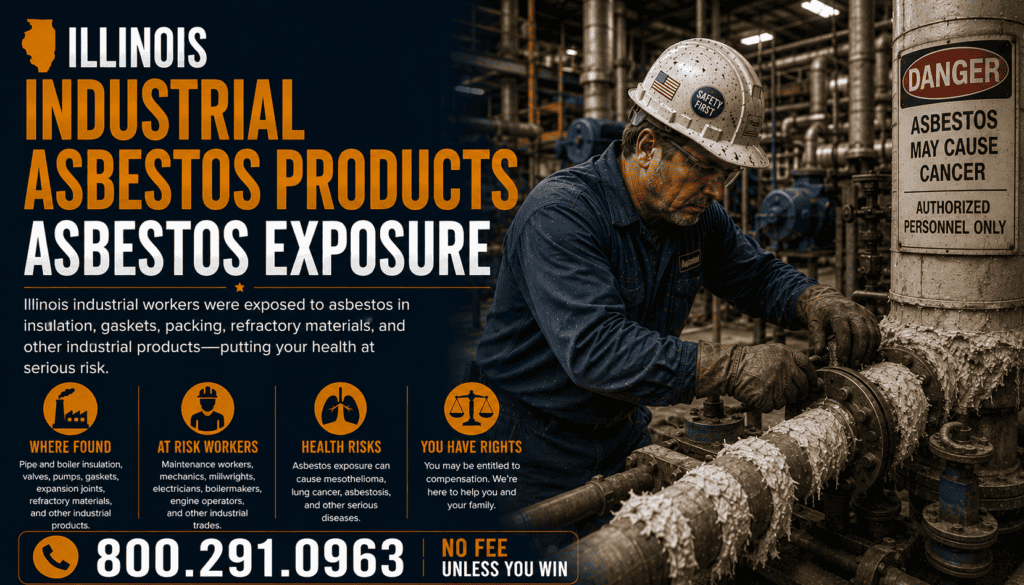
🏭 Illinois Industrial Asbestos Products
For much of the twentieth century, asbestos was one of the most widely used industrial materials in Illinois. Manufacturers relied on asbestos because it could withstand extreme temperatures, resist chemicals, reduce friction, insulate high-temperature equipment, and improve the durability of industrial machinery. Asbestos eventually became an essential component in thousands of industrial products used throughout factories, power plants, steel mills, refineries, paper mills, chemical plants, food processing facilities, and manufacturing operations.
Illinois industrial workers routinely handled asbestos-containing gaskets, packing materials, pumps, valves, boilers, turbines, compressors, insulation products, refractory materials, cement products, pipe coverings, electrical components, and countless other industrial products. Every time these materials were repaired, removed, rebuilt, or replaced, microscopic asbestos fibers could become airborne and be inhaled by workers. During the twentieth century, asbestos was incorporated into more than 3,000 commercial and industrial products because of its heat resistance, durability, and insulating properties.
Many Illinois industrial workers were unknowingly exposed for years before later developing mesothelioma, asbestos lung cancer, or asbestosis decades after their occupational exposure.
If you worked in an Illinois factory, refinery, mill, power plant, or manufacturing facility, you may also find our Illinois Asbestos Exposure Sites page helpful for identifying industrial facilities where asbestos-containing products were commonly used.
🏗️ Industrial Asbestos Products Used Throughout Illinois
For decades, asbestos-containing industrial products were installed, maintained, and repaired throughout nearly every major industrial facility in Illinois.
Common workplaces included:
- Steel mills
- Manufacturing plants
- Chemical plants
- Oil refineries
- Power plants
- Paper mills
- Food processing plants
- Foundries
- Railroad shops
- Water treatment plants
- Cement plants
- Glass factories
- Warehouses
- Automotive manufacturing plants
- Industrial machine shops
- Utility facilities
- Metal fabrication plants
- Industrial laundries
- Grain processing facilities
- Municipal utility plants
Industrial maintenance personnel routinely worked around asbestos-containing products every day.
🔥 Why Asbestos Was Used in Industrial Products
Industrial equipment often operated under extreme heat, pressure, vibration, and chemical exposure.
Manufacturers selected asbestos because it provided:
- Exceptional heat resistance
- Fire protection
- Thermal insulation
- Chemical resistance
- Friction resistance
- Mechanical strength
- Electrical insulation
- Moisture resistance
- Long service life
- Low maintenance requirements
Because of these qualities, asbestos became a standard component in thousands of industrial products used throughout American manufacturing.
⚙️ Industrial Equipment Products
Large industrial equipment commonly incorporated asbestos-containing components.
Examples included:
- Boilers
- Pumps
- Valves
- Turbines
- Generators
- Compressors
- Heat exchangers
- Condensers
- Storage tanks
- Pressure vessels
- Industrial ovens
- Kilns
- Furnaces
- Steam traps
- Cooling towers
Maintenance personnel routinely dismantled, repaired, and rebuilt this equipment, disturbing asbestos-containing components.
🧰 Industrial Gaskets and Packing Materials
Industrial gaskets and packing materials represented one of the most common sources of occupational asbestos exposure.
Common products included:
- Pump gaskets
- Valve gaskets
- Flange gaskets
- Heat exchanger gaskets
- Boiler gaskets
- Compressor gaskets
- Turbine gaskets
- Engine gaskets
- Packing rope
- Valve packing
- Pump packing
- Mechanical seals
- Compression packing
- Braided packing
- High-temperature seals
Removing hardened gaskets and packing frequently required scraping, grinding, and wire brushing, releasing asbestos fibers into the air.
🌡️ Industrial Insulation Products
Industrial facilities relied heavily on asbestos insulation to conserve energy and protect workers from high temperatures.
Common insulation products included:
- Pipe insulation
- Boiler insulation
- Block insulation
- Blanket insulation
- Cement insulation
- Thermal insulation
- Valve insulation
- Pump insulation
- Turbine insulation
- Generator insulation
- Tank insulation
- Furnace insulation
- Duct insulation
- Mechanical insulation
- Fireproof insulation
Industrial insulation remained one of the largest occupational sources of asbestos exposure.
🧱 Refractory and High-Temperature Products
Many industrial operations required products capable of withstanding extremely high temperatures.
Common refractory products included:
- Firebrick
- Refractory cement
- Refractory mortar
- Kiln linings
- Furnace linings
- Boiler refractory
- Castable refractory
- Fireproof panels
- Heat shields
- Thermal barriers
- High-temperature boards
- Combustion chamber linings
- Oven insulation
- Ladle linings
- Incinerator linings
These products were routinely removed and replaced during plant shutdowns and equipment rebuilds.
⚡ Electrical and Industrial Control Products
Industrial electrical systems frequently incorporated asbestos-containing components.
Common products included:
- Electrical panel insulation
- Arc shields
- Switchgear insulation
- Transformer insulation
- Generator insulation
- Cable insulation
- Wire insulation
- Terminal boards
- Electrical barriers
- Heat-resistant electrical boards
- Fuse panels
- Control cabinets
- Electrical cloth
- Insulating paper
- Electrical tape
Electricians and maintenance mechanics frequently disturbed these materials during equipment upgrades.
🚰 Industrial Pipe and Steam Products
Steam systems throughout Illinois industries relied on asbestos-containing products.
Common products included:
- Steam pipe insulation
- Pipe lagging
- Pipe covering
- Pipe elbows
- Pipe fittings
- Valve insulation
- Flange insulation
- Expansion joints
- Steam traps
- Pipe wrap
- Pipe cement
- Thermal jackets
- Steam seals
- Condensate piping
- Mechanical pipe coverings
Pipefitters and maintenance workers routinely removed deteriorated insulation while repairing piping systems.
🏭 Manufacturing Materials
Industrial facilities also utilized numerous asbestos-containing manufacturing materials.
Examples included:
- Industrial adhesives
- Industrial cement
- Friction materials
- Conveyor brake linings
- Industrial brake pads
- Clutch facings
- Millboard
- Asbestos cloth
- Asbestos rope
- Asbestos tape
- Asbestos paper
- Asbestos felt
- Protective blankets
- Fire curtains
- Heat-resistant fabrics
These products were widely used throughout manufacturing operations because of their durability and resistance to heat.
👷 Occupations with High Industrial Asbestos Exposure
Many industrial occupations routinely handled asbestos-containing products.
Higher-risk occupations included:
- Industrial maintenance mechanics
- Millwrights
- Pipefitters
- Steamfitters
- Boilermakers
- Electricians
- Welders
- Plant engineers
- Industrial mechanics
- Power plant workers
- Refinery workers
- Chemical plant workers
- Manufacturing workers
- Steel workers
- Utility workers
- Foundry workers
- Instrument technicians
- Maintenance supervisors
- Machine operators
- Demolition workers
Many workers encountered asbestos-containing industrial products every day throughout their careers.
👨👩👧 Secondary (Take-Home) Asbestos Exposure
Industrial workers frequently carried asbestos fibers home on:
- Work clothing
- Coveralls
- Boots
- Gloves
- Hard hats
- Tool bags
- Shop towels
- Personal vehicles
- Lunch boxes
- Protective equipment
Family members could unknowingly inhale asbestos fibers while:
- Washing contaminated work clothes
- Cleaning dusty boots
- Handling work gloves
- Vacuuming personal vehicles
- Cleaning tool bags
- Greeting workers after their shifts
Some spouses and children later developed mesothelioma despite never working in an industrial facility.
Families researching legal options should also review our Illinois Mesothelioma Lawsuits page.
🏭 Common Industrial Asbestos Products Used Throughout Illinois
For decades, Illinois industrial workers, millwrights, maintenance mechanics, pipefitters, boilermakers, electricians, welders, refinery workers, power plant employees, and manufacturing personnel routinely worked around asbestos-containing industrial products. Because asbestos could withstand extreme temperatures, pressure, chemicals, and constant mechanical stress, manufacturers incorporated it into thousands of industrial components used throughout factories, steel mills, refineries, power plants, chemical facilities, paper mills, food processing plants, and manufacturing operations.
Whenever industrial products were repaired, rebuilt, replaced, cut, scraped, drilled, sanded, or removed, microscopic asbestos fibers could become airborne. Plant shutdowns, maintenance outages, equipment overhauls, and modernization projects often produced the highest levels of occupational asbestos exposure.
Common asbestos-containing industrial products included:
- Industrial gaskets
- Packing materials
- Pipe insulation
- Boiler insulation
- Valve insulation
- Pump insulation
- Turbine insulation
- Generator insulation
- Refractory products
- Firebrick
- Industrial cement
- Expansion joints
- Steam pipe coverings
- Mechanical insulation
- Electrical insulation
- Heat shields
- Thermal blankets
- Industrial brakes
- Clutch materials
- Protective fabrics
Many of these products remained in Illinois industrial facilities for decades before maintenance or demolition disturbed the asbestos fibers.
Workers responsible for maintaining industrial equipment should also review our Illinois Equipment & Machinery Asbestos Exposure page.
⚙️ Industrial Gaskets and Sealing Products
Industrial gaskets represented one of the most common asbestos-containing products found throughout Illinois manufacturing facilities.
Common products included:
- Pump gaskets
- Valve gaskets
- Flange gaskets
- Boiler gaskets
- Heat exchanger gaskets
- Turbine gaskets
- Compressor gaskets
- Pressure vessel gaskets
- Engine gaskets
- Steam pipe gaskets
- Exhaust gaskets
- Mechanical seals
- High-temperature seals
- Expansion joint seals
- Industrial flange seals
Routine maintenance often required workers to:
- Scrape old gaskets
- Remove hardened gasket material
- Wire brush sealing surfaces
- Install replacement gaskets
- Sand metal surfaces
- Clean flange faces
- Replace worn seals
- Rebuild equipment
- Inspect leaking joints
- Perform plant shutdown maintenance
Removing deteriorated gaskets frequently released asbestos fibers into surrounding work areas.
🧵 Industrial Packing Materials
Packing materials were widely used to prevent leaks around pumps, valves, and rotating industrial equipment.
Common asbestos-containing packing products included:
- Valve packing
- Pump packing
- Braided packing
- Compression packing
- Rope packing
- Mechanical packing
- Stem packing
- Shaft packing
- High-temperature packing
- Industrial sealing rope
- Packing rings
- Graphite packing with asbestos
- Pump seals
- Valve seals
- Expansion packing
Maintenance workers routinely removed old packing with picks, wire tools, and scrapers before installing replacement materials.
🌡️ Industrial Insulation Products
Industrial insulation products represented one of the largest occupational sources of asbestos exposure throughout Illinois.
Common products included:
- Pipe insulation
- Boiler insulation
- Valve insulation
- Pump insulation
- Turbine insulation
- Generator insulation
- Tank insulation
- Vessel insulation
- Block insulation
- Blanket insulation
- Cement insulation
- Thermal insulation
- Mechanical insulation
- Duct insulation
- Fireproof insulation
Routine maintenance often involved removing large sections of deteriorated insulation before servicing industrial equipment.
Workers who maintained insulated equipment should also review our Illinois Asbestos Insulation Products page.
🔥 Boilers, Furnaces, and Heat-Resistant Products
Industrial boilers and furnaces required numerous asbestos-containing products capable of withstanding extreme temperatures.
Common products included:
- Boiler block insulation
- Boiler blankets
- Boiler cement
- Furnace insulation
- Furnace cement
- Firebrick
- Refractory brick
- Refractory mortar
- Castable refractory
- Kiln linings
- Combustion chamber linings
- Fireproof panels
- Heat shields
- Thermal barriers
- High-temperature boards
Plant shutdowns frequently required complete replacement of worn refractory materials.
⚡ Electrical and Power Distribution Products
Industrial electrical systems commonly contained asbestos because of its heat resistance and insulating properties.
Common products included:
- Switchgear insulation
- Electrical panel insulation
- Generator insulation
- Transformer insulation
- Arc shields
- Terminal boards
- Cable insulation
- Wire insulation
- Electrical barriers
- Heat-resistant electrical boards
- Fuse panels
- Motor insulation
- Control cabinet insulation
- Electrical cloth
- Electrical tape
Electricians and maintenance mechanics routinely encountered these products while upgrading industrial electrical systems.
🚰 Steam Systems and Piping Products
Steam distribution systems throughout Illinois industrial facilities relied heavily on asbestos-containing products.
Common products included:
- Steam pipe insulation
- Pipe lagging
- Pipe covering
- Valve insulation
- Flange insulation
- Pipe elbows
- Expansion joints
- Steam traps
- Condensate piping
- Pipe jackets
- Thermal wraps
- Steam seals
- Pipe cement
- Mechanical coverings
- Pipe fittings
Pipefitters and steamfitters routinely removed these products during equipment repairs and piping upgrades.
🏭 Industrial Friction Products
Many industrial machines required friction products capable of operating under heavy loads.
Common products included:
- Industrial brake linings
- Brake pads
- Brake blocks
- Clutch facings
- Clutch discs
- Conveyor brake systems
- Winch brakes
- Hoist brake linings
- Crane brake shoes
- Elevator brake linings
- Press brake linings
- Friction plates
- Industrial clutch assemblies
- Mechanical brake systems
- Heavy-duty friction materials
Maintenance personnel routinely replaced worn friction materials during scheduled equipment overhauls.
🧱 Industrial Construction Materials
Many industrial buildings also incorporated asbestos-containing construction materials.
Common products included:
- Cement board
- Transite panels
- Fireproof wallboard
- Ceiling tiles
- Floor tile
- Roofing materials
- Fire doors
- Expansion joints
- Industrial adhesives
- Caulks
- Sealants
- Pipe coverings
- Thermal barriers
- Fireproof coatings
- Spray-applied fireproofing
Industrial maintenance often disturbed these materials during plant remodeling projects.
🚧 Plant Maintenance and Shutdown Exposure
Scheduled maintenance shutdowns often produced the highest occupational asbestos exposure levels.
Common shutdown activities included:
- Boiler overhauls
- Turbine rebuilds
- Pump repairs
- Valve replacement
- Heat exchanger repairs
- Steam line replacement
- Pipe insulation removal
- Gasket replacement
- Refractory replacement
- Plant modernization
Large maintenance crews frequently worked in confined mechanical areas where asbestos fibers could accumulate.
👷 Occupations with Increased Industrial Asbestos Exposure
Many industrial occupations routinely worked around asbestos-containing products.
Higher-risk occupations included:
- Industrial maintenance mechanics
- Millwrights
- Pipefitters
- Steamfitters
- Boilermakers
- Electricians
- Welders
- Industrial mechanics
- Plant engineers
- Refinery workers
- Chemical plant workers
- Power plant workers
- Steel workers
- Utility workers
- Manufacturing workers
- Instrument technicians
- Maintenance supervisors
- Foundry workers
- Machine operators
- Demolition workers
Many employees spent decades maintaining asbestos-containing industrial products throughout Illinois manufacturing facilities.
📋 Documenting Industrial Asbestos Product Exposure
Many former industrial workers cannot remember every asbestos-containing product or manufacturer they encountered decades ago. Fortunately, successful asbestos claims often rely on employment records, maintenance logs, plant shutdown records, union records, equipment repair histories, coworker testimony, engineering documents, and historical evidence documenting asbestos use throughout industrial facilities.
Helpful documentation may include:
- Employment records
- Job titles
- Plant maintenance records
- Equipment repair logs
- Shutdown schedules
- Union membership records
- Engineering drawings
- Purchase orders
- Coworker statements
- Medical records
- Social Security employment history
- Industrial facility records
Workers should focus on identifying the industrial plants where they worked, the equipment they maintained, and the types of industrial products they routinely repaired or replaced rather than attempting to remember every manufacturer or individual product.