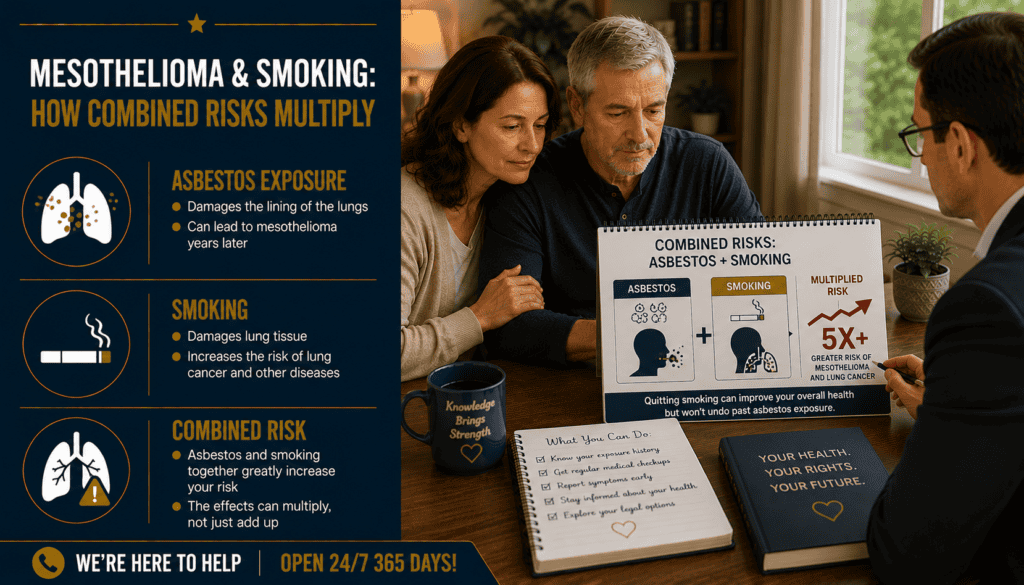
Mesothelioma and Smoking: How Combined Risks Really Work
Why smoking and asbestos greatly increase lung cancer risk—but should not be described as multiplying mesothelioma risk
Smoking and asbestos are often discussed together, but the distinction between mesothelioma and lung cancer is essential. This guide explains which combined-risk claims are supported, what a smoking history does—and does not—mean for mesothelioma, and how to seek an accurate diagnosis and appropriate care.
Does Smoking Multiply Mesothelioma Risk?
The most important distinction is between mesothelioma, a cancer of the lining of the chest or abdomen, and lung cancer, a cancer that begins in lung tissue. Asbestos exposure is an established cause of mesothelioma. Smoking is not established as a cause of mesothelioma, and evidence does not show the same smoking–asbestos interaction for mesothelioma that is seen for lung cancer.
Smoking and asbestos exposure together increase the risk of lung cancer much more than either exposure alone. The exact combined risk differs across studies and individuals, so a single multiplier should not be applied to everyone. People who have both exposures should discuss their personal history with a clinician rather than assume that a lung cancer statistic predicts their mesothelioma risk.
| Question | Evidence-based answer |
|---|---|
| Does smoking cause mesothelioma? | Smoking is not an established cause of mesothelioma. |
| Does asbestos cause mesothelioma? | Yes. Asbestos exposure is an established cause. |
| Do smoking and asbestos interact for lung cancer? | Yes. Combined exposure greatly increases lung cancer risk. |
| Can a smoker develop mesothelioma? | Yes, but smoking history alone does not establish the cause. |
For a separate discussion of lung cancer, see our lung cancer information.
Why Mesothelioma and Lung Cancer Must Be Separated
Mesothelioma arises in the mesothelium, most often the pleura around the lungs and sometimes the peritoneum in the abdomen. Lung cancer starts in lung cells. Both can cause cough, breathlessness, chest discomfort and weight loss, but they require different diagnostic and treatment decisions.
| Feature | Mesothelioma | Lung cancer |
|---|---|---|
| Typical origin | Lining of chest or abdomen | Lung tissue |
| Asbestos relationship | Established cause | Established risk factor |
| Smoking relationship | Not an established cause | Major established cause |
| Combined smoking/asbestos effect | Do not apply lung-cancer multipliers | Combined exposure substantially increases risk |
| Diagnosis | Imaging and appropriate tissue pathology | Imaging and appropriate tissue pathology |
A person may have more than one condition. A clinician must determine what is causing new symptoms rather than attribute every symptom to prior asbestos exposure. Read about mesothelioma diagnosis and mesothelioma symptoms.
What Research Means by Combined or Synergistic Risk
In occupational and public-health research, the term synergistic describes an interaction in which the combined effect is greater than would be expected under a specified model. For asbestos and tobacco, this concept is well established in discussions of lung cancer. Different studies use different populations, exposure measures and statistical models, so published ratios are not interchangeable.
| Term | Plain-language meaning | Important limit |
|---|---|---|
| Relative risk | Risk compared with a reference group | Not the chance an individual will develop cancer |
| Absolute risk | Number or percentage affected in a defined group | Depends on age, exposure and follow-up |
| Interaction | Combined exposures alter risk beyond a simple comparison | The model and outcome must be named |
| Latency | Time between exposure and disease | Cannot date an individual cancer precisely |
An illustrative statement such as “smoking multiplies mesothelioma risk” is inaccurate. The supported statement is that asbestos and smoking together greatly increase lung cancer risk. No universal multiplier can describe an individual patient.
How Asbestos Exposure History Matters
A clinician may ask about shipyards, construction, insulation, manufacturing, military service, maintenance work, older buildings and household contact with asbestos-contaminated work clothing. Relevant details include tasks, products, locations, dates, duration, protective measures and possible exposure through family members. People may not remember product names; an honest timeline is more useful than guessing.
| History item | What to record |
|---|---|
| Work and service | Employers, occupations, military branch, worksites and dates |
| Materials and tasks | Insulation, gaskets, brakes, demolition or other relevant tasks when actually recalled |
| Household contact | Whether anyone brought dusty work clothing or equipment home |
| Smoking | Current/former status and approximate duration, if known |
| Symptoms | Onset, changes and what makes symptoms better or worse |
Avoid disturbing suspected asbestos materials to obtain proof. A clinician can review your history and arrange appropriate testing. A smoking history should be recorded accurately; it does not negate the importance of asbestos exposure.
Symptoms and Diagnostic Testing
Symptoms such as persistent cough, chest pain, shortness of breath, unexplained weight loss and fluid around the lung can occur with mesothelioma, lung cancer and noncancerous conditions. A history of asbestos exposure does not establish a diagnosis, and symptoms alone cannot distinguish the diseases.
| Test or step | What it can contribute | What it cannot do alone |
|---|---|---|
| Clinical history and examination | Identify exposures, symptoms and urgent concerns | Confirm a cancer type |
| Chest X-ray or CT | Show abnormalities and help plan further tests | Provide definitive cell identification |
| PET/CT or MRI when indicated | Help assess selected disease questions | Replace pathology |
| Fluid sampling | May identify malignant cells or help relieve symptoms | A negative result cannot reliably exclude mesothelioma |
| Tissue biopsy and pathology | Establish the diagnosis and distinguish tumor types | Guarantee that one sample answers every question |
Read about imaging tests, biopsy and specialist second opinions. Blood biomarkers may assist in selected contexts but are not a stand-alone diagnostic test; see blood tests and biomarkers.
Seek emergency care for sudden severe breathlessness, crushing chest pain, coughing up substantial blood, fainting or other immediately life-threatening symptoms. Promptly contact a healthcare professional about new or worsening symptoms.
Does Quitting Smoking Still Help After Asbestos Exposure?
Yes. Quitting smoking reduces future tobacco-related health risks and may support breathing, cardiovascular health, wound healing and treatment tolerance. It does not erase past asbestos exposure, and quitting is not a proven way to eliminate mesothelioma risk. A person with a cancer diagnosis can still benefit from discussing tobacco cessation with the treating team.
| Option | How it may help | Discuss with clinician |
|---|---|---|
| Behavioral counseling | Builds a practical quit plan and addresses triggers | Ask for individual or group support |
| Nicotine replacement | May reduce nicotine withdrawal | Choose a safe product and dose |
| Prescription cessation medicines | May reduce cravings for appropriate patients | Review contraindications and interactions |
| Smoke-free home | Reduces secondhand smoke exposure | Plan household changes without blame |
Avoid blaming patients for a diagnosis. The purpose of discussing smoking is to improve health decisions, not assign fault. Ask your team about cessation support that fits your treatment plan.
Treatment and Care Planning
Treatment depends on the confirmed cancer type, extent of disease, health status, goals and specialist recommendations. Mesothelioma care may involve systemic therapy, selected surgery, radiation and symptom-directed procedures. Lung cancer follows different disease-specific pathways. A treatment plan should not be based on the assumption that the two diagnoses are interchangeable.
| Decision | Useful question |
|---|---|
| Confirm pathology | Has a specialist pathologist reviewed the tissue? |
| Understand extent | Which scans and staging methods apply to this cancer type? |
| Review options | What are the benefits, limitations and adverse effects of each option? |
| Address tobacco | What cessation support is safe alongside my treatment? |
| Support symptoms | Who can help with breathlessness, pain, nutrition and emotional stress? |
Learn about mesothelioma stages, treatment options and support resources.
Frequently Asked Questions
These answers provide general education; they cannot replace an individualized assessment.
Does smoking cause mesothelioma?
Smoking is not an established cause of mesothelioma. Asbestos exposure is an established cause. A clinician should evaluate individual risk and symptoms.
Does smoking make asbestos-related lung cancer risk worse?
Yes. Research identifies a strong interaction between tobacco smoking and asbestos exposure for lung cancer. The size of the effect varies across populations and studies.
Is mesothelioma the same as asbestos-related lung cancer?
No. Mesothelioma develops in a lining such as the pleura; lung cancer develops in lung tissue. Diagnosis and treatment differ.
If I never smoked, can I still get mesothelioma?
Yes. Mesothelioma can occur in people who have never smoked.
Will quitting smoking remove my asbestos-related risk?
No. Quitting does not undo past asbestos exposure, but it offers important health benefits and lowers future tobacco-related risks.
Can a CT scan tell which cancer I have?
Imaging can identify abnormalities and guide biopsy, but tissue pathology is generally needed to distinguish mesothelioma from other cancers.
Should I tell my doctor about smoking and asbestos exposure?
Yes. Share both histories as accurately as possible, including work, military, household and tobacco exposures.
Where can I get help after diagnosis?
Ask for a mesothelioma specialist, symptom-management support, cessation services when relevant and a second opinion if diagnostic questions remain.
Confirmed Medical and Public-Health Sources
Get Help and Explore Your Options
Call 800.291.0963 for assistance. Live chat is available 24/7, 365 days a year. Submit Your Case using the form below.
A diagnosis, exposure history or inquiry does not guarantee eligibility, compensation or a particular outcome. Individual circumstances require professional review.
⚕️ Legal & Medical Information Disclaimer
This article is general educational information, not medical or legal advice. Seek qualified medical care for diagnosis and treatment and consult an appropriately licensed attorney about legal rights or deadlines.