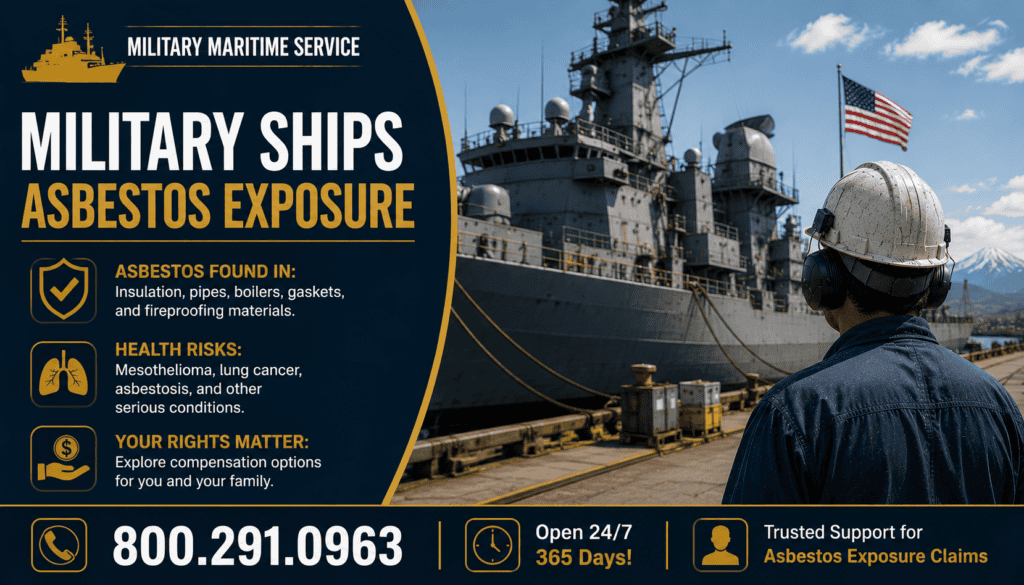
Military Ships Asbestos Exposure
Military ships played a vital role in every major conflict of the twentieth century, transporting troops, launching aircraft, supporting amphibious operations, protecting shipping lanes, and delivering supplies around the world. Behind that service, however, was a serious occupational danger that affected many veterans: asbestos exposure.
For decades, asbestos was considered an essential shipbuilding material because it resisted heat, insulated steam systems, reduced fire hazards, and protected critical machinery. It was installed throughout engine rooms, boiler rooms, turbine spaces, electrical compartments, ventilation systems, sleeping quarters, and other areas aboard military vessels.
Whenever insulation was removed, boilers were repaired, valves were rebuilt, or steam piping was replaced, microscopic asbestos fibers could become airborne. Veterans working in confined shipboard spaces often inhaled those fibers without knowing the long-term health risks.
Many former service members later developed mesothelioma, asbestos-related lung cancer, asbestosis, pleural disease, and other serious illnesses decades after leaving military service.
This guide explains how exposure occurred aboard military ships, where asbestos was commonly found, which military occupations faced the highest risks, and what medical, financial, and legal resources may be available to veterans and their families.
Veterans can also explore the broader U.S. Military Veterans Asbestos Exposure guide for information covering military branches, bases, occupations, aircraft, vehicles, equipment, and legal resources.
Those who served aboard Navy vessels should visit the Navy Ships Asbestos Exposure hub for detailed information about ship classes, occupations, equipment, and shipboard exposure history.
What You’ll Learn
This guide covers:
- Why asbestos was used aboard military ships
- How shipboard asbestos exposure occurred
- Common locations where asbestos was found
- Military occupations with the highest exposure risk
- Types of military ships that contained asbestos
- Diseases linked to asbestos exposure
- Ways veterans may document military exposure
- VA benefits and legal compensation options
Why Was Asbestos Used on Military Ships?
Military vessels operated under demanding conditions. Steam propulsion systems, boilers, turbines, engines, generators, electrical equipment, and fuel systems generated intense heat. Fire protection was also essential because ships carried fuel, ammunition, aircraft, vehicles, and large crews.
Asbestos was widely used because it provided:
- Heat resistance
- Fire resistance
- Electrical insulation
- Durability in marine environments
- Resistance to corrosion
- Low manufacturing cost
- Long service life
From World War II through the Cold War, asbestos became a standard material in naval construction. Even after its health risks became better understood, many military vessels remained in service with older asbestos-containing materials still installed.
The Navy Ship Asbestos Exposure Timeline provides more information about the historical use of asbestos aboard naval vessels.
How Veterans Were Exposed Aboard Military Ships
Most veterans were exposed during maintenance, repairs, overhauls, or equipment replacement.
Common exposure situations included:
- Removing pipe insulation
- Replacing boiler insulation
- Repairing steam systems
- Rebuilding pumps
- Replacing valve packing
- Scraping old gaskets
- Repairing turbines
- Servicing electrical equipment
- Completing shipyard overhauls
- Performing dry-dock maintenance
- Repairing battle damage
- Renovating aging vessels
Many of these activities took place inside confined machinery spaces where airborne fibers could accumulate. Once released, asbestos fibers could remain suspended in the air before settling onto uniforms, tools, bunks, machinery, and surrounding work areas.
Crew members who did not directly handle asbestos products could still inhale fibers released by nearby maintenance work or circulated through ventilation systems.
The Asbestos Pipe and Steam Insulation on Ships and Bases guide explains how insulation repairs created exposure risks aboard ships and at military facilities.
Where Was Asbestos Found on Military Ships?
Asbestos was used in thousands of shipboard products and components. Several areas presented especially high exposure risks.
Engine Rooms
Engine rooms housed propulsion equipment, pumps, generators, turbines, exhaust systems, and other machinery operating at high temperatures.
Asbestos insulation was commonly installed around:
- Main engines
- Auxiliary engines
- Exhaust systems
- Steam lines
- Turbines
- Pumps
- Generators
- Heat shields
Veterans who maintained propulsion systems often worked beside deteriorating insulation and asbestos-containing gaskets.
Related guide:
Boiler Rooms
Boiler rooms frequently contained some of the largest concentrations of asbestos aboard steam-powered military ships.
Asbestos products included:
- Boiler insulation
- Steam-pipe insulation
- Pipe lagging
- Valve insulation
- Insulating cement
- Fireproof blankets
- Expansion joints
- Gaskets
- Heat shields
Routine boiler maintenance could release significant amounts of asbestos dust into enclosed compartments.
Related guide:
Steam Pipes and Pipe Insulation
Thousands of feet of steam and hot-water piping ran throughout older military ships.
Asbestos could be found in:
- Pipe lagging
- Pipe wraps
- Pipe elbows
- Flange insulation
- Joint compounds
- Valve covers
- Removable insulation pads
Pipefitters and maintenance personnel regularly disturbed these materials while repairing leaks, replacing valves, or accessing damaged piping.
Related guide:
Turbine Rooms
Steam turbines converted high-pressure steam into power used to propel military ships.
Turbines, steam lines, valves, and surrounding machinery were often insulated with asbestos. Repairs could require removing insulation and opening equipment that contained asbestos gaskets.
Related guide:
Pumps
Military ships depended on pumps to move seawater, fuel, oil, hydraulic fluid, steam condensate, and other materials.
Asbestos could be found in:
- Pump gaskets
- Packing materials
- Flange seals
- Insulating covers
- Heat-resistant components
Maintenance workers often scraped old gaskets from pump housings or removed deteriorated packing from pump shafts.
Related guide:
Valves
Military vessels contained thousands of valves controlling steam, water, fuel, oil, and hydraulic systems.
Asbestos was commonly used in:
- Valve packing
- Flange gaskets
- Insulating covers
- High-temperature seals
- Joint materials
Valve repairs frequently required workers to remove brittle packing and scrape old gasket material from metal surfaces.
Related guide:
Electrical Equipment
Military ships required extensive electrical systems to power communications, navigation, weapons, lighting, propulsion, and emergency equipment.
Asbestos could be found in:
- Switchgear
- Electrical panels
- Arc shields
- Generator insulation
- Wiring insulation
- Cable coverings
- Motor components
- Fireproof partitions
Related guides:
HVAC and Ventilation Systems
Heating and ventilation systems often contained asbestos insulation around ducts, heating equipment, joints, and mechanical components.
These systems also created another risk: fibers released in one compartment could circulate into other areas of the vessel.
Asbestos dust could travel into:
- Sleeping quarters
- Mess areas
- Medical spaces
- Offices
- Passageways
- Storage rooms
- Command spaces
Related guide:
Crew Living Quarters
Veterans did not need to work in engineering spaces to encounter asbestos.
Crew quarters could contain:
- Floor tiles
- Flooring adhesives
- Ceiling panels
- Bulkhead insulation
- Fire doors
- Heating components
- Pipe insulation
- Ventilation materials
Fibers released elsewhere aboard the ship could travel through ducts or be carried into sleeping areas on uniforms, tools, and shoes.
Mess Halls and Galley Areas
Shipboard galleys and mess areas contained ovens, steam pipes, heating equipment, floor tiles, wall panels, and fireproof materials.
Food-service personnel could experience indirect exposure when nearby insulation or equipment was disturbed.
Firefighting and Damage-Control Areas
Asbestos was widely used in firefighting and damage-control materials because it could withstand intense heat.
Potential asbestos-containing items included:
- Fireproof suits
- Gloves
- Blankets
- Curtains
- Fire doors
- Bulkhead panels
- Emergency repair materials
- Pipe insulation
Damage-control personnel could be exposed during fires, flooding, collisions, combat damage, and emergency repairs.
Deck Machinery
Deck crews could encounter asbestos in:
- Winches
- Hoists
- Cranes
- Brakes
- Pumps
- Valves
- Gaskets
- Packing materials
- Electrical equipment
Maintenance involving brake linings, friction materials, seals, and mechanical equipment could release asbestos dust.
How Confined Shipboard Spaces Increased Exposure
Military ships contained narrow passageways, enclosed machinery compartments, and limited ventilation.
Once fibers became airborne, they could remain suspended for extended periods and settle on:
- Uniforms
- Tools
- Decks
- Machinery
- Bunks
- Ventilation ducts
- Personal belongings
Later cleaning or movement could make settled fibers airborne again.
Submarines presented an especially serious risk because personnel lived and worked in enclosed compartments with recirculated air.
Learn more through the Navy Submarines Asbestos Exposure resource.
Secondary Asbestos Exposure
Veterans who never directly handled asbestos could still be exposed when:
- Dust entered shared sleeping spaces
- Ventilation systems circulated fibers
- Crew members cleaned machinery rooms
- Laundry personnel handled dusty uniforms
- Sailors worked near active repairs
- Marines slept near engineering compartments
- Personnel carried fibers on clothing and shoes
Family members could also be exposed when veterans returned home with asbestos fibers on uniforms, bags, tools, or personal belongings.
Military Personnel at Highest Risk
Everyone serving aboard an older military ship may have experienced some asbestos exposure. However, personnel responsible for engineering, propulsion, electrical systems, maintenance, and repairs generally faced the greatest risks.
Machinist’s Mates
Machinist’s Mates operated and repaired engines, turbines, pumps, valves, condensers, and auxiliary machinery.
Their duties frequently involved removing gaskets, packing, and insulation.
Related guide:
Boiler Technicians
Boiler Technicians worked directly around boilers, steam lines, insulation, valves, pumps, and high-temperature machinery.
Related guide:
Pipefitters
Pipefitters installed and repaired steam, water, fuel, oil, and hydraulic piping. Their work often required cutting through asbestos insulation or removing lagging from valves and flanges.
Related guide:
Electricians
Electricians maintained generators, switchboards, wiring, motors, lighting systems, and electrical panels that sometimes incorporated asbestos insulation and fireproofing.
Related guide:
Welders
Welders repaired piping, bulkheads, machinery, and structural components. They often worked beside asbestos-insulated equipment and sometimes used asbestos-containing blankets for heat protection.
Related guide:
Other High-Risk Personnel
Other occupations associated with elevated exposure included:
- Enginemen
- Hull Maintenance Technicians
- Damage Control Personnel
- Machinery Repairmen
- Generator Technicians
- Steam System Technicians
- Insulators
- Firefighters
- Ship Engineers
- Maintenance Crews
- Dry-Dock Workers
- Shipyard Laborers
- Civilian Contractors
The Military Ship Personnel Asbestos Exposure guide provides additional occupation-specific information.
Types of Military Ships Linked to Asbestos Exposure
Asbestos use was not limited to one vessel category. It appeared across nearly every class of military ship built or repaired before modern asbestos restrictions.
Navy Ships
The Navy Ships Asbestos Exposure hub is the primary resource for veterans researching ship classes, equipment, occupations, and asbestos exposure aboard Navy vessels.
Aircraft Carriers
Aircraft carriers contained extensive propulsion systems, steam lines, boilers, turbines, electrical rooms, aircraft-maintenance spaces, and fireproof materials.
Battleships
Battleships contained large steam-propulsion systems, gun-turret machinery, pumps, valves, boilers, electrical systems, and insulated piping.
Cruisers
Cruisers exposed engineering crews and maintenance personnel to asbestos in propulsion rooms, steam systems, electrical compartments, and insulated machinery.
Destroyers
Destroyers often contained compact boiler and engine compartments where disturbed asbestos fibers could become concentrated.
Frigates
Frigates contained boilers, turbines, pumps, valves, electrical systems, and insulated steam piping.
Submarines
Submarines presented unique risks because crews lived and worked in sealed compartments with recirculated air.
Amphibious Assault Ships
Amphibious assault ships carried Marines, aircraft, vehicles, equipment, and landing craft. Both Navy personnel and embarked Marines could be exposed.
Landing Ship Docks
Landing Ship Docks contained propulsion rooms, pump spaces, vehicle decks, maintenance areas, and troop compartments.
Landing Ship Tanks
Landing Ship Tanks transported vehicles, equipment, supplies, and troops while relying on asbestos-containing engines, pipes, pumps, valves, and electrical equipment.
Attack Transport Ships
Attack transport ships carried troops and equipment while containing insulated propulsion machinery, steam systems, and crew spaces.
Amphibious Cargo Ships
These ships carried equipment and supplies for amphibious operations and contained asbestos in propulsion systems, cargo machinery, pipes, pumps, and valves.
Naval Auxiliary Ships
Auxiliary ships supported the fleet by transporting fuel, ammunition, equipment, supplies, and personnel.
Fleet Oilers
Fleet oilers contained fuel-transfer equipment, pumps, boilers, engines, valves, gaskets, and extensive piping.
Fleet Replenishment Ships
Fleet replenishment ships operated propulsion systems, refrigeration machinery, cargo equipment, and transfer systems that could contain asbestos.
Hospital Ships
Hospital ships could expose engineers, maintenance workers, medical personnel, and patients through machinery insulation and asbestos-containing interior materials.
Escort Carriers
Escort carriers contained propulsion equipment, steam systems, aircraft-support spaces, electrical compartments, and maintenance shops.
Tugboats
Navy tugboats had compact engine rooms containing asbestos-insulated pipes, exhaust systems, pumps, valves, and gaskets.
Minesweepers
Minesweepers contained asbestos in propulsion machinery, electrical systems, ventilation equipment, and deck machinery.
Patrol Torpedo Boats
Patrol torpedo boats could contain asbestos in engines, exhaust systems, brakes, electrical components, gaskets, and fireproofing.
Seaplane Tenders
Seaplane tenders supported aircraft operations while containing asbestos in shipboard propulsion systems, electrical equipment, and aviation-maintenance areas.
Cable Repair Ships
Cable repair ships contained boilers, engines, generators, pumps, electrical systems, and cable-handling machinery.
Ammunition Ships
Ammunition ships used asbestos in propulsion spaces, cargo equipment, fireproof compartments, pipes, and crew areas.
Aviation Store Ships
Aviation store ships contained asbestos in engines, steam piping, refrigeration equipment, storage compartments, and support machinery.
Oil Transporter Ships
Oil transporter ships exposed crews through fuel-transfer systems, pumps, valves, boilers, gaskets, and pipelines.
Barrack Craft
Barrack craft could contain asbestos in floor tiles, heating systems, wall panels, ceilings, pipes, and ventilation components.
Fast Combat Support Ships
Fast combat support ships contained large propulsion systems, cargo-transfer machinery, pumps, valves, electrical equipment, and steam piping.
Coast Guard Vessels
Coast Guard ships also contained asbestos in machinery, insulation, electrical systems, flooring, and fireproofing.
Related guides include:
- Coast Guard Cutters Asbestos Exposure
- Coast Guard Patrol Boats Asbestos Exposure
- Coast Guard Icebreakers Asbestos Exposure
- Coast Guard Tugboats Asbestos Exposure
- Coast Guard Utility Boats Asbestos Exposure
- Seagoing Buoy Tenders Asbestos Exposure
Marine Corps Personnel Aboard Military Ships
Marines serving aboard Navy amphibious and transport vessels could be exposed even when they did not maintain propulsion equipment.
Fibers could enter:
- Troop berthing compartments
- Vehicle decks
- Maintenance areas
- Passageways
- Ventilation systems
- Storage spaces
Related guides:
Military Shipyards and Dry Docks
Military shipyards, repair yards, and dry docks created some of the most concentrated asbestos-exposure conditions connected to military service.
During construction, overhaul, modernization, and decommissioning, workers routinely removed old insulation, opened steam systems, rebuilt engines, replaced boilers, repaired electrical equipment, and cut through asbestos-containing materials. Several trades often worked in the same confined area, allowing dust from one project to expose everyone nearby.
Shipyard exposure could involve:
- Removing deteriorated pipe lagging
- Replacing boiler insulation
- Rebuilding turbines and engines
- Repairing pumps and valves
- Scraping asbestos gaskets
- Cutting insulated piping
- Removing fireproof panels
- Replacing floor and ceiling materials
- Repairing electrical systems
- Cleaning dust and demolition debris
- Decommissioning older vessels
Veterans assigned to ships undergoing overhauls could be exposed even when civilian contractors completed the work. Asbestos fibers could spread through open compartments, passageways, machinery rooms, and ventilation systems.
Related guides include:
- Navy Shipyards Asbestos Exposure
- U.S. Naval Shipyards Asbestos Exposure
- Requesting Shipyard and Base Work Records
- Navy Decommissioning Yards Asbestos Exposure
- Pearl Harbor Naval Shipyard Asbestos Exposure
- Long Beach Naval Shipyard Asbestos Exposure
- Charleston Naval Shipyard Asbestos Exposure
Diseases Linked to Military Ship Asbestos Exposure
Asbestos-related diseases usually develop slowly. A veteran may feel healthy for decades after service before symptoms begin.
The time between exposure and diagnosis is known as the latency period. For many asbestos diseases, this period can last 20 to 60 years.
Mesothelioma
Mesothelioma is a rare cancer that develops in the thin tissue lining certain organs.
The most common form is pleural mesothelioma, which affects the lining of the lungs. Other forms can affect the abdomen, heart, or testes.
Possible symptoms include:
- Shortness of breath
- Chest pain
- Persistent cough
- Fluid around the lungs
- Fatigue
- Difficulty swallowing
- Unexplained weight loss
Military veterans represent an important group among people diagnosed with mesothelioma because asbestos was used extensively on ships, bases, vehicles, aircraft, and military equipment.
Asbestos-Related Lung Cancer
Asbestos exposure can cause lung cancer independently of smoking.
Veterans who were exposed to asbestos and also smoked may face a substantially higher lung-cancer risk than people with either risk factor alone.
Possible symptoms include:
- Persistent coughing
- Chest pain
- Coughing up blood
- Hoarseness
- Shortness of breath
- Repeated respiratory infections
- Unexplained weight loss
Asbestosis
Asbestosis is a chronic lung disease caused by inhaled asbestos fibers.
The fibers can produce inflammation and permanent scarring inside the lungs, making breathing progressively more difficult.
Symptoms may include:
- Shortness of breath
- Dry cough
- Chest tightness
- Fatigue
- Reduced exercise tolerance
- Finger clubbing in advanced cases
Pleural Disease
Veterans exposed to asbestos may also develop noncancerous pleural conditions, including:
- Pleural plaques
- Pleural thickening
- Pleural effusions
- Rounded atelectasis
These conditions may indicate prior asbestos exposure and can sometimes affect breathing.
Learn more through the Navy Ship Asbestos Exposure Health Risks guide.
How to Prove Military Ship Asbestos Exposure
A diagnosis alone does not identify where exposure occurred. Veterans may need records showing the ships, shipyards, occupations, and equipment connected to their service.
Useful evidence may include:
- DD Form 214
- Military personnel files
- Service treatment records
- Ship assignment records
- Duty-station records
- Occupational rating records
- Muster rolls
- Deck logs
- Overhaul schedules
- Shipyard repair records
- Equipment-maintenance records
- Technical manuals
- Construction specifications
- Witness statements
- Civilian employment records
- Medical and pathology reports
Ship Assignments and Occupational Ratings
A veteran’s duty assignment can establish service aboard a particular vessel. Occupational ratings may help explain the type of work performed and whether the veteran regularly entered engine rooms, boiler spaces, electrical compartments, or repair areas.
Deck Logs
Deck logs can show:
- Where a ship was stationed
- When it entered dry dock
- When major repairs occurred
- When machinery failed
- When overhauls began
- When emergency repairs took place
The Accessing Navy Ship Deck Logs to Prove Asbestos Exposure guide explains how deck logs may support an exposure history.
Shipyard and Repair Records
Repair documents may show that asbestos insulation, boilers, turbines, valves, pumps, or electrical systems were removed or replaced while a veteran served aboard the vessel.
Veterans can review Requesting Shipyard and Base Work Records for additional guidance.
Technical Manuals
Technical manuals can identify the machinery and systems installed aboard a ship. They may also show the types of insulation, gaskets, packing, and replacement parts used during maintenance.
See How to Obtain Navy Bureau of Ships Technical Manuals for more information.
Exposure-Evidence Guides
Additional resources include:
- Navy Ship Exposure Evidence Guide
- Documents Needed for Navy Asbestos Claims
- Filing FOIA Requests for Military Exposure Data
- Using Occupational Specialty Codes in VA Claims
VA Benefits for Military Veterans
Veterans diagnosed with an asbestos-related disease may qualify for benefits through the Department of Veterans Affairs when evidence connects the illness to military service.
Potential benefits include:
- Monthly disability compensation
- VA health care
- Cancer treatment
- Travel reimbursement
- Caregiver assistance
- Aid and Attendance
- Dependency and Indemnity Compensation
- Survivor benefits
A VA claim generally requires:
- A current medical diagnosis
- Evidence of military asbestos exposure
- A medical connection between the exposure and disease
Helpful resources include:
- Navy Ship VA Benefits for Mesothelioma
- VA Disability Benefits for Mesothelioma Veterans
- VA Health Care for Mesothelioma
- VA Hospitals With Mesothelioma Programs and Telehealth Options
Military Ship Mesothelioma Lawsuits
Veterans generally do not file asbestos lawsuits against the U.S. military for exposure that occurred during service.
However, they may be able to pursue claims against private companies that manufactured or supplied asbestos-containing products used aboard military ships.
Potential defendants may include manufacturers of:
- Boilers
- Turbines
- Pumps
- Valves
- Gaskets
- Packing
- Pipe insulation
- Electrical equipment
- Generators
- Fireproof materials
- Flooring
- Joint compounds
Compensation may be available for:
- Medical costs
- Lost income
- Reduced earning ability
- Pain and suffering
- Travel for treatment
- Household expenses
- Family financial losses
Veterans may often pursue legal compensation while also receiving VA benefits.
Related guides include:
- Legal Options for Navy Asbestos Victims
- Navy Ships Asbestos Exposure Mesothelioma Lawsuit
- Filing a Mesothelioma Lawsuit While Receiving VA Benefits
- Filing VA and Civilian Lawsuits Without Losing Benefits
Asbestos Trust Fund Claims
Many companies that made asbestos products later filed for bankruptcy. Some established asbestos trust funds to compensate people harmed by their products.
A military veteran may qualify for one or more trust claims if evidence connects exposure to products made by a trust-associated company.
Trust claims may involve manufacturers of:
- Ship insulation
- Boiler materials
- Pump gaskets
- Valve packing
- Turbine insulation
- Electrical components
- Fireproof products
- Flooring materials
Eligibility may depend on:
- Ship assignments
- Service dates
- Occupational duties
- Equipment repaired
- Shipyard history
- Product identification
- Medical diagnosis
Trust claims may sometimes be pursued alongside VA benefits and lawsuits against companies that remain financially active.
Wrongful-Death Claims
When a veteran dies from mesothelioma or another asbestos-related disease, surviving family members may have several possible compensation options.
These may include:
- Wrongful-death lawsuits
- Asbestos trust fund claims
- VA Dependency and Indemnity Compensation
- Accrued VA benefits
- Survivor pension benefits
- Claims connected to later civilian employment
Families can learn more through the Navy Ship Wrongful Death Asbestos Lawsuits guide.
Statute of Limitations
Every state has filing deadlines for asbestos personal-injury and wrongful-death claims.
These deadlines often begin when a person is diagnosed or when an asbestos-related death occurs, rather than when the original exposure happened.
The exact deadline depends on:
- The state where the claim is filed
- The veteran’s residence
- The location of exposure
- The date of diagnosis
- The type of claim
- Whether the claim involves wrongful death
Waiting too long may affect the ability to pursue compensation.
Review the Navy Ship Asbestos Statute of Limitations resource for additional information.
Frequently Asked Questions
Did most older military ships contain asbestos?
Many U.S. military ships built or repaired before the 1980s contained asbestos somewhere aboard. The amount depended on the vessel’s age, size, propulsion system, and repair history.
Where was asbestos most heavily used?
The greatest concentrations were generally found in engine rooms, boiler rooms, turbine spaces, pump rooms, electrical compartments, and around steam piping.
Could non-engineering personnel be exposed?
Yes. Fibers released during maintenance could spread through passageways and ventilation systems into sleeping areas, offices, mess halls, medical spaces, and storage compartments.
Could Marines aboard Navy ships be exposed?
Yes. Marines serving aboard amphibious or transport ships could be exposed in troop compartments, vehicle decks, maintenance spaces, and shared ventilation systems.
Could Coast Guard veterans be exposed?
Yes. Coast Guard cutters, patrol boats, icebreakers, tugboats, buoy tenders, and other vessels also used asbestos-containing insulation, equipment, flooring, and fireproofing.
How long does mesothelioma take to develop?
Mesothelioma commonly develops decades after asbestos exposure. Many veterans are diagnosed 20 to 60 years after leaving military service.
Can veterans receive VA benefits and lawsuit compensation?
In many cases, yes. VA benefits and claims against private asbestos companies are separate compensation systems.
What records help prove shipboard exposure?
Ship assignments, occupational ratings, deck logs, muster rolls, repair schedules, technical manuals, shipyard records, witness statements, and medical records may all help establish exposure.
Can family members be exposed through military uniforms?
Yes. Asbestos fibers carried home on uniforms, shoes, bags, tools, or personal belongings could expose spouses and children.
Can a family file a claim after a veteran dies?
Possibly. Surviving family members may qualify for wrongful-death claims, asbestos trust claims, VA survivor benefits, or other forms of compensation.
Related Military Ship Asbestos Resources
Explore these related guides:
- U.S. Navy Asbestos Exposure
- Navy Ships Asbestos Exposure
- Navy Ships Asbestos Exposure Articles
- Military Ship Personnel Asbestos Exposure
- Asbestos Pipe and Steam Insulation on Ships and Bases
- Navy Ship Exposure Evidence Guide
- Accessing Navy Ship Deck Logs
- Requesting Shipyard and Base Work Records
- How to Obtain Navy Bureau of Ships Technical Manuals
- Navy Ship Asbestos Exposure Timeline
- Navy Ship Equipment Manufacturers and Asbestos Use
Get Help After Military Ship Asbestos Exposure
Veterans who served aboard military ships helped protect the country while working and living around materials that may have contained asbestos.
If you or a loved one served aboard a Navy, Coast Guard, Marine Corps, or other military vessel and later developed mesothelioma, asbestos-related lung cancer, asbestosis, or another asbestos-related disease, compensation may be available.
A free case review may help:
- Identify ships connected to exposure
- Review military and shipyard records
- Determine which products may have been involved
- Locate deck logs and overhaul records
- Evaluate asbestos trust fund eligibility
- Explain VA benefit options
- Review lawsuit eligibility
- Identify wrongful-death options for surviving families
📞 Call 800.291.0963 for a Free Case Evaluation
- Veterans served nationwide
- Available 24 hours a day
- Open 365 days a year
- No upfront costs for a case review