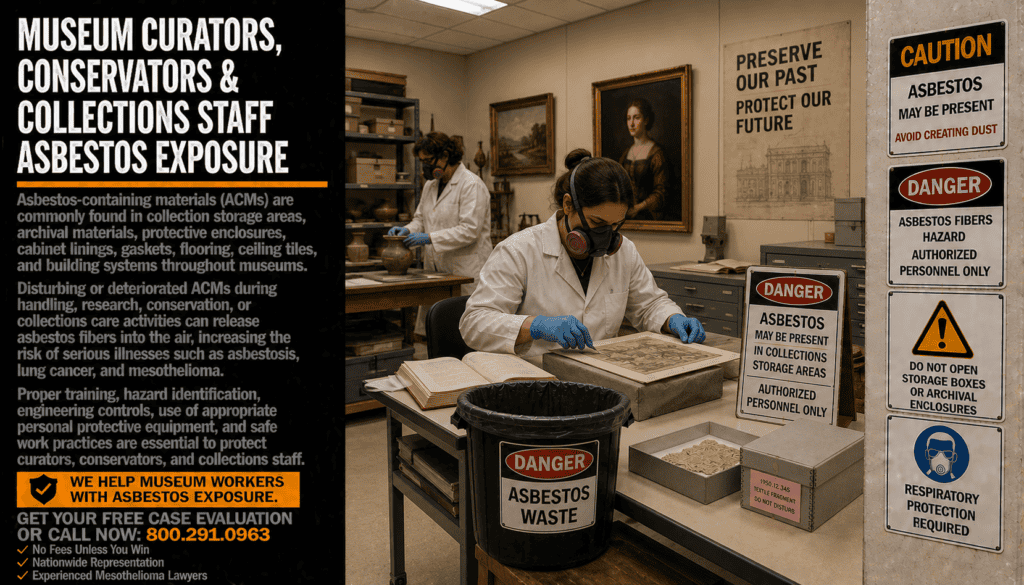
🧑🎨 Museum Curators, Conservators & Collections Staff Asbestos Exposure
Museum curators, conservators, and collections staff were exposed to asbestos while working in galleries, archives, storage rooms, and exhibit preparation areas within older museum buildings containing asbestos materials.
Museum curators, conservators, and collections staff are often viewed as far removed from building hazards. In reality, their work frequently placed them in high-risk indoor environments where asbestos-containing materials were present and deteriorating. Because these professionals spent long hours inside museums—often in enclosed, climate-controlled spaces—they experienced chronic, low-to-moderate asbestos exposure over many years.
Unlike maintenance or construction workers, curators and conservators were rarely informed about asbestos risks. Exposure occurred quietly through airborne fibers released from aging ceilings, walls, ductwork, flooring, fireproofing, and exhibit materials—especially in storage areas and behind-the-scenes workspaces not open to the public.
🏛️ Why Curators & Conservators Faced Asbestos Exposure
Curators, conservators, and collections staff faced exposure because:
-
🧱 They worked inside older museum buildings
-
🌬️ HVAC systems circulated contaminated air
-
📦 Storage rooms often contained deteriorating materials
-
🖼️ Exhibit preparation disturbed asbestos nearby
-
🕰️ They spent full careers in these environments
-
⚠️ They were rarely warned of asbestos hazards
Exposure was typically long-term and cumulative, increasing health risks.
🧪 Asbestos Sources Affecting Curators & Collections Staff
Asbestos exposure for museum professionals came from multiple building-related sources:
🧱 Building Materials
-
Ceiling tiles and acoustic panels
-
Plaster walls and joint compound
-
Vinyl asbestos floor tiles and adhesives
-
Spray-on fireproofing
🌬️ HVAC & Climate Control Systems
-
Insulated ducts and plenums
-
Air handlers distributing fibers
📦 Storage & Archive Areas
-
Aging insulation in vaults and basements
-
Asbestos dust settling on shelving and artifacts
🖼️ Exhibit Preparation & Handling
-
Nearby construction or exhibit modification
-
Disturbance of asbestos-containing display materials
Even without direct contact, curators inhaled fibers daily.
⚠️ How Asbestos Exposure Occurred During Daily Museum Work
Exposure occurred during routine activities such as:
-
Working in archives and storage rooms
-
Preparing exhibits in back-of-house spaces
-
Handling artifacts in contaminated environments
-
Sitting beneath deteriorating ceilings
-
Working near renovation or maintenance zones
-
Using shared offices connected to HVAC systems
Because asbestos fibers are invisible, most exposure went unnoticed.
🌫️ Airborne Asbestos in Galleries & Storage Areas
Curator and conservator exposure was amplified because:
-
🌬️ Ventilation systems circulated fibers continuously
-
🧹 Cleaning re-aerosolized settled dust
-
🚪 Fibers migrated between galleries and storage
-
🧱 Vibrations loosened aging materials
This created building-wide contamination, even in quiet, controlled spaces.
🧑🏭 Museum Professionals Most at Risk
🧑🎨 Curators
Spent extensive time in galleries and behind-the-scenes areas.
🧪 Conservators
Worked closely with artifacts in storage and preparation rooms.
📚 Archivists & Registrars
Handled collections in vaults and basements with aging materials.
🧾 Collections Managers
Oversaw storage areas containing deteriorating asbestos materials.
🧑💼 Research & Academic Staff
Worked long hours inside older museum facilities.
Exposure often occurred over entire careers.
🧬 Secondary (Take-Home) Asbestos Exposure
Curators and collections staff also carried asbestos fibers home when dust:
-
Settled on clothing and shoes
-
Transferred to vehicles and personal items
Family members were exposed during laundry and household contact, leading to secondary exposure cases.
🫁 Health Risks Linked to Curator & Conservator Asbestos Exposure
Long-term asbestos exposure among museum professionals is associated with:
🧠 Mesothelioma
A rare, aggressive cancer caused almost exclusively by asbestos exposure.
🫁 Asbestosis
A chronic lung disease from prolonged fiber inhalation.
🫁 Lung Cancer
Elevated risk following long-term exposure.
Because exposure was often low-level but continuous, diagnosis frequently occurred decades later.
📜 Employer Knowledge & Safety Failures
Many museums and governing institutions failed to:
-
Identify asbestos in storage and gallery areas
-
Warn curators and staff of exposure risks
-
Restrict access during maintenance or renovations
-
Monitor indoor air quality
-
Provide asbestos safety training
These failures form the basis for many asbestos claims involving museum professionals.
❓ Frequently Asked Questions (FAQs)
1️⃣ Can curators be exposed without handling asbestos?
Yes. Airborne fibers spread throughout museum buildings.
2️⃣ Are storage areas higher risk than galleries?
Often yes. Aging materials are common in basements and vaults.
3️⃣ Did exhibit preparation increase exposure?
Yes. Nearby work disturbed asbestos materials.
4️⃣ Can family members file secondary exposure claims?
Yes. Take-home asbestos exposure is legally recognized.
5️⃣ Can claims still be filed decades later?
Yes. Asbestos diseases have long latency periods.
⚖️ How a Lawyer Can Help Get Compensation
An experienced asbestos lawyer can help curators, conservators, and families by:
-
Investigating museum building histories and layouts
-
Identifying asbestos-containing materials present
-
Tracing responsible asbestos product manufacturers
-
Documenting long-term occupational exposure
-
Filing mesothelioma lawsuits
-
Submitting asbestos trust fund claims
-
Maximizing compensation across all available options
Because curator exposure was indirect and prolonged, detailed investigation is essential.
📞 Free Case Evaluation – Get Help Today
If you worked as a museum curator, conservator, archivist, or collections staff member and later developed mesothelioma or another asbestos-related illness—or were exposed through a family member—help is available.
📞 Call Now for a FREE Case Evaluation: 800-291-0963
There is no obligation, and compensation may be available.
📌 Key Takeaways
-
Curators and conservators faced long-term asbestos exposure
-
Airborne fibers spread throughout museum buildings
-
Storage and archive areas posed elevated risks
-
Families experienced secondary exposure
-
Legal options may still be available