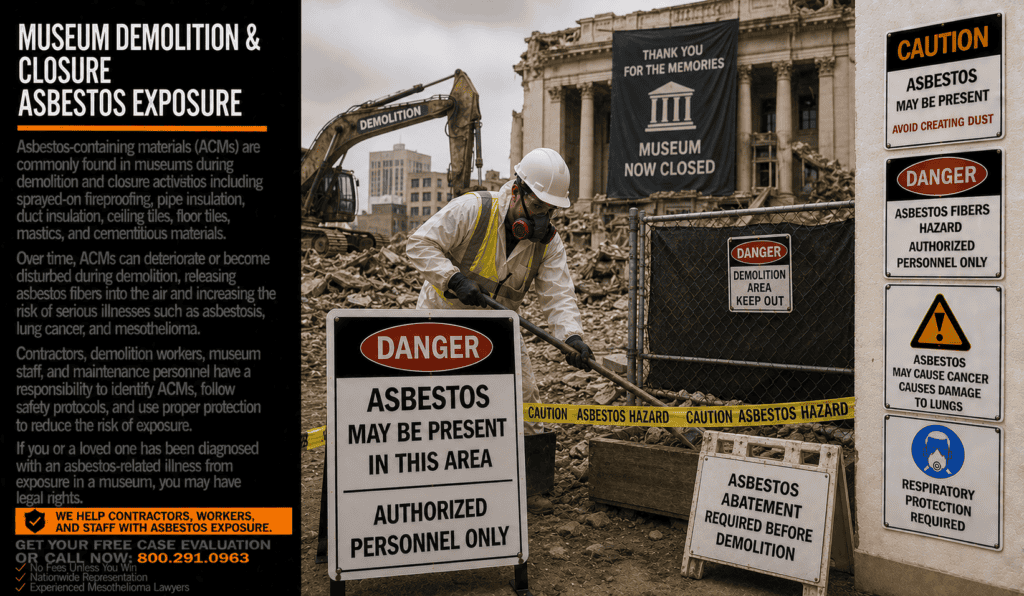
🏚️ Museum Demolition & Closure Asbestos Exposure
Demolition and closure of older museum buildings released large amounts of asbestos dust from walls, ceilings, flooring, insulation, ductwork, and fireproofing, exposing demolition crews, contractors, nearby workers, and surrounding communities.
When museums permanently closed or were demolished to make way for redevelopment, asbestos exposure risks reached their highest levels. Many museum buildings were constructed or renovated during peak asbestos-use decades, meaning asbestos was embedded throughout structural materials and building systems. During demolition, these materials were broken apart, crushed, and removed—releasing massive quantities of asbestos fibers into the air.
Unlike routine renovations, demolition involved aggressive mechanical force and large-scale material disturbance. This created dense asbestos dust clouds that exposed not only demolition crews, but also maintenance staff, contractors, neighboring workers, and sometimes the surrounding public.
🏛️ Why Museum Demolition Created Extreme Asbestos Risks
Museum demolition and closure projects were especially dangerous because:
-
🧱 Asbestos was widespread and undocumented
-
🔨 Structural destruction pulverized friable materials
-
🌫️ Dust clouds formed during tearing down
-
🌬️ Wind carried fibers beyond work zones
-
🏗️ Projects often occurred near occupied areas
-
⚠️ Containment measures were sometimes inadequate
Demolition exposure was often intense, short-term, and highly concentrated—a pattern strongly linked to asbestos disease.
🧪 Asbestos-Containing Materials Disturbed During Demolition
Demolition projects released asbestos from:
🧱 Structural Materials
-
Plaster walls and joint compound
-
Fireproofed beams and columns
-
Decorative ceilings and moldings
🪵 Flooring & Subflooring
-
Vinyl asbestos tiles
-
Mastics and adhesives
-
Concrete underlayment
🌬️ HVAC & Utility Systems
-
Insulated ducts and plenums
-
Pipe insulation and lagging
⚡ Electrical & Fireproofing
-
Fireproofed electrical rooms
-
Insulated wiring and panels
🔥 Mechanical Systems
-
Boiler and equipment insulation
Breaking apart these materials released large volumes of asbestos fibers.
⚠️ How Asbestos Exposure Occurred During Museum Demolition
Exposure commonly occurred during:
-
Structural collapse and mechanical demolition
-
Cutting and crushing building materials
-
Removal of asbestos-insulated systems
-
Handling debris and rubble
-
Loading and hauling demolition waste
-
Cleanup of dust and residual materials
Heavy machinery and hand tools generated airborne asbestos continuously.
🌫️ Asbestos Spread Beyond Demolition Sites
Asbestos exposure extended beyond demolition zones because:
-
🌬️ Wind carried fibers into surrounding areas
-
🚛 Trucks transported contaminated debris
-
🧹 Cleanup re-aerosolized settled dust
-
🧱 Vibrations loosened asbestos in nearby structures
This placed adjacent workers, contractors, and even passersby at risk.
🧑🏭 Workers Most at Risk During Museum Demolition
👷 Demolition Crews
Handled large-scale destruction of asbestos-containing materials.
🚛 Debris Haulers & Laborers
Loaded and transported contaminated rubble.
🛠️ Maintenance & Facilities Staff
Assisted with shutdowns and pre-demolition tasks.
👷 Contractors & Trades
Removed mechanical and electrical systems before teardown.
🚨 Site Supervisors & Inspectors
Spent extended time in contaminated zones.
Many workers experienced high-dose exposure during relatively short projects.
🧬 Secondary (Take-Home) Asbestos Exposure
Demolition workers frequently carried asbestos fibers home on clothing, boots, tools, and vehicles. Family members were exposed during:
-
Laundry and clothing handling
-
Vehicle cleaning
-
Routine household contact
Secondary exposure from demolition work has been linked to mesothelioma cases among spouses and children.
🫁 Health Risks Linked to Demolition-Related Asbestos Exposure
High-intensity asbestos exposure during demolition is strongly associated with:
🧠 Mesothelioma
A rare, aggressive cancer caused almost exclusively by asbestos exposure.
🫁 Asbestosis
A severe lung disease caused by heavy fiber inhalation.
🫁 Lung Cancer
Elevated risk following high-dose exposure.
Even short-term demolition exposure can have lifelong health consequences.
📜 Safety Failures During Museum Demolition
Many museum demolition projects failed to:
-
Perform comprehensive asbestos abatement beforehand
-
Warn workers of asbestos hazards
-
Use full containment and negative air systems
-
Monitor airborne fiber levels
-
Protect nearby workers and the public
These failures form the basis for many asbestos claims related to demolition projects.
❓ Frequently Asked Questions (FAQs)
1️⃣ Is demolition more dangerous than renovation for asbestos exposure?
Yes. Demolition releases far greater fiber concentrations.
2️⃣ Can nearby workers be exposed during demolition?
Yes. Wind and debris spread fibers beyond the site.
3️⃣ Does short-term demolition exposure still cause disease?
Yes. High-dose exposure can lead to mesothelioma.
4️⃣ Can family members file secondary exposure claims?
Yes. Take-home asbestos exposure is legally recognized.
5️⃣ Can claims still be filed decades later?
Yes. Asbestos diseases have long latency periods.
⚖️ How a Lawyer Can Help Get Compensation
An experienced asbestos lawyer can help demolition-exposed workers and families by:
-
Investigating museum demolition and closure projects
-
Identifying asbestos-containing materials disturbed
-
Tracing responsible asbestos product manufacturers
-
Documenting exposure intensity and job duties
-
Filing mesothelioma lawsuits
-
Submitting asbestos trust fund claims
-
Maximizing compensation across all legal avenues
Because demolition exposure often involved extreme fiber levels, legal claims are frequently strong.
📞 Free Case Evaluation – Get Help Today
If you worked on or near a museum demolition or closure project and later developed mesothelioma or another asbestos-related illness—or were exposed through a family member—help is available.
📞 Call Now for a FREE Case Evaluation: 800-291-0963
There is no obligation, and compensation may be available.
📌 Key Takeaways
-
Museum demolition released large amounts of asbestos
-
Structural destruction created dense dust clouds
-
Exposure extended beyond demolition crews
-
Families experienced secondary exposure risks
-
Legal options may still be available