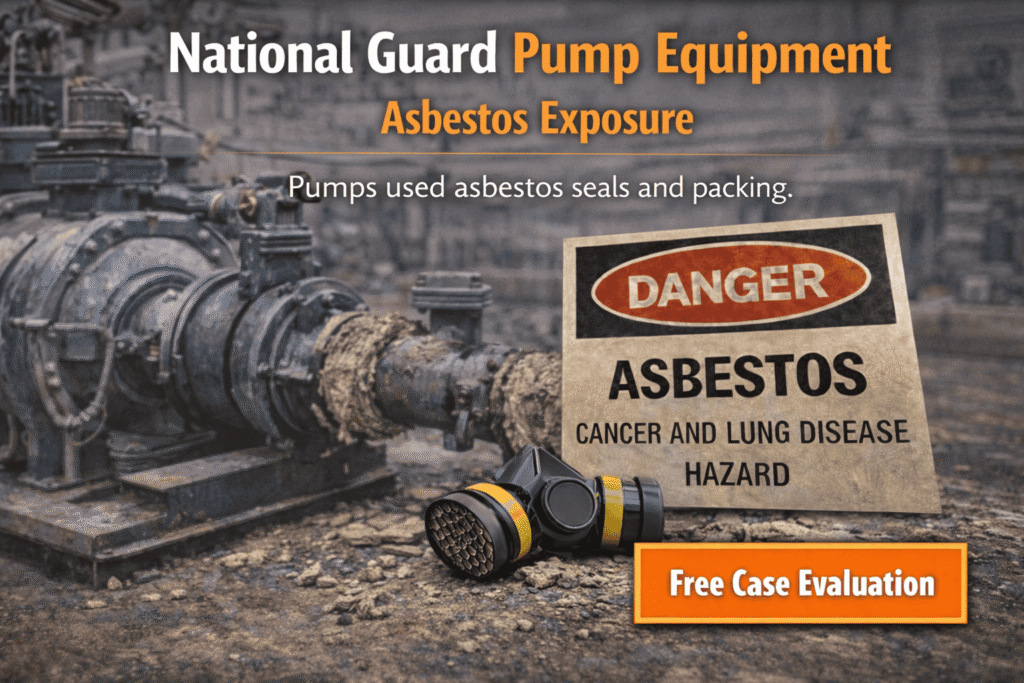
💧 National Guard Pump Equipment Asbestos Exposure
Pumps used asbestos seals, packing, gaskets, and insulation that exposed Guard members during installation, operation, and maintenance.
Pump equipment was essential across National Guard facilities, supplying water, fuel, chemicals, steam, and wastewater to armories, training centers, medical facilities, aircraft hangars, power plants, and emergency response systems. From the 1940s through the 1980s, asbestos was routinely incorporated into pump systems because of its heat resistance, durability, and ability to withstand pressure and corrosive fluids.
As a result, asbestos-containing materials were present in pump housings, seals, packing, gaskets, insulation, and nearby piping. Guard members and civilian workers were exposed during routine pump operation, inspections, repairs, overhauls, and emergency maintenance, often in confined mechanical spaces with limited ventilation.
🧱 Why Asbestos Was Used in National Guard Pump Equipment
Pumps operate under constant friction, pressure, and heat. Asbestos was used because it:
-
🔥 Resisted heat generated by rotating shafts
-
⚙️ Reduced friction in seals and packing
-
🧱 Withstood pressure and corrosive fluids
-
🚒 Added fire resistance in fuel and boiler systems
-
🔩 Improved durability of gaskets and joints
These properties made asbestos standard in both industrial and military pump systems.
🚧 Common Asbestos-Containing Pump Components
National Guard pump equipment frequently contained asbestos in:
-
🔩 Shaft packing and rope seals
-
⚙️ Pump gaskets and flange seals
-
🔥 Thermal insulation on pumps and pipes
-
🧱 Fireproofing around pump rooms
-
🛢️ Valves and expansion joints connected to pumps
When these components aged or were disturbed, asbestos fibers became friable and airborne.
🔧 How Asbestos Exposure Occurred During Pump Work
Exposure occurred during routine maintenance and emergency repairs.
Common exposure scenarios included:
-
🧰 Removing and replacing pump packing
-
🔧 Scraping old gaskets from flanges
-
🧹 Cleaning pump housings and floors
-
🔥 Servicing pumps in boiler and fuel systems
-
🚨 Emergency repairs during leaks or failures
Because pump rooms were often enclosed, asbestos fibers accumulated quickly.
🎖️ Who Was Exposed to Pump Equipment Asbestos
Exposure extended beyond pump specialists.
Commonly exposed individuals include:
-
🎖️ National Guard maintenance personnel
-
🛠️ Mechanics and equipment technicians
-
🔌 Electricians working near pump systems
-
🧑🏭 Engineers overseeing mechanical operations
-
👨💼 Inspectors and supervisors
-
👨👩👧 Guard members assigned nearby
Even personnel without direct pump duties could inhale airborne fibers.
⚠️ Why Pump Asbestos Exposure Was Underrecognized
Pump-related asbestos exposure was often overlooked because:
-
❌ Asbestos packing was considered a routine consumable
-
❌ Dust was seen as normal mechanical debris
-
❌ Protective equipment was rarely provided
-
❌ Exposure occurred gradually over years
-
❌ Diseases developed decades later
Many veterans never realized pump maintenance involved asbestos.
🫁 Diseases Linked to Pump Equipment Asbestos Exposure
Exposure to asbestos from National Guard pump equipment has been linked to:
-
Mesothelioma
-
Asbestos-related lung cancer
-
Pleural plaques and pleural thickening
-
Asbestosis
Symptoms typically appear 20–50 years after exposure, long after Guard service ends.
⏳ Latency Period and Delayed Diagnosis
Pump equipment exposure often involved:
-
⏱️ Repeated low-level exposure
-
⏱️ No immediate symptoms
-
⏱️ Diagnosis decades later
Because pump work was considered ordinary maintenance, exposure was rarely recorded.
⚖️ Legal Responsibility for Pump Equipment Asbestos Exposure
Pump-related claims do not sue the National Guard itself.
Instead, claims target:
-
🏭 Pump manufacturers
-
🏭 Packing, gasket, and seal suppliers
-
🏭 Insulation and fireproofing manufacturers
Many of these companies later established asbestos trust funds to compensate exposed individuals.
Pump systems across facilities operated by the National Guard relied on these products for decades.
🧑⚖️ How a Lawyer Can Help Pump Exposure Victims
An experienced asbestos lawyer can:
-
🔍 Identify asbestos-containing pump components
-
📂 Review service records and duty locations
-
🏭 Match pump models to known asbestos products
-
🏦 File asbestos trust fund claims
-
⚖️ Pursue lawsuits against responsible manufacturers
-
👨👩👧 Assist families with wrongful death claims
Most cases are handled on a contingency basis — no upfront cost.
⌛ Statute of Limitations for Pump Equipment Claims
Deadlines vary by state but typically begin:
-
🩺 At date of diagnosis, or
-
⚰️ At date of death for wrongful death claims
Because asbestos diseases are diagnosed late, prompt legal review is critical.
❓ Frequently Asked Questions (FAQs)
❓ Did National Guard pumps really contain asbestos?
Yes. Packing, gaskets, and insulation commonly used asbestos.
❓ Can brief pump repairs cause exposure?
Yes. Confined pump rooms increase fiber concentration.
❓ Do I need proof of specific pump brands?
No. Lawyers use military equipment and facility records.
❓ Can non-mechanics file claims?
Yes. Environmental exposure is recognized.
❓ Can families file claims after death?
Yes. Wrongful death claims are common.
📞 Help for National Guard Veterans Exposed to Pump Equipment Asbestos
If you worked with or around National Guard pump equipment and later developed an asbestos-related disease, you may still have legal options today.
📌 You May Be Eligible For:
-
Asbestos trust fund compensation
-
Lawsuit settlements
-
VA disability benefits (if applicable)
-
Wrongful death compensation for families
📞 Call 800-291-0963 for a free, confidential National Guard pump exposure review
⏱️ No upfront costs • National Guard–focused claims • Nationwide representation
Keeping systems flowing should never cost you your health.