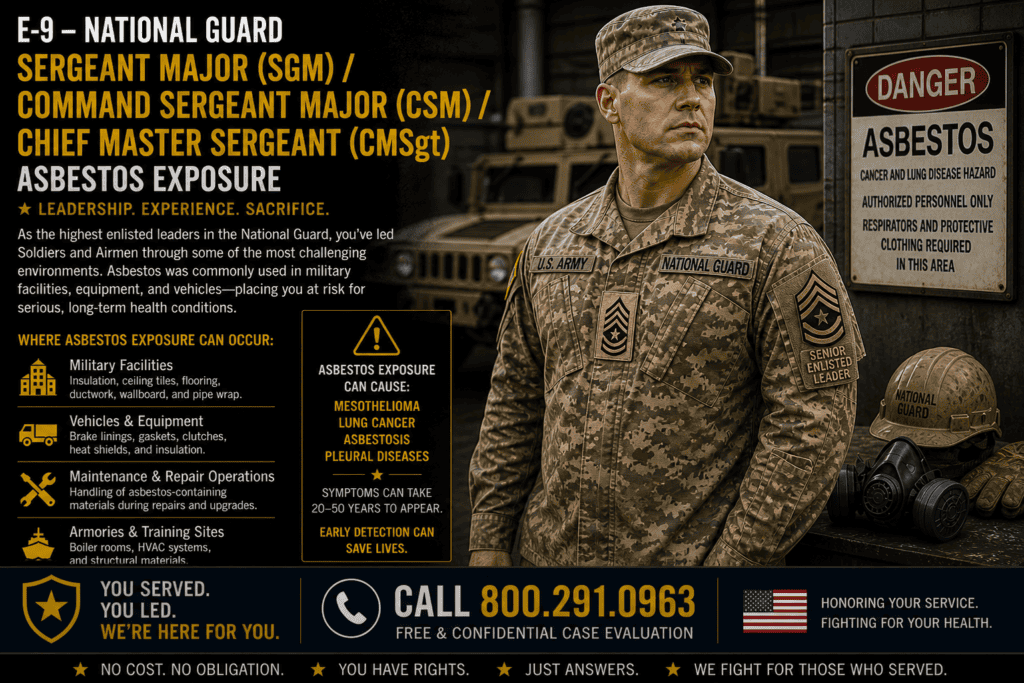
E-9 – Nat Guard Sergeant Major (SGM) / Command Sergeant Major (CSM) / Chief Master Sergeant (CMSgt)
🛠️ Highest enlisted leadership
Asbestos Exposure
⚠️ Long-term exposure across aging facilities
⚠️ Command centers with ACM floors and ceilings
Asbestos Exposure Risks for Senior Enlisted Leadership in the National Guard
An E-9 in the National Guard—Army Sergeant Major (SGM) or Command Sergeant Major (CSM), or Air Guard Chief Master Sergeant (CMSgt)—serves as the highest enlisted leader within their unit or wing. Their responsibilities include advising commanders, overseeing large-scale operations, supervising unit readiness, managing facilities at the installation level, and inspecting multiple buildings across the base. Because of these expansive duties, E-9 leaders accumulate decades of exposure to older National Guard facilities—many of which were built during heavy asbestos-use eras.
Command centers, headquarters buildings, readiness centers, drill halls, administrative facilities, and meeting rooms often contain asbestos in ceiling tiles, floor tiles, insulation, ductwork, and structural components. As senior leaders routinely walk these spaces, inspect conditions, and observe renovation or maintenance work, long-term cumulative exposure becomes unavoidable.
The Installation-Level Role of an E-9 in the National Guard
SGMs, CSMs, and CMSgts serve as the senior enlisted authorities, ensuring safe operations, functional training spaces, and effective infrastructure support.
Typical Responsibilities of a National Guard E-9 Include:
-
🏛️ assessing building readiness across the installation
-
📋 advising commanders on facility issues and operational risks
-
🛠️ supervising large maintenance or modernization efforts
-
🧱 overseeing renovation, repair, and construction projects
-
🧰 inspecting offices, training areas, and mechanical spaces
-
🪖 ensuring safe working environments for all personnel
-
🗂️ managing coordination between units and facility staff
-
🔧 evaluating long-term infrastructure needs
Because E-9 leaders enter numerous buildings and frequently inspect aging spaces, they face recurring exposure to deteriorated asbestos materials.
Why E-9 Personnel Faced Significant Asbestos Exposure
E-9 enlisted leaders regularly operate in:
-
headquarters and command centers
-
readiness centers
-
administrative buildings
-
large training halls
-
older armories
-
maintenance facilities
-
storage and logistics buildings
Many were constructed between the 1940s and 1980s, when asbestos was heavily used.
Exposure Source #1: Long-Term Exposure Across Aging Facilities
Over decades of service, senior enlisted leaders accumulate exposure by moving through multiple pre-1980 buildings that contain:
-
🧩 ceiling tiles
-
👣 vinyl floor tiles
-
🧱 drywall and joint compound
-
❄️ HVAC duct insulation
-
🔌 electrical panel insulation
-
♨️ steam line materials
How E-9 Leaders Are Exposed
SGMs, CSMs, and CMSgts frequently:
-
inspect facilities for readiness
-
evaluate safety or structural concerns
-
walk through buildings undergoing renovation
-
address maintenance complaints
-
attend meetings in older rooms
-
oversee training in asbestos-containing structures
Exposure is cumulative—years of brief contact add up significantly.
Exposure Source #2: Command Centers With ACM Floors and Ceilings
Command centers, drill halls, and HQ spaces often contain asbestos in:
-
ceiling panels
-
floor tiles and adhesives
-
wallboard compounds
-
HVAC returns
-
insulation behind panels
E-9 Exposure Occurs When:
-
checking command spaces before events
-
evaluating building conditions
-
supervising office remodeling
-
inspecting HVAC or wiring failures
-
entering ceilings or crawlspaces after water damage
Leadership requires repeated entry into buildings most personnel rarely see.
Exposure Source #3: Oversight of Renovation and Modernization Projects
Large-scale updates to old Guard buildings often involve:
-
tile removal
-
ceiling replacement
-
wiring upgrades
-
HVAC duct removal
-
demolition of outdated sections
Why E-9 Leaders Are at Risk
They often:
-
observe contractor activity
-
inspect renovation progress
-
evaluate safety prior to unit re-entry
-
assist in scheduling or approving construction tasks
Being physically present during or immediately after demolition exposes them to airborne fibers.
Exposure Source #4: Mechanical and Utility Room Inspections
Even though maintenance teams handle repairs, E-9 leaders still enter:
-
boiler rooms
-
electrical vaults
-
HVAC corridors
-
storage basements
-
steam line access areas
These are the highest-risk locations for asbestos fiber concentration.
Exposure Source #5: Multi-Installation Movement
Many E-9s serve at the state level or across multiple training locations.
Exposure compounds with each site visited:
-
regional training centers
-
storage depots
-
readiness centers
-
aviation facilities
-
logistics hubs
Every older building adds another layer of asbestos exposure.
Long-Term Health Risks for National Guard E-9 Personnel
Asbestos-related diseases typically appear 20–50 years after exposure.
Diseases Include:
-
🫁 Mesothelioma
-
🫀 Asbestos-related lung cancer
-
🌫️ Asbestosis
-
🩻 Pleural plaques and fibrosis
Because E-9 careers span decades, cumulative exposure is usually high.
VA Disability Benefits for E-9 Asbestos Exposure
The VA recognizes facility-based asbestos exposure for senior enlisted members.
Evidence That Strengthens a VA Claim:
-
📄 records showing service in older command or administrative buildings
-
🧱 documentation of facility inspections or oversight duties
-
💬 statements from officers, NCOs, or maintenance staff
-
📝 building age records showing ACM presence
-
🩺 medical evidence linking disease to exposure
Mesothelioma qualifies automatically for a 100% disability rating.
Asbestos Trust Fund & Legal Compensation for National Guard E-9 Veterans
Over $30 billion remains available in asbestos trust funds—funded by manufacturers, not the military.
Compensation Options Include:
-
💵 asbestos trust fund payouts
-
⚖️ product liability lawsuits
-
👨👩👧 survivor benefits
-
🎖️ VA disability benefits (collected separately from legal claims)
E-9 personnel frequently qualify due to long-term, multi-building exposure.
📞 Free Case Review for National Guard E-9 Veterans
If you served as an SGM, CSM, or CMSgt in the National Guard and later developed mesothelioma, asbestos lung cancer, or asbestosis, you may qualify for significant compensation.
📞 Call 800.291.0963 now for a free, confidential case review.
A specialist will help confirm your exposure history and guide you through every compensation path available.