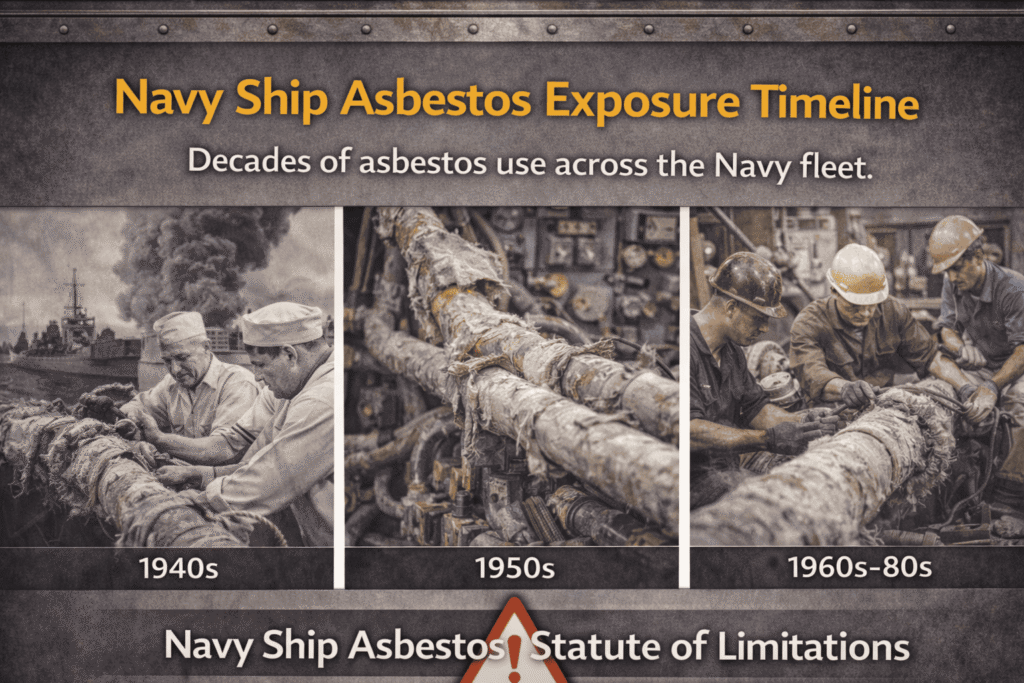
🕰️ Navy Ship Asbestos Exposure Timeline
For nearly a century, asbestos was used extensively across U.S. Navy ships—exposing generations of sailors to dangerous fibers long before the risks were acknowledged or controlled.
Asbestos use aboard Navy ships did not happen in isolated incidents. It followed a decades-long pattern driven by military demand for fire resistance, durability, and cost efficiency. From early 20th-century shipbuilding through the late Cold War era, asbestos was integrated into propulsion systems, machinery, living quarters, electrical components, and structural materials.
Understanding the timeline of Navy asbestos exposure helps veterans and families connect service history to modern diagnoses of mesothelioma, lung cancer, and other asbestos-related diseases—often appearing 30–50 years after exposure in the United States Navy.
⚓ Early 1900s–1930s: Introduction of Asbestos in Naval Shipbuilding
Asbestos began appearing in Navy ships as steel hulls and steam propulsion became standard.
Key developments:
-
🔥 Steam boilers and turbines required heat insulation
-
🧱 Fireproofing was added to bulkheads and decks
-
⚙️ Early pipe insulation used asbestos cloth and cement
-
🛠️ Shipyards adopted asbestos for durability and cost
At this stage, asbestos was viewed as a miracle material, with no health warnings.
⚔️ 1940s: World War II and Peak Asbestos Use
World War II marked the largest expansion of asbestos use in Navy history.
During this period:
-
⚓ Thousands of ships were built rapidly
-
🔥 Boilers, turbines, and pipes were fully asbestos-insulated
-
🧯 Spray-on asbestos fireproofing was widely applied
-
🛏️ Living quarters used asbestos ceiling and floor materials
-
🛠️ Sailors and shipyard workers handled asbestos daily
Protection was minimal, and exposure affected entire crews, not just engineers.
🧰 1950s–1960s: Cold War Expansion and Continued Exposure
Despite early medical warnings in civilian industries, asbestos use continued.
Common exposure sources:
-
⚙️ Maintenance and repair of aging WWII-era ships
-
🧱 Replacement of asbestos insulation and gaskets
-
🛠️ Frequent shipyard overhauls
-
🛏️ Continued asbestos use in living spaces
-
🔌 Electrical systems with asbestos insulation
Most sailors during this era were never warned about asbestos risks.
🚢 1970s: Awareness Grows, Use Slowly Declines
Scientific evidence linking asbestos to cancer became undeniable.
Changes during this decade:
-
⚠️ Growing awareness of asbestos health risks
-
🧾 Initial Navy safety guidelines introduced
-
🧱 Gradual reduction in some asbestos products
-
🛠️ Existing asbestos left in place aboard ships
Exposure continued because older ships and materials remained active.
🚫 1980s–1990s: Regulation and Phase-Out
By the 1980s, asbestos use was sharply restricted.
Key shifts:
-
❌ New ship construction avoided asbestos where possible
-
🔄 Asbestos removal during major refits
-
🧯 Safer substitute materials adopted
-
⚓ Older ships still contained legacy asbestos
Veterans who served even briefly during this period may still have been exposed.
🫁 2000s–Present: Long-Latency Diseases Emerge
Asbestos diseases often appear decades after exposure.
Current realities:
-
⏳ Veterans diagnosed 30–50 years after service
-
🧬 Mesothelioma cases peak long after exposure era
-
👨👩👧 Families face secondhand exposure diagnoses
-
⚖️ Legal and VA claims increase as awareness grows
Many veterans are only now learning that shipboard asbestos caused their illness.
🧱 Which Sailors Were Exposed Across the Timeline?
Exposure was not limited to one rating or era.
High-risk groups included:
-
⚙️ Machinist mates, boiler technicians, pipefitters
-
🔧 Hull maintenance and damage controlmen
-
🔌 Electricians and mechanics
-
🛏️ Sailors living in asbestos-lined quarters
-
👨👩👧 Family members exposed secondhand
Even brief service aboard certain ship classes could result in exposure.
⚠️ Why the Timeline Matters for Legal and VA Claims
The exposure timeline helps establish:
-
📄 When and how exposure occurred
-
🧠 The long latency between service and disease
-
⚖️ Why claims are valid decades later
-
🏦 Eligibility for trust funds and lawsuits
-
🏛️ Service connection for VA benefits
Courts and the VA rely heavily on historical asbestos usage records.
🧑⚖️ How a Lawyer Uses the Exposure Timeline
An experienced asbestos lawyer can:
-
🔍 Match service dates to known asbestos usage periods
-
⚓ Identify ship classes and refit eras
-
🏭 Connect exposure to specific manufacturers
-
🧾 Support trust fund and lawsuit filings
-
⚖️ Coordinate claims with VA benefits
-
👨👩👧 Assist families with wrongful death cases
Veterans do not need to recall exact materials—the timeline does the work.
❓ Frequently Asked Questions (FAQs)
❓ I served briefly—does the timeline still matter?
Yes. Even short service during high-use periods can establish exposure.
❓ What if I served after asbestos use declined?
Older ships still contained asbestos well into the 1980s and beyond.
❓ Does the VA recognize this exposure history?
Yes. Shipboard asbestos exposure is widely accepted.
❓ Can families use this timeline in claims?
Yes. It helps establish secondhand and wrongful death claims.
❓ Why am I being diagnosed now?
Asbestos diseases have very long latency periods.
📞 Get Help Connecting Your Service to Today’s Diagnosis
If you or a loved one served aboard a U.S. Navy ship during any period when asbestos was used—and were later diagnosed with mesothelioma or another asbestos-related disease—the timeline supports your right to compensation.
📌 You May Be Eligible For:
-
Asbestos trust fund compensation
-
Mesothelioma and lung cancer lawsuits
-
VA disability and survivor benefits
-
Wrongful death claims for families
📞 Call 800-291-0963 for a free, confidential Navy asbestos exposure timeline review
⏱️ No upfront costs • Timeline-based case analysis • Nationwide representation
History explains exposure. The law provides the remedy.