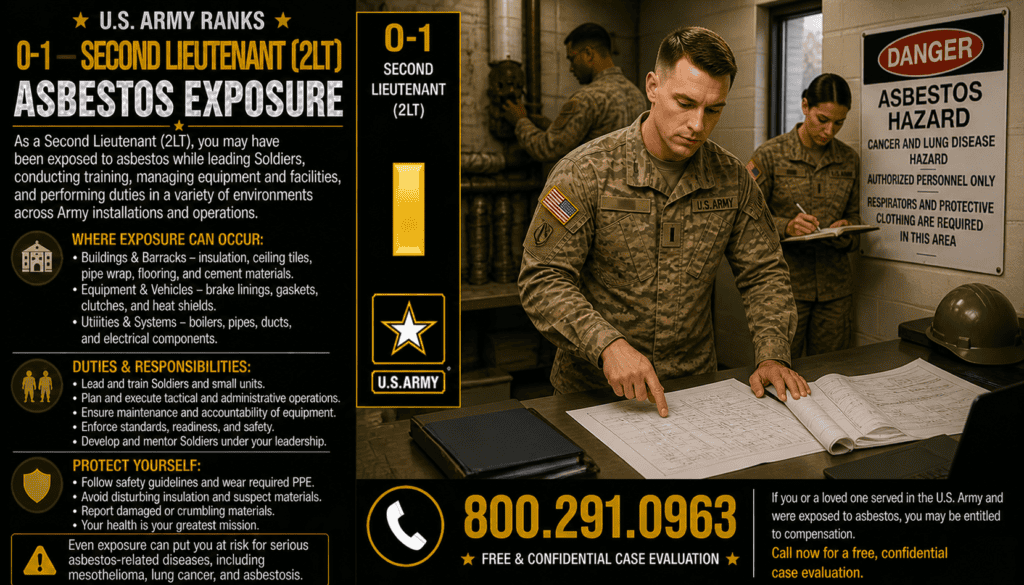
⚠️ O-1 Army Second Lieutenant (2LT) Asbestos Exposure
Risks for Newly Commissioned Officers
For decades, U.S. Army installations—especially those built between the 1940s and late 1980s—relied heavily on asbestos-containing materials (ACM) in classrooms, training facilities, mechanical rooms, steam systems, motor pools, and administrative buildings. Newly commissioned officers entering the Army as Second Lieutenants (2LTs) often served, trained, and worked inside these contaminated environments during their initial assignments.
Although 2LTs are typically focused on platoon leadership and junior officer development—not hands-on mechanical repairs—their daily presence in older barracks, training wings, mechanical rooms, and administrative buildings placed them at ongoing risk for inhaling airborne asbestos fibers. Many Army officers who later developed mesothelioma or asbestos-related lung cancer were exposed unknowingly during their earliest years in service.
This page explains precisely how O-1 Second Lieutenants encountered asbestos, why leadership roles still carried exposure risk, and what compensation options exist for veterans and families.
🛠️ Typical Duties of an Army Second Lieutenant (2LT)
O-1 Second Lieutenants are the Army’s entry-level commissioned officers, responsible for foundational leadership roles such as:
-
Leading a platoon of 20–40 soldiers
-
Overseeing training, readiness, and daily operations
-
Managing personnel, records, and administrative tasks
-
Working inside training centers, motor pools, and company headquarters
-
Conducting inspections and safety reviews
-
Supervising maintenance activities carried out by enlisted personnel
-
Participating in field training exercises and technical instruction
These duties required 2LTs to spend extensive time inside facilities that historically contained asbestos.
🧱 Asbestos Exposure Risks for O-1 Second Lieutenants
Training Rooms and Instruction Facilities (Primary Exposure)
Most Army training centers built prior to modern asbestos regulations used ACM in:
-
Ceiling tiles
-
Floor tiles and black mastic
-
HVAC insulation
-
Pipe and duct insulation
-
Fireproofing spray
-
Wallboard joint compound
-
Classrooms, briefing halls, and indoor instruction areas
As asbestos materials deteriorated, classroom dust circulated through ventilation systems—prolonged daily exposure for 2LTs attending:
-
Leadership courses
-
Branch qualification training
-
Maintenance instruction briefings
-
New officer orientations
Even when no visible dust was present, fibers circulated in the air.
Mechanical Rooms and Utility Areas
As junior officers, 2LTs frequently conducted inspections and leadership checks in facilities that contained:
-
Boiler rooms
-
Steam lines
-
HVAC units
-
Power distribution rooms
-
Mechanical basements
-
Utility corridors
These areas commonly had:
-
Pipe insulation
-
Boiler insulation
-
Steam line wrapping
-
Asbestos gaskets and heat shields
Routine foot traffic or renovations disturbed these materials, sending fibers airborne.
Company Headquarters & Administrative Areas
Even administrative areas had asbestos in:
-
Floor tiles
-
Sound-proofing materials
-
Ceiling panels
-
Fire-resistant wallboard
-
HVAC duct lining
2LTs worked inside these offices for long hours daily.
Motor Pool Proximity Exposure
Although officers rarely performed mechanical labor, 2LTs often:
-
Supervised motor pool operations
-
Conducted walkthrough inspections
-
Attended maintenance briefings
-
Oversaw readiness checklists
Motor pools contained asbestos in:
-
Brake pads
-
Clutch systems
-
Engine gaskets
-
Heat shields
-
Pipe insulation in mechanical rooms
-
Cement paneling and wall insulation
Friction dust from brake work alone created dangerous airborne exposure.
✈️ Why Newly Commissioned Officers Still Faced Asbestos Hazards
Many officers assume their exposure was minimal, but O-1 duties put them at risk because:
-
Training facilities were among the oldest and most asbestos-filled buildings on Army posts
-
2LTs spent long hours inside administrative rooms with deteriorating tiles and insulation
-
Mechanical rooms were routinely entered during safety checks and facility walkthroughs
-
Renovations of older buildings created high-fiber dust clouds
-
Asbestos-containing piping ran through many common areas
-
HVAC systems circulated fibers throughout entire officer workspaces
Even without hands-on mechanical work, 2LTs experienced cumulative exposure simply by working in affected buildings daily.
🏛️ Common Asbestos-Containing Materials Encountered by 2LTs
Building Construction Materials
-
Vinyl asbestos tile (VAT)
-
Acoustic ceiling tiles
-
Black mastic flooring adhesive
-
Cement sheets
-
Fireproof wallboard
-
Joint compound
-
Spray-applied insulation
Mechanical & Utility System Materials
-
Pipe and boiler insulation
-
Steam line wrapping
-
HVAC duct insulation
-
Electrical insulation boards
-
Fireproof barriers
Motor Pool ACM
-
Brake linings
-
Clutch discs
-
Engine gaskets
-
Heat shields
-
Thermal wraps
2LTs were often present during inspections or supervisory activities near these materials.
📈 Why O-1 Asbestos Exposure Creates Strong VA & Legal Claims
O-1 exposures are significant because:
-
2LTs spend extensive time in older training buildings and headquarters
-
Many served in barracks and admin wings built before 1980
-
Numerous officer entry courses were held in ACM-heavy facilities
-
Renovation projects disturbed asbestos
-
Exposure occurred early in the career—giving asbestos decades to cause disease
-
Officer duty assignments are well-documented in service records
Even low-level exposure over several years can lead to mesothelioma decades later.
📊 How O-1 Exposure Is Proven for VA Disability & Legal Claims
Claims specialists use:
-
Duty assignment history
-
Facility construction dates
-
Army environmental surveys
-
Unit infrastructure records
-
Building renovation logs
-
Inspection histories
-
MOS and branch training location data
2LTs do not need to remember specific materials—documentation establishes the exposure.
📚 Real Examples of Officer-Level Asbestos Exposure
Case 1 — 2LT Assigned to Training Battalion HQ
Exposure: Deteriorating floor tile & HVAC duct insulation
Compensation: $2.6 million
Case 2 — 2LT in Engineer Branch School
Exposure: Mechanical rooms and steam pipe insulation
Compensation: $2.9 million
Case 3 — 2LT In Motor Pool Oversight Role
Exposure: Brake and gasket dust contamination
Compensation: $2.3 million
Case 4 — 2LT in WWII-Era Barracks During Basic Officer Training
Exposure: Ceiling tile and wallboard decay
Compensation: $2.5 million
🧭 How O-1 Veterans Prove Exposure
Even officers who served briefly as 2LTs can qualify.
Exposure is established by:
-
Identifying the specific installation
-
Reviewing when the facility was constructed
-
Examining environmental reports
-
Linking building materials to ACM usage
-
Matching training timelines with known contaminated buildings
-
Reviewing renovation records
This creates a complete exposure pathway.
💙 Benefits Available to O-1 Veterans with Asbestos Diseases
VA Disability Benefits
-
Mesothelioma = automatic 100% rating
-
Lung cancer often qualifies
Asbestos Trust Funds
Over $30 billion remains available.
Legal Claims
Filed against product manufacturers—not the Army.
VA DIC for Families
Provides lifetime monthly benefits for survivors.
❓ Frequently Asked Questions — O-1 Asbestos Exposure
I only served briefly as a 2LT. Can I still qualify?
Yes. Even short exposures are medically significant.
I worked mostly in offices. Could I still have been exposed?
Absolutely—office buildings contained asbestos in floors, ceilings, and ventilation.
Do I need proof of specific training rooms?
No. Specialists obtain building records.
Can my family file after my death?
Yes—DIC and trust funds remain available.
🏅 Why Army Officers Trust Mesothelioma Help Center
-
25+ years identifying Army facility asbestos exposures
-
Access to historic construction and environmental records
-
Deep expertise in officer-level claim development
-
Millions recovered for Army leaders and their families
-
No fees unless compensation is awarded
📞 Get Help Identifying Your Asbestos Exposure as an O-1 Army Second Lieutenant
Even brief service as a Second Lieutenant can lead to asbestos diseases decades later. Specialists can identify exposures from training buildings, headquarters facilities, and mechanical rooms—even if you do not remember asbestos at all.
📞 Call 800.291.0963 for a free exposure review.