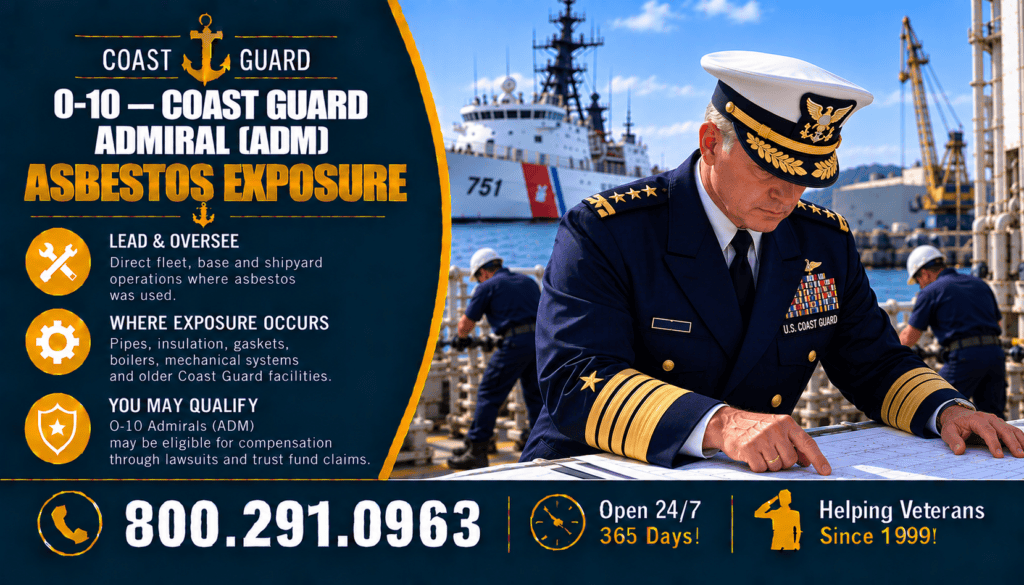
O-10 – Coast Guard Admiral (ADM) Asbestos Exposure
⚠️ Asbestos Risks for Coast Guard Admirals (ADM)
The rank of Admiral (O-10) is the highest attainable rank in the United States Coast Guard. Admirals serve as the Commandant of the Coast Guard, Deputy Commandant, Area Commanders, or senior leaders at the national and international level. They oversee the entire service’s mission execution, modernization, operational strategy, readiness, acquisitions, and organizational direction.
Although Admirals do not perform hands-on mechanical work or daily shipboard duties, their long, multi-decade careers place them repeatedly in environments where asbestos was used extensively—from the 1950s through the 1980s and even into the early 1990s. Asbestos was built into cutters, base facilities, headquarters structures, hangars, training centers, shipyards, and district offices. Simply living, working, and conducting inspections in these spaces can lead to significant long-term environmental asbestos exposure.
Because asbestos diseases (such as mesothelioma) often take 40–50 years to develop, many retired Admirals are only now experiencing symptoms and discovering possible exposure from early and mid-career assignments.
This page details how exposure occurs, why it applies even to senior flag officers, and what compensation options are available.
🛠 Typical Duties of a Coast Guard Admiral (ADM)
Overall Command of the United States Coast Guard
As Commandant or senior flag leader, an Admiral oversees:
-
All nationwide Coast Guard operations
-
Maritime safety and search-and-rescue programs
-
National security missions
-
Cutter fleet operations
-
Aviation operations
-
Logistics and engineering readiness
-
Training and personnel
-
Modernization and acquisitions
-
Shore infrastructure and support
This role requires extensive travel and presence inside the full operational spectrum of Coast Guard facilities—many of which were built during the height of military asbestos use.
Oversight of the Entire Cutter Fleet
Admirals frequently visit:
-
National Security Cutters
-
Medium Endurance Cutters
-
High Endurance Cutters
-
Offshore Patrol Cutters
-
Icebreakers
-
Support vessels
Many legacy cutters contain asbestos in:
-
insulation blankets
-
bulkhead panels
-
deck tile and adhesives
-
engine-room lagging
-
pump and valve packing
-
boiler systems
-
ventilation ducts
Admirals enter these spaces during readiness visits, command walkthroughs, and operational inspections.
Direct Supervision of Aviation Units & Air Stations
ADM responsibilities include oversight of:
-
helicopter air stations
-
fixed-wing aviation command centers
-
search-and-rescue hangars
-
aviation logistics facilities
-
avionics repair shops
Hangars and aviation buildings historically contained:
-
asbestos ceiling tiles
-
brake and clutch components
-
electrical insulation
-
fireproof coatings
-
engine heat shields
-
aging insulation blankets
These areas shed asbestos fibers when deteriorating, drilled, opened, or repaired—exposing personnel walking through them, including flag officers.
Leadership of Districts, Areas & National Headquarters
Admirals spend significant time in:
-
District offices
-
Area headquarters
-
National Command Center
-
Headquarters complexes
-
Operational policy centers
-
Secure communication facilities
Many of these buildings were constructed between 1940–1980 and were built with ACM such as:
-
floor tiles
-
ceiling panels
-
structural insulation
-
HVAC duct linings
-
boiler-room insulation
-
acoustical wallboard
-
mastic adhesives
Daily presence in these buildings—often for years—creates chronic asbestos exposure.
Participation in Shipyard, Drydock & Modernization Programs
As the service’s top leaders, Admirals tour:
-
major shipyards
-
drydock modernization projects
-
cutter refits
-
pre-commissioning cutter inspections
-
hull, machinery, and piping renovations
Shipyards represent the highest-risk asbestos environments, with fibers released during:
-
boiler removals
-
pipe lagging tear-outs
-
hull cutting
-
compartment demolition
-
sanding or grinding ACM
-
turbine insulation replacement
Even brief walkthroughs in “hard-hat zones” can result in inhalation of disturbed asbestos fibers.
Career Progression Through Earlier, High-Risk Assignments
Before reaching O-10, Admirals often serve for 25–35 years as:
-
junior officers aboard cutters
-
department heads (LT, LCDR)
-
executive officers and commanding officers (CDR, CAPT)
-
aviation or cutter leadership
Many of these assignments include:
-
living aboard older cutters
-
sleeping in berthing compartments with ACM
-
working in command centers with aging ceiling tile
-
walking engineering spaces
-
spending years in asbestos-filled district offices
Thus, by the time they become Admirals, their asbestos exposure has accumulated from decades of lower-level roles.
🧱 Asbestos Exposure Risks for Coast Guard Admirals (ADM)
1. Headquarters & District Office Exposure
Older headquarters buildings contained:
-
asbestos floor tile
-
ceiling panels
-
ventilation insulation
-
boiler systems
-
fireproof walls
Admirals often spend several tours—or entire careers—inside these buildings.
2. Frequent Cutter Walkthroughs and Command Visits
Even if only occasionally entering engineering spaces, older cutters contain asbestos in:
-
bulkheads
-
engine rooms
-
propulsion systems
-
pipe insulation
-
heat shielding
Just walking through these areas adds to lifetime exposure.
3. Shipyard and Drydock Presence
Shipyards disturb the most ACM, and Admirals often visit during:
-
budget inspections
-
modernization updates
-
commissioning visits
-
readiness reviews
Disturbed asbestos fibers can remain suspended for hours—exposing anyone present.
4. Long-Term Occupancy in Sector and Base Buildings
Sector buildings often contained ACM, especially in:
-
ventilation
-
heating ducts
-
boiler rooms
-
ceiling tiles
-
wall panels
Years spent inside these offices create chronic exposure.
5. Aviation Facility Exposure
Air stations historically used asbestos in:
-
hangar insulation
-
avionics shop walls
-
brake systems
-
clutch and friction components
Flag officers routinely walk through these spaces during inspections.
📊 Why Admirals Have Strong Asbestos Claims
✔ Multi-decade exposure timeline
ADM careers often span the exact decades when asbestos use was highest.
✔ Documented asbestos in Coast Guard infrastructure
Thousands of pages of engineering logs confirm heavy ACM use until 1991.
✔ Environmental exposure qualifies
Admirals do not need mechanical responsibilities to have been exposed.
✔ Annual and quarterly inspections placed them in high-risk areas
Engineering spaces, hangars, and shipyards produce the highest fiber levels.
✔ Long-term office exposure is medically significant
Asbestos circulates through ventilation systems, even in administrative buildings.
📂 Evidence That Helps Admirals Prove Asbestos Exposure
📘 Service Assignment Records
Matches time periods and duty locations to known ACM facilities.
📄 Base & Cutter Engineering Documents
Show asbestos installation locations and materials used.
🛳 Drydock & Renovation Logs
Provide proof of disturbed asbestos during their visits.
👨✈️ Witness Statements
Officers and enlisted crew may verify the Admiral’s presence during ACM-heavy operations.
💼 Sample Compensation Outcomes (Comparable High-Ranking Veterans)
-
$4.8 million — Senior flag officer exposed in shipyards and HQ buildings
-
$4.5 million — Cutter and aviation leader exposed across career
-
$4.2 million — High-ranking staff officer exposed through decades of environmental exposure
These amounts represent combined trust fund and legal settlements.
💙 Benefits Available to Coast Guard Admirals With Asbestos Illness
💵 Asbestos Trust Funds
Part of the national $30+ billion system.
⚖ Lawsuits Against Manufacturers
Claims are filed against asbestos manufacturers, not the Coast Guard.
❤️ VA Disability Benefits
Mesothelioma is almost always rated 100% disability.
👨👩👧 Survivor Benefits (DIC)
Available to families if the ADM passed away from asbestos-related disease.
📞 Free Asbestos Exposure Case Review for Coast Guard Admirals (ADM)
If you or a loved one served as a Coast Guard Admiral and later developed mesothelioma, asbestos-related lung cancer, or another asbestos illness, you may qualify for substantial compensation.
📞 Call 800.291.0963 for a free, confidential case review.
You’ll speak with a real mesothelioma case specialist who understands Coast Guard leadership roles and lifelong exposure patterns.