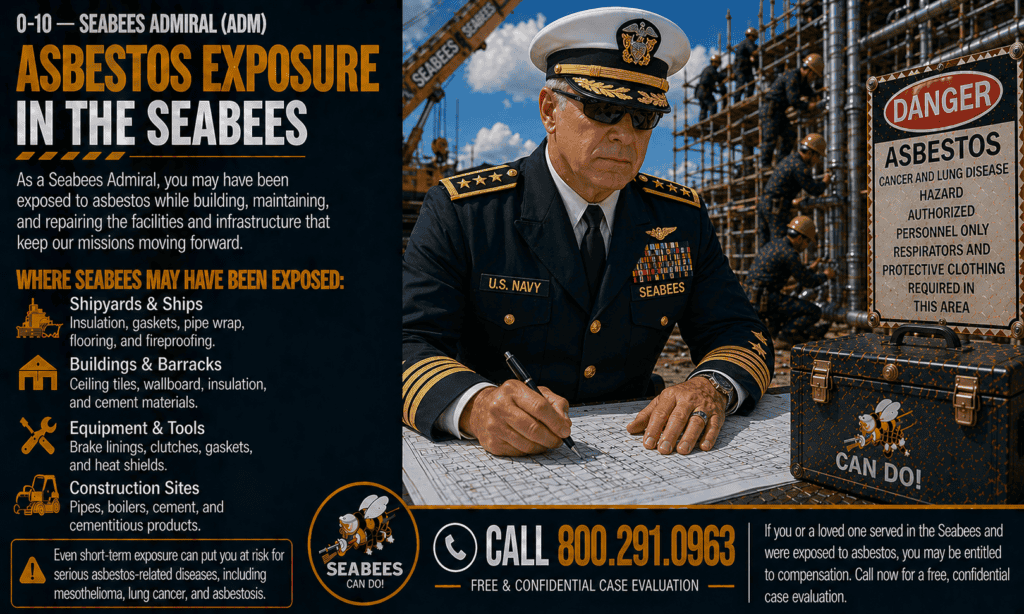
O-10 — Seabees Admiral (ADM) Asbestos Exposure
Typical Duties
🛠️ Senior Navy engineering leadership
Asbestos Exposure
Long-term presence in older command facilities
Aging infrastructure with ACM
Administrative complexes built before asbestos restrictions
Asbestos Exposure Risks for Seabees Admiral (ADM)
A Seabees Admiral (ADM) represents the highest level of engineering command within the United States Navy, responsible for directing global Naval Construction Force (NCF) operations, overseeing Navy-wide infrastructure strategy, setting engineering doctrine, shaping modernization initiatives, and leading the Civil Engineer Corps at the strategic level. Admirals make decisions that impact fleet readiness, long-term military construction programs, global basing, and major Department of Defense infrastructure policies.
Despite holding the highest leadership positions, Admirals faced substantial asbestos exposure throughout their careers due to decades spent working in pre-1980 Navy headquarters, administrative complexes, command facilities, and operational buildings where asbestos-containing materials (ACM) were widely used. Admirals frequently conducted inspections, attended high-level planning meetings, oversaw modernization efforts, and reviewed infrastructure conditions in buildings constructed with asbestos before restrictions were enacted.
This page details:
✔ The global engineering leadership role of a Seabees Admiral
✔ How older command facilities contributed to asbestos exposure
✔ Common ACM sources in administrative buildings and mechanical areas
✔ Long-term health risks associated with ADM-level careers
✔ Eligibility for VA disability, trust funds, and legal compensation
The Highest Level of Engineering Command in the U.S. Navy
As O-10 Flag Officers, Admirals lead the strategic direction of Navy engineering forces and infrastructure operations worldwide.
Typical Responsibilities Include:
Leading global Naval Construction Force operations
Setting engineering and infrastructure policy for the entire Navy
Commanding enterprise-level engineering and facilities organizations
Reviewing readiness and infrastructure condition reports from major regions
Overseeing billion-dollar construction and modernization initiatives
Directing environmental, safety, and facility management standards
Coordinating with joint military commands, federal agencies, and allies
Supervising RADMs, senior CEC officers, and major command staffs
Conducting strategic inspections of bases and engineering installations
Guiding humanitarian, expeditionary, and global construction operations
These responsibilities placed Admirals inside older command buildings and engineering centers where ACM remained present for decades.
Why Seabees Admirals Faced Significant Asbestos Exposure
Asbestos was widely used in Navy infrastructure built from WWII through the late 1970s. Admirals—who spent long periods working in these buildings during their rise to senior leadership—were exposed repeatedly across multiple decades.
Common sources of exposure included:
Pre-1980 command headquarters
Planning and administrative centers
Older Seabees facilities
Utilities and mechanical rooms
HVAC and power distribution centers
Barracks, warehouses, and support buildings
Exposure occurred during:
Strategic oversight visits
Infrastructure reviews
Command briefings
Inspection tours
Modernization evaluations
Facility damage assessments
With careers often spanning 30–40 years, cumulative exposure becomes medically significant.
Exposure Source #1: Older Command Facilities
Admirals spent years in administrative and command complexes where ACM was found in:
Ceiling tile
Vinyl asbestos tile (VAT)
Wallboard and plaster
Pipe insulation
Duct lining
Electrical panel insulation
Fireproof coatings
Transite walls and partitions
Aging ventilation systems frequently circulated asbestos dust throughout office environments.
Exposure Source #2: Aging Infrastructure and ACM Systems
Admirals regularly evaluated and reviewed:
Boiler plants
Steam distribution systems
Mechanical rooms
Utility corridors
HVAC systems
Electrical vaults
Power-generation facilities
These facilities contained high concentrations of ACM such as:
Pipe wrap
Boiler refractory materials
Thermal insulation
Valve and pump gaskets
Breaker backboards
High-temperature insulation
Brief visits during inspections—multiplied over a long career—added meaningful exposure.
Exposure Source #3: Administrative Complexes Built Before Asbestos Restrictions
Most Navy administrative centers used extensively by senior leadership included:
Asbestos ceiling and flooring materials
Cement board wall systems
Fireproof doors
Insulated piping
HVAC interior insulation
Plaster and joint compounds
Admirals frequently worked in these buildings for daily command responsibilities.
Exposure Source #4: Oversight of Major Renovation & Modernization Projects
Admirals reviewed or approved major Navy-wide engineering programs, including:
Demolition of outdated structures
Modernization of command headquarters
Facility recapitalization
Mechanical and utilities infrastructure replacement
Roofing, siding, and structural upgrades
Asbestos abatement efforts
Site visits during renovation and modernization exposed Admirals to airborne fibers.
Exposure Source #5: Long-Term Career Exposure Across Multiple Commands
Admirals typically served several decades, progressing through ranks and assignments that placed them in:
Pre-1980 administrative buildings
Engineering command centers
Utilities and mechanical areas
Aging operational facilities
Shipyard support spaces
Training centers and field installations
Repeated exposure across worldwide commands compounded the health risks.
Long-Term Health Risks for Seabees Admirals
Asbestos exposure is cumulative. Illness may appear 20–50 years after initial contact.
Asbestos-related diseases affecting Admirals include:
Mesothelioma
Asbestos-related lung cancer
Asbestosis
Pleural plaques
Chronic breathing impairment
Senior officers often develop symptoms later in life due to long-term, low-level exposure.
VA Disability Benefits for ADM Asbestos Exposure
The VA recognizes that Navy flag officers frequently worked in asbestos-containing administrative and command buildings.
Admirals may qualify for:
100% VA disability for mesothelioma
Compensation for asbestos-related lung cancer
Ratings for asbestosis or pleural disease
Dependency and Indemnity Compensation (DIC) for survivors
Evidence That Strengthens Claims:
Leadership roles in pre-1980 military facilities
Engineering or infrastructure oversight duties
Multiple command tours across older installations
Medical documentation linking asbestos to illness
Asbestos Trust Fund & Legal Compensation
More than $30 billion is still available through asbestos trust funds.
Claims target asbestos manufacturers—not the U.S. Navy.
Seabees Admirals may qualify for:
✔ VA disability benefits
✔ Multiple asbestos trust fund claims
✔ Legal compensation from manufacturers
Senior officers often qualify for all three.
📞 Free Case Review for Seabees ADM Veterans
If you served as a Seabees Admiral and later developed mesothelioma, lung cancer, or another asbestos-related illness, you may be entitled to significant financial compensation.
📞 Call 800.291.0963 now for a free, confidential case review.