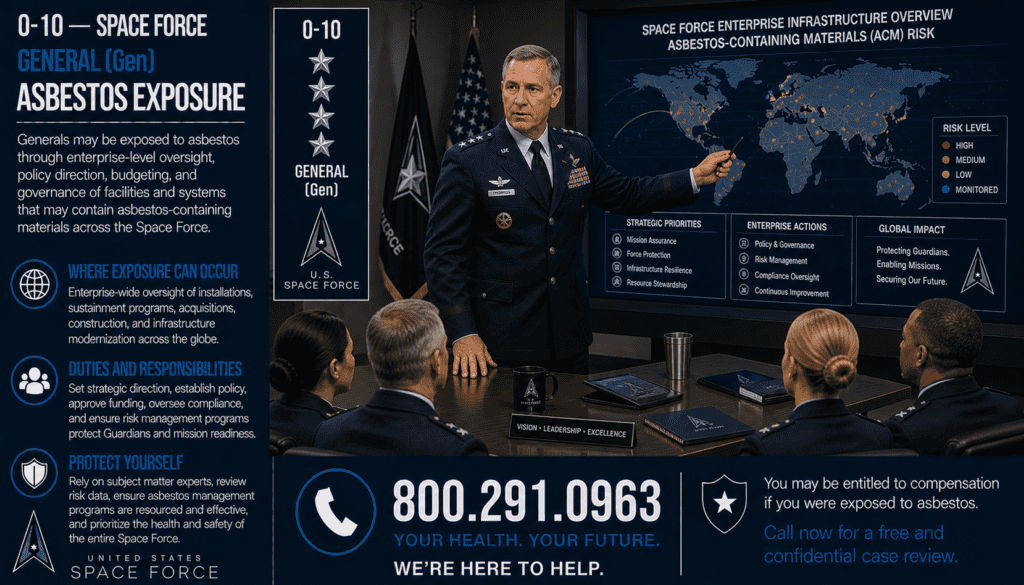
O-10 – Space Force General (Gen)
🛠️ Highest operational commander in the Space Force
Asbestos Exposure
⚠️ Historical base assessments
⚠️ Insulation in pre-1980 mission facilities
⚠️ Residual ACM in older operations centers
Asbestos Exposure Risks for Space Force Generals
A Space Force General (Gen) serves as a four-star officer and the highest operational commander within the United States Space Force. Generals provide strategic direction, oversee service-wide mission readiness, guide national security space operations, and supervise the organizational health of the entire force. Their responsibilities span policy development, infrastructure oversight, strategic planning, and cross-service coordination—frequently requiring travel to multiple bases and mission facilities.
Many legacy Air Force and Space Force installations still contain asbestos in mechanical rooms, communication centers, command facilities, hangars, administrative buildings, and mission support structures. Although Generals do not engage in hands-on maintenance, their leadership duties bring them into aging environments during inspections, readiness visits, facility evaluations, and crisis assessments—moments when airborne asbestos exposure is most likely.
The full scope of General-level service leadership
How historical and legacy space installations create asbestos exposure
Why top-level commanders remain vulnerable despite limited field duties
Long-term health dangers
VA disability, asbestos trust fund eligibility, and legal options
The Senior Command Role of a Space Force General
Generals oversee all aspects of Space Force readiness, strategic capability development, and mission success across multiple operational domains, including launch operations, satellite systems, missile warning, cyber defense, and space surveillance.
Typical Responsibilities of a Gen Include:
-
leading the highest operational commands in the Space Force
-
overseeing readiness and infrastructure across all major bases
-
conducting high-level inspections of mission facilities
-
reviewing modernization initiatives and environmental risks
-
supervising generals, commanders, and senior civilian leadership
-
shaping national space strategy and mission capability development
-
coordinating with the Department of Defense, Congress, and allied forces
-
assessing installation hazards and emergency response effectiveness
These responsibilities require frequent entry into older, historically significant space infrastructure.
Why Space Force Generals Faced Asbestos Exposure
Generals often visit:
-
historic Air Force command buildings
-
legacy satellite control centers
-
early-generation radar and surveillance facilities
-
older administrative headquarters
-
mechanical and HVAC infrastructures
-
pre-1980 mission support structures
Exposure occurs when airborne fibers from deteriorating asbestos-containing materials become disturbed during inspections or incident evaluations.
Exposure Source #1: Historical Base Assessments
Generals conduct broad-scope evaluations of entire installations, many of which contain aging asbestos materials from the 1940s–1980s.
Historical buildings contain ACM in:
-
wall and ceiling insulation
-
floor tiles and adhesives
-
fireproof structural coatings
-
mechanical ductwork
-
electrical system components
Exposure Happens When Generals:
-
perform installation-wide readiness visits
-
assess the condition of aging mission buildings
-
oversee strategic modernization initiatives
-
respond to structural, environmental, or operational incidents
Legacy structures often harbor undisturbed asbestos that becomes airborne during inspection activity.
Exposure Source #2: Insulation in Pre-1980 Mission Facilities
Earlier mission centers and control rooms relied heavily on asbestos for:
-
thermal insulation
-
soundproofing
-
equipment bay fireproofing
-
structural reinforcement
-
electrical protection
Generals Encounter Exposure When:
-
touring command facilities
-
walking through mechanical zones during evaluations
-
inspecting mission control environments
-
reviewing construction or renovation progress
Fiber release increases as materials age or degrade.
Exposure Source #3: Residual ACM in Older Operations Centers
Many long-standing operations centers used asbestos in:
-
ceiling tiles
-
communication room wallboard
-
old HVAC systems
-
server room flooring materials
-
electrical insulation components
Generals May Be Exposed When:
-
reviewing operational continuity or emergency readiness
-
entering restricted or aging control centers
-
participating in command-level facility assessments
-
inspecting secure operations environments requiring modernization
Residual contamination may persist for decades after installation.
Long-Term Health Risks for Space Force Generals
Asbestos-related diseases typically appear 20–50 years after exposure.
Major Conditions Include:
-
🫁 Mesothelioma
-
🫀 Asbestos-related lung cancer
-
🌬️ Asbestosis
-
🩻 Pleural plaques and fibrosis
Even limited exposure during inspections can result in serious disease.
VA Disability Benefits for Space Force Generals
Generals may qualify for VA disability benefits if diagnosed with an asbestos-related illness.
Evidence That Strengthens Claims:
-
official inspection records of legacy facilities
-
historical base construction or asbestos reports
-
command correspondence noting infrastructure risks
-
statements from aides or accompanying personnel
-
medical evidence linking disease to exposure
Mesothelioma automatically qualifies for 100% VA disability.
Asbestos Trust Fund & Legal Compensation
More than $30 billion remains available through asbestos trust funds.
Generals May Be Eligible For:
-
💵 asbestos trust fund payouts
-
⚖️ legal claims against asbestos product manufacturers
-
👨👩👧 survivor benefits
-
🎖️ VA disability benefits (independent of legal compensation)
Exposure largely stems from outdated Air Force infrastructure—not from Space Force operations.
📞 Free Case Review for U.S. Space Force Generals
If you served as a Space Force General and later developed mesothelioma, asbestos lung cancer, or asbestosis, you may qualify for compensation.
📞 Call 800.291.0963 today for a free, confidential case review.
A specialist will review your inspection history, base exposures, and service records to identify every available compensation pathway.