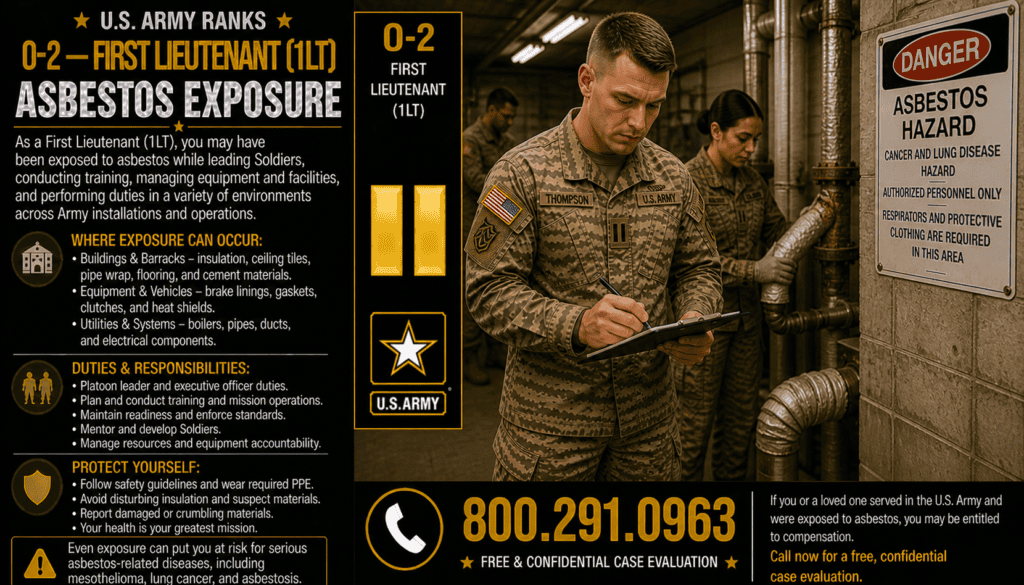
⚠️ O-2 – Army First Lieutenant (1LT) Asbestos Exposure
Risks for Executive Officers
Army First Lieutenants (1LTs) serve in critical leadership roles, most commonly as Executive Officers (XOs) responsible for overseeing company-level operations, facilities, logistics, and readiness. While 1LTs do not perform hands-on mechanical repairs, their responsibilities frequently required them to enter older buildings, mechanical rooms, utility spaces, and training facilities—many of which were constructed during the WWII, Korea, and Vietnam eras using heavy amounts of asbestos-containing materials (ACM).
Because 1LTs conduct facility inspections, readiness walkthroughs, building evaluations, barracks checks, and motor-pool oversight, they often encountered deteriorating asbestos in:
-
Ceiling tiles
-
Floor tile and black mastic
-
Steam lines
-
Boiler rooms
-
HVAC insulation
-
Mechanical basements
-
Electrical rooms
-
Barracks with aging construction materials
Today, many Army officers are being diagnosed with mesothelioma, asbestos-related lung cancer, and asbestosis due to these exposures—often from the very rooms and corridors they supervised as part of their XO duties.
🛠️ Typical Duties of an Army First Lieutenant (1LT)
1LTs typically serve as:
-
Company Executive Officers
-
Second-in-command to the Company Commander
-
Leaders overseeing supply, logistics, facility management, and readiness
-
Supervisors of daily operations across training, administrative, and mechanical areas
Their responsibilities include:
-
Conducting building inspections
-
Ensuring maintenance issues are identified and reported
-
Overseeing barracks conditions
-
Managing workspaces used by enlisted personnel
-
Conducting leadership walkthroughs in mechanical rooms, boiler areas, and storage wings
-
Monitoring training facilities for safety compliance
-
Evaluating older infrastructure for readiness concerns
These duties placed 1LTs in ACM-heavy buildings on a routine basis.
🧱 Asbestos Exposure Risks for O-2 First Lieutenants
Facility Inspections (Primary Exposure Pathway)
As Executive Officers, 1LTs performed scheduled and unscheduled inspections of:
-
Company headquarters
-
Administrative offices
-
Barracks
-
Motor pools
-
Supply rooms
-
Mechanical spaces
-
Training wings
-
Utility corridors
Many of these buildings contained asbestos in:
-
Ceiling panels
-
Floor tiles
-
Steam pipes
-
HVAC systems
-
Fireproof wallboard
-
Electrical panel insulation
-
Boiler room materials
Even short periods inside these rooms released airborne fibers.
Barracks and Office Building Exposure
Most barracks built from the 1940s through the 1980s contained:
-
Vinyl asbestos tile
-
Mastic adhesive
-
Acoustic ceiling tiles
-
Joint compound
-
Duct and pipe insulation
-
Cement board
-
Fire-resistant construction materials
1LTs often worked long hours inside these facilities as part of administrative and readiness duties.
Motor Pool & Mechanical Wing Inspections
Even though 1LTs did not perform repairs, they supervised areas containing:
-
Brake and clutch dust
-
Gaskets and heat shields
-
Engine compartment insulation
-
Steam line insulation
-
Wiring insulation in utility closets
-
Asbestos-lagged pipes
Friction materials—especially brakes—sent asbestos dust into motor pools daily.
Renovation Event Exposure
Renovations of older Army buildings are among the highest documented asbestos exposure events, and 1LTs were frequently present during:
-
HVAC overhauls
-
Ceiling tile replacements
-
Floor tile removals
-
Pipe repairs
-
Boiler room upgrades
-
Wallboard demolition
Even when work happened in adjoining rooms, airborne fibers traveled through hallways and ventilation.
✈️ Why Executive Officers Faced Significant Asbestos Risks
1LTs often underestimate their exposure because they were not mechanics—but XO duties placed them in some of the highest-risk areas on Army installations.
Reasons for high exposure include:
-
XOs routinely entered mechanical rooms
-
They were required to inspect older infrastructure
-
They spent long hours inside asbestos-filled headquarters buildings
-
They conducted readiness walkthroughs in contaminated facilities
-
They worked in barracks with aging construction materials
-
Renovation work occurred during many 1LT tours
-
Their role required frequent movement between multiple high-risk structures
Exposure was cumulative and occurred simply by breathing in older Army facilities.
🏛️ Common Asbestos-Containing Materials Encountered by 1LTs
Building Construction ACM
-
Floor tiles
-
Black mastic adhesive
-
Ceiling panels
-
Fireproof sheetrock
-
Cement board
-
Wall joint compound
-
Acoustic insulation
Mechanical & Utility ACM
-
Boiler and furnace insulation
-
Steam pipe wrap
-
Duct insulation
-
Electrical insulation boards
-
Fireproofing materials
Motor Pool ACM
-
Brake linings
-
Clutch facings
-
Engine gaskets
-
Thermal insulation around exhaust and engines
1LTs supervising these areas repeatedly inhaled airborne fibers.
📈 Why O-2 Exposure Creates Strong VA & Legal Claims
O-2-level exposure is medically and legally significant because:
-
Facility inspection duty records are clear and easy to verify
-
Headquarters and barracks exposures are well-documented
-
ACM materials were common in every type of building a 1LT inspected
-
Renovation events during O-2 service greatly increase exposure intensity
-
Even low-dose exposure can cause mesothelioma decades later
-
Officers often served 3–10 years before promotion, giving asbestos time to accumulate
These factors make First Lieutenant claims strong and well-supported.
📊 How O-2 Exposure Is Proven for VA Disability & Legal Claims
A 1LT does not need to identify specific asbestos materials.
Claims specialists prove exposure through:
-
Unit assignment records
-
Building construction dates
-
Army environmental surveys
-
Mechanical room schematics
-
Barracks infrastructure reports
-
Renovation logs
-
Technical manuals from your duty station
-
Asbestos abatement documents
-
Command inspection checklists
This information creates a full picture of your exposure.
📚 Real Examples of O-2 Asbestos Exposure Cases
Case 1 — 1LT XO Assigned to a Vietnam-Era Headquarters Building
Exposure: Ceiling tile and ductwork insulation
Compensation: $2.7 million
Case 2 — 1LT Overseeing Motor Pool Readiness
Exposure: Brake and clutch dust from multiple vehicle bays
Compensation: $2.5 million
Case 3 — 1LT Conducting Barracks Inspections
Exposure: Floor tiles, steam pipe insulation
Compensation: $2.4 million
Case 4 — 1LT Present During Facility Renovations
Exposure: Wallboard and HVAC demolition dust
Compensation: $2.6 million
🧭 How O-2 Veterans Prove Exposure Today
Exposure is easily documented through:
-
Training facility age
-
Type of buildings inspected
-
Maintenance history
-
HVAC system age
-
Known ACM materials from installation records
-
XO responsibilities that placed 1LTs in high-risk areas
-
Duration of service inside contaminated buildings
Because asbestos was so widespread, proving exposure is straightforward.
💙 Benefits Available to O-2 Veterans with Asbestos Diseases
VA Disability Benefits
-
Mesothelioma = automatic 100% VA disability rating
-
Many lung cancer cases qualify
Asbestos Trust Funds
Over $30 billion available for exposed veterans.
Legal Compensation
Filed against asbestos manufacturers—not the Army.
VA DIC Benefits for Families
Provides tax-free monthly compensation to survivors.
❓ Frequently Asked Questions — O-2 Asbestos Exposure
Do I qualify even if I never worked with asbestos?
Yes. Exposure came from buildings—not the materials themselves.
Was I exposed in training buildings?
Nearly all pre-1980 training centers contained asbestos.
Do I need proof of specific inspections?
No—XO duties alone verify exposure.
Can my family file a claim if I passed away?
Yes—trust funds and VA DIC are available.
🏅 Why Army Officers Trust Mesothelioma Help Center
-
25+ years researching Army facility asbestos exposure
-
Access to historic base construction and renovation records
-
Proven results for Army officers at every rank
-
No fees unless compensation is awarded
-
Comprehensive support for families
📞 Get Help Identifying Your Asbestos Exposure as an O-2 Army First Lieutenant
If you or a loved one served as an O-2 in the U.S. Army and later developed mesothelioma, asbestos lung cancer, or asbestosis, experts can identify your exact asbestos exposure from facility inspections, barracks, mechanical rooms, and more.
📞 Call 800.291.0963 for a free exposure review.