⚠️ O-3 – Army Captain (CPT): Asbestos Exposure
Risks for Company Commanders
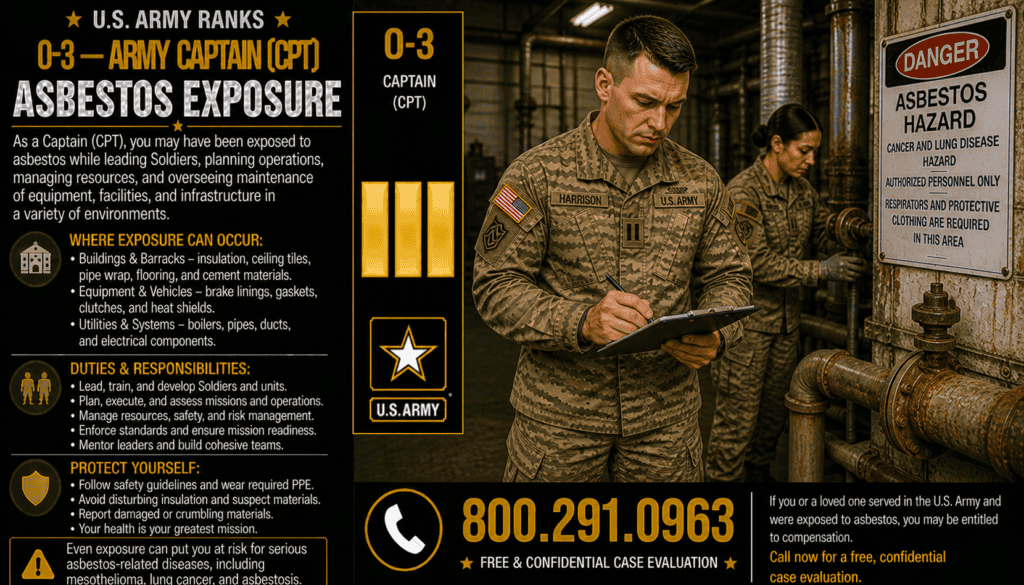
Army Captains (CPTs) carry one of the most demanding leadership roles at the company level—responsible for command operations, facility oversight, soldier welfare, and unit readiness. While CPTs rarely performed direct mechanical work, they spent extensive hours inside administrative buildings, barracks offices, headquarters sections, armories, and support facilities—many of which were constructed from the 1940s through the 1980s using large quantities of asbestos-containing materials (ACM).
Damaged insulation, aging ceiling tiles, deteriorating floor tiles, HVAC systems, and steam/boiler systems within these buildings exposed CPTs to airborne asbestos fibers daily. These exposures frequently occurred during:
-
Company commander walkthroughs
-
Inspections of administrative and training areas
-
Leadership meetings inside pre-1980 facilities
-
Renovation activities
-
Movement through mechanical basements, utility doors, and maintenance wings
Today, many former Captains are being diagnosed with mesothelioma, asbestos lung cancer, and asbestosis—diseases that trace back to prolonged exposure inside Army administrative buildings.
🛠️ Typical Duties of an Army Captain (CPT)
As Company Commanders, CPTs oversee every aspect of a 100–200 soldier company. Duties include:
-
Leading company operations
-
Managing administrative buildings and offices
-
Supervising inspections and safety compliance
-
Overseeing barracks conditions and readiness
-
Conducting walkthroughs of unit workspaces
-
Managing armories, supply rooms, and training buildings
-
Attending meetings in battalion and brigade headquarters
-
Conducting facility maintenance evaluations
-
Coordinating repairs with installation engineers
These responsibilities placed CPTs in high-risk ACM environments on a near-daily basis.
🧱 Asbestos Exposure Risks for Army Captains (CPTs)
Damaged Insulation in Administrative Buildings (Primary Exposure Risk)
Administrative buildings constructed before 1980 commonly contained asbestos in:
-
Pipe insulation
-
Steam line wrapping
-
HVAC duct insulation
-
Boiler systems in building basements
-
Mechanical room coverings
-
Damaged insulation around office ceilings and walls
CPTs regularly entered these buildings for:
-
Command briefs
-
Training coordination
-
Operations oversight
-
Unit administration
-
Counseling sessions
-
Soldier evaluations
Even when insulation was not visibly damaged, fibers circulated through ventilation systems.
Aging Ceiling and Floor Tiles
Company headquarters and battalion admin wings often contained:
-
Vinyl asbestos tile (VAT)
-
Floor tile mastic
-
Acoustic ceiling tiles
-
Sound insulation panels
-
Wallboard with asbestos-based joint compound
As these materials deteriorated, they shed airborne fibers that CPTs breathed for many years.
Barracks & Unit Headquarters Buildings
CPTs spent long hours in:
-
Barracks offices
-
Orderly rooms
-
Admin wings
-
Company HQs
-
Supply rooms
-
Day rooms
All commonly built with ACM.
Cracked tiles, loose insulation, and aging ductwork produced ongoing low-level exposure.
Mechanical Rooms & Utility Corridors
As company commanders, CPTs conducted scheduled and unscheduled checks in:
-
Boiler rooms
-
Steam tunnels
-
HVAC closets
-
Mechanical basements
-
Electrical rooms
These spaces often featured:
-
Fraying pipe insulation
-
Flaking boiler wrapping
-
Asbestos cement board
-
Thermal insulation coatings
Officers entering these rooms inhaled highly concentrated dust.
Renovation Exposure
Renovation projects are one of the most dangerous asbestos exposure events. CPTs frequently worked in proximity to:
-
Ceiling tile removal
-
Floor tile demolition
-
HVAC duct replacement
-
Wallboard demolition
-
Pipe/steam line repair
-
Room expansions and rewiring
Even when CPTs were “not in the room,” fibers drifted through hallways and ventilation systems.
✈️ Why O-3 Captains Faced Significant Asbestos Hazards
CPTs often underestimate their exposure because their duties are leadership-oriented. However, their physical presence in administrative, barracks, and headquarters buildings puts them in constant contact with ACM.
Risk factors include:
-
Long daily hours inside pre-1980 buildings
-
Responsibility for facility oversight
-
Frequent inspections and walkthroughs
-
Required entry into mechanical utility rooms
-
Proximity to maintenance or renovation projects
-
Frequent meetings inside asbestos-laden battalion headquarters
CPTs often served multiple years in these environments, creating prolonged exposure windows.
🏛️ Common Asbestos-Containing Materials Encountered by CPTs
Administrative Building ACM
-
Ceiling tiles
-
Floor tiles & mastic
-
Fireproof sheetrock
-
Cement board
-
Sound insulation panels
-
HVAC duct insulation
-
Pipe and steam line covering
Barracks and Unit Headquarters ACM
-
Boiler and furnace insulation
-
Heating system ducting
-
Vinyl floor tile
-
Wall joint compound
-
Spray-on fireproofing
Mechanical Room ACM
-
Steam line insulation
-
Boiler wrap
-
Electrical insulation boards
-
Fire-resistant wall materials
CPTs encountered or supervised maintenance of these materials routinely.
📈 Why O-3 Exposure Creates Strong VA & Legal Claims
Captain-level exposure is medically and legally significant because:
-
ACM was widespread in administrative buildings
-
O-3s spent long hours daily inside contaminated structures
-
Renovation events during command often disturbed insulation
-
Officers often served 4–10+ years at the company command level
-
Exposure was unavoidable during inspections and facility oversight
-
Administrative buildings are well-documented as asbestos-heavy
These factors create strong evidence for VA disability and trust fund compensation.
📊 How O-3 Exposure Is Proven for VA Disability & Legal Claims
Captains do not need to identify specific materials.
Exposure is documented by examining:
-
Facility construction records
-
Environmental site surveys
-
Barracks and HQ building histories
-
Steam/HVAC system age
-
Renovation and maintenance logs
-
Assignment and duty records
-
Known ACM lists for specific buildings
This forms a complete and verifiable exposure profile.
📚 Real Examples of O-3 Asbestos Exposure Cases
Case 1 — CPT in Pre-1980 Company Headquarters
Exposure: Ceiling tile and duct insulation
Compensation: $2.8 million
Case 2 — Company Commander Overseeing Barracks Renovations
Exposure: Floor tile and wallboard demolition
Compensation: $2.6 million
Case 3 — CPT Performing Facility Inspections
Exposure: Steam pipe insulation in mechanical rooms
Compensation: $2.4 million
Case 4 — Battalion-Level XO Rotational Duties
Exposure: Administrative wing aging insulation
Compensation: $2.7 million
🧭 How O-3 Veterans Prove Exposure Today
CW3 exposure is established using:
-
Building age
-
Duty location
-
Unit assignment length
-
Renovation activity
-
Heating/cooling system type
-
Known asbestos inventories
-
Base environmental review documentation
No firsthand asbestos knowledge is required.
💙 Benefits Available to O-3 Veterans with Asbestos Diseases
VA Disability Benefits
-
Mesothelioma = 100% disability rating
-
Lung cancer often qualifies
Asbestos Trust Funds
Over $30 billion available for veterans.
Legal Compensation
Filed against manufacturers—not the Army.
VA DIC for Families
Tax-free monthly benefits for surviving spouses.
❓ Frequently Asked Questions — O-3 Asbestos Exposure
I worked mostly in offices. Can I really be exposed?
Yes—administrative buildings were built with ACM.
Was barracks insulation dangerous?
Extremely. Much of it was asbestos-based before 1980.
Do I need to remember details?
No—records and building data provide proof.
Can my family file after my death?
Yes—DIC + trust fund claims are available.
🏅 Why Army Captains Trust Mesothelioma Help Center
-
25+ years documenting Army facility asbestos exposure
-
Full access to historic construction and engineering records
-
Proven track record for officer-level claims
-
Millions recovered for Army leaders and their families
-
No fees unless compensation is awarded
📞 Get Help Identifying Your Asbestos Exposure as an O-3 Army Captain
If you or a loved one served as an O-3 Captain and later developed mesothelioma, asbestos lung cancer, or asbestosis, experts can identify the exact buildings and materials that caused exposure—even decades later.
📞 Call 800.291.0963 for a free exposure review.