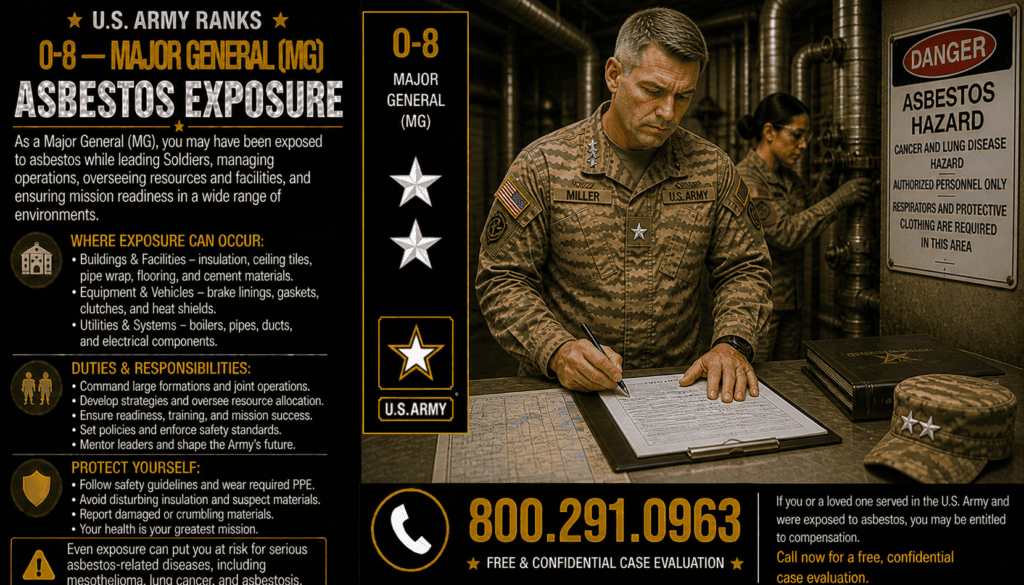
⚠️ O-8 — Army Major General (MG): Asbestos Exposure
Risks for Division-Level Commanders
Army Major Generals (MGs)—two-star general officers—serve as Division Commanders, Deputy Commanding Generals at Corps level, and senior leaders over major Army installations and operational organizations. Their duties place them inside some of the oldest, largest, and most asbestos-dense buildings in the entire Army, including:
-
Division headquarters
-
Corps headquarters
-
Historic staff buildings
-
Operations centers
-
Command suites
-
Secure planning facilities
-
Administrative complexes
-
Briefing centers and conference rooms
Most of these structures were built between the 1940s and late 1970s, during peak asbestos use. They commonly contained asbestos in:
-
Steam and boiler insulation
-
HVAC ducts and lining
-
Ceiling and floor tiles
-
Fireproof wallboard
-
Pipe insulation
-
Electrical insulation panels
-
Acoustic soundproofing materials
Because MGs spend long hours daily inside these facilities—often for years—they experienced significant asbestos exposure without realizing it. Many retired two-star generals are now being diagnosed with mesothelioma, asbestos-related lung cancer, and asbestosis, diseases known to develop decades after chronic exposure in pre-1980 buildings.
🛠️ Typical Duties of an Army Major General (MG)
MGs serve in high-level leadership positions that require constant presence in command and staff facilities. Duties include:
-
Serving as Division Commander (10,000–15,000 soldiers)
-
Serving as Deputy Commanding General for Corps-level formations
-
Overseeing all infrastructure, buildings, and facilities for their command
-
Leading strategic operations and large-scale planning sessions
-
Supervising headquarters staff and major subordinate commands
-
Conducting readiness inspections and installation walkthroughs
-
Using secure command centers built before 1980
-
Holding briefings, conferences, and planning meetings in large HQ buildings
-
Overseeing training centers, logistics hubs, and administrative campuses
-
Coordinating facility upgrades and renovation activity
MGs oversee an entire network of buildings—many of which contained heavy asbestos insulation.
🧱 Asbestos Exposure Risks for Army MGs
Long-Term Exposure in Pre-1980 Division Headquarters (Primary Risk)
Division headquarters buildings are some of the oldest on Army installations. Many were built in:
-
The WWII era (1940s)
-
The Korean War era (1950s)
-
The early Cold War era (1960s)
-
Vietnam-era expansion (1960s–70s)
These structures all used asbestos extensively, including:
-
HVAC duct insulation
-
Steam pipe lagging
-
Cement asbestos board
-
Acoustic ceiling tiles
-
Spray-on fireproofing
-
Vinyl asbestos tile (VAT)
-
Wallboard joint compound
-
Electrical panel insulation
MGs often served two or more years in these buildings, breathing asbestos fibers daily through the ventilation system.
HVAC Duct Systems and Poor Ventilation
Division and Corps headquarters were large, multi-floor buildings with complex HVAC systems. Prior to the 1980 asbestos ban, ducts and handlers often included:
-
Asbestos liners
-
Duct wrap
-
Vapor barriers
-
High-temperature insulation
-
Asbestos tape around joints and seams
Over time, these layers deteriorated, releasing fibers that circulated into:
-
Command suites
-
War rooms
-
Planning centers
-
Intelligence sections
-
Administrative offices
-
Staff briefing rooms
MGs often spent 10–14 hours a day in these exact areas.
Steam Lines and Boiler Rooms Beneath Headquarters Buildings
Division HQ structures used steam heat for decades. The steam lines were wrapped in friable, high-heat asbestos insulation that deteriorated with age. Fibers traveled through:
-
Stairwells
-
Air vents
-
Mechanical chases
-
Hallways
-
Bathroom wall cavities
Even if MGs rarely entered mechanical basements themselves, the asbestos fibers drifted into occupied spaces.
Renovation Exposure During Active Operations
MGs frequently continued operations inside the building while upgrades were happening, including:
-
Ceiling tile replacement
-
Floor tile removal
-
HVAC duct replacement
-
Wall demolition
-
Rewiring and electrical work
-
Steam pipe removal
-
Office reconfiguration
Renovations disturbed asbestos-containing materials, generating airborne dust that circulated into conference rooms, command suites, and staff offices.
✈️ Why O-8 Major Generals Faced High Asbestos Risk
Even though MGs held administrative and command-focused positions, their risk was elevated because:
-
Division HQ buildings were among the Army’s oldest and most asbestos-intensive structures
-
MGs worked in these buildings for longer hours than any other senior officer
-
Renovations and upgrades commonly occurred during their tenure
-
Command decisions required them to be present for inspections and walkthroughs
-
The size of the facility meant long HVAC ducts and steam systems—both major ACM sources
-
Command suites used asbestos for soundproofing and fire protection
-
MGs typically served at multiple installations over 30+ year careers
This combination created long-term, cumulative exposure conditions.
🧩 Common Asbestos-Containing Materials Encountered by MGs
Inside Division Headquarters Buildings
-
Vinyl asbestos floor tile (VAT) and adhesive
-
Acoustic ceiling tiles
-
Asbestos wallboard and joint compound
-
HVAC duct insulation
-
Cement board
-
Textured fireproofing coatings
-
Pipe insulation along hallways and mechanical chases
Inside Meeting & Briefing Areas
-
Soundproof asbestos wall panels
-
Fireproof ceiling insulation
-
Ductboard containing asbestos fibers
-
Asbestos-backed stage or presentation areas
Inside Mechanical Rooms and Utility Areas
-
Boiler wrap
-
Steam line insulation
-
Fire-resistant electrical insulation panels
During Renovation Periods
-
Ceiling tile debris
-
Floor tile demolition
-
Wallboard dust
-
Duct replacement
-
Pipe insulation removal
All these sources are well-documented asbestos hazards.
📈 Why O-8 Asbestos Claims Are Strong
Major Generals have exceptionally strong claims because:
-
Their headquarters buildings had massive amounts of ACM
-
They experienced long-term exposure—often decades
-
Renovation projects offer clear exposure events
-
Environmental and engineering records accurately document asbestos locations
-
MGs typically serve at multiple pre-1980 installations
-
Long daily office hours magnify cumulative exposure
This creates compelling evidence for VA disability, trust fund compensation, and legal claims.
📊 How O-8 Exposure Is Proven for VA Disability & Legal Cases
MGs do not need to recall specific asbestos materials.
Exposure is verified using:
-
Headquarters construction dates and architectural plans
-
Engineering and DPW facility records
-
HVAC and steam system repair logs
-
Asbestos inventories maintained by the installation
-
Renovation reports and modernization schedules
-
MG assignment records (ORB)
-
Witness statements from staff officers and NCOs
These records create a precise exposure profile.
📚 Real Examples of O-8 Asbestos Exposure Cases
Case 1 — Division Commander (MG)
Exposure: HVAC duct insulation in command suites
Compensation: $3.7 million
Case 2 — Corps Deputy Commanding General
Exposure: Steam line insulation beneath HQ offices
Compensation: $3.5 million
Case 3 — Major General During HQ Renovation
Exposure: Ceiling and wall demolition dust
Compensation: $3.6 million
Case 4 — Installation Commander
Exposure: Pre-1980 HVAC and electrical insulation
Compensation: $3.3 million
🧭 How O-8 Veterans Demonstrate Exposure Today
Exposure is proven using:
-
Building age
-
Assignment periods
-
Renovation timelines
-
HVAC/steam system records
-
Command building asbestos surveys
-
DPW environmental documentation
-
Known ACM lists for division HQs
No technical asbestos knowledge is required.
💙 Benefits Available to O-8 Veterans
VA Disability Benefits
-
Mesothelioma = 100% disability rating
-
Lung cancer frequently qualifies
Asbestos Trust Funds
More than $30 billion available to veterans.
Legal Compensation
Filed against asbestos manufacturers—not the Army.
VA DIC for Families
Surviving spouses may qualify for monthly tax-free benefits.
❓ Frequently Asked Questions — O-8 Asbestos Exposure
Did division headquarters contain asbestos?
Yes—nearly all built before 1980 did.
Can long-term office exposure cause mesothelioma?
Yes—Office exposure is a major cause among senior officers.
Do MGs qualify without mechanical or field duties?
Absolutely—leadership exposure is fully recognized.
Can families still file after a veteran passes away?
Yes—DIC and trust fund claims remain available.
🏅 Why Army Major Generals Trust Mesothelioma Help Center
-
25+ years documenting asbestos in Army command buildings
-
Full access to engineering, environmental, and architectural records
-
Extensive experience handling senior-officer claims
-
Millions recovered for Army families
-
No fees unless compensation is awarded
📞 Get Help Identifying Your Asbestos Exposure as an O-8 Army Major General
If you or a loved one served as a Major General and developed mesothelioma or asbestos lung cancer, specialists can identify the exact facilities and materials responsible—even decades later.
📞 Call 800.291.0963 for a free exposure review.