⚓ Pearl Harbor Naval Shipyard
Legacy of Asbestos Exposure Still Felt
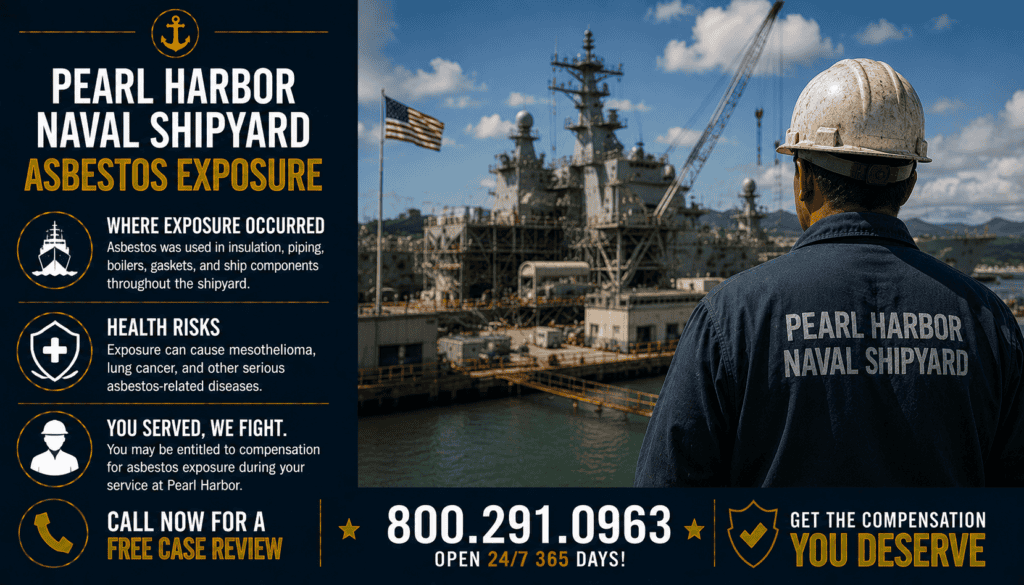
The Pearl Harbor Naval Shipyard in Honolulu, Hawaii — one of the oldest and busiest naval facilities in the U.S. — played a major role in World War II, the Korean War, and the Vietnam era. For decades, workers and sailors were surrounded by asbestos insulation, gaskets, and fireproofing materials used to maintain the Pacific Fleet. These toxic fibers lingered throughout the shipyard’s dry docks, workshops, and naval vessels, creating one of the nation’s largest concentrations of asbestos exposure.
This guide details where exposure occurred, who was affected, and how veterans and shipyard employees can pursue VA and legal compensation today.
📞 Need help proving Pearl Harbor exposure? Call 800.291.0963 for free assistance from experienced asbestos claim advocates.
🧭 Step 1: History of Asbestos Use at Pearl Harbor Naval Shipyard
From the 1930s through the 1980s, asbestos was considered essential for ship insulation and heat control.
Primary asbestos applications included:
-
⚙️ Boiler and engine-room insulation on Navy ships.
-
🧱 Pipe lagging, gaskets, and valve packing throughout the shipyard.
-
🔧 Welding blankets and protective coatings.
-
🏗️ Power plant and machine shop insulation.
-
🩺 Asbestos-lined laboratories and medical facilities on base.
Goal: Understand how widespread asbestos was in both ship and shore operations.
📁 Step 2: Who Was Exposed
Thousands of military and civilian personnel were affected, including sailors stationed nearby and civilian repair workers.
Commonly exposed groups:
-
⚓ Shipfitters, welders, and machinists.
-
🧰 Electricians and pipefitters.
-
🧱 Insulators, painters, and boiler tenders.
-
🪖 Sailors serving aboard docked vessels during repair cycles.
-
🧾 Civilians employed in maintenance and cleanup operations.
Goal: Identify your role or occupation to establish presumptive asbestos exposure.
💼 Step 3: Where Exposure Occurred Within the Shipyard
Asbestos dust permeated nearly every workspace in Pearl Harbor’s massive industrial complex.
High-exposure areas:
-
🛠️ Dry docks and vessel repair bays.
-
🧱 Boiler and propulsion repair facilities.
-
⚙️ Pipefitting and metal fabrication shops.
-
🩺 Base hospitals and power plants.
-
🚢 Decommissioning and scrapping zones.
Goal: Document your worksite locations for use in VA or trust-fund filings.
🧾 Step 4: Long-Term Health Risks
Decades later, many who served or worked at Pearl Harbor developed severe asbestos-related illnesses.
Diseases include:
-
💀 Malignant pleural and peritoneal mesothelioma.
-
🫁 Asbestosis and chronic respiratory failure.
-
🩺 Lung, throat, and stomach cancers.
-
💬 Pleural thickening and fibrosis.
Goal: Seek medical evaluation immediately if you served or worked at Pearl Harbor between 1930 and 1985.
⚖️ Step 5: VA and Federal Benefits for Pearl Harbor Veterans
Veterans diagnosed with mesothelioma linked to service at Pearl Harbor qualify for 100% VA disability compensation and access to specialized cancer treatment.
VA benefits include:
-
💰 Monthly, tax-free compensation.
-
🏥 Treatment at VA mesothelioma care centers.
-
🕊️ Survivor benefits for spouses and dependents.
-
⚖️ Legal right to file asbestos trust-fund claims.
Goal: File both VA and trust-fund claims to ensure maximum recovery.
🧱 Step 6: Civilian Worker Legal Rights
Civilian shipyard employees also have powerful legal options under federal asbestos laws.
Available compensation channels:
-
⚖️ Asbestos trust-fund claims against product manufacturers.
-
💵 Settlements from companies supplying ship materials.
-
🧾 Social Security Disability or Medicare coverage for diagnosed workers.
-
🕊️ Wrongful-death claims for surviving family members.
Goal: Pursue all legal avenues for financial and medical recovery.
🩺 Step 7: Evidence That Strengthens Pearl Harbor Claims
Proving exposure is easier than many realize due to extensive historical documentation.
Key evidence includes:
-
🧾 Employment or service records listing Pearl Harbor duty.
-
⚙️ Maintenance and overhaul work orders.
-
📜 BuShips technical manuals confirming asbestos use.
-
💬 Statements from coworkers or shipmates.
Goal: Collect multiple forms of documentation to verify exposure dates and duties.
🧠 Step 8: Environmental Cleanup and Legacy Contamination
Pearl Harbor Naval Shipyard remains one of the nation’s largest asbestos cleanup sites.
Recent findings:
-
🏗️ Ongoing asbestos abatement in older workshops and barracks.
-
🧱 Contaminated soil and insulation debris near dry docks.
-
⚙️ Veterans exposed during 1970s–1980s modernization projects.
Goal: Use environmental reports as additional proof of exposure during your service years.
🌈 Step 9: Survivor and Dependent Benefits
Families of veterans or shipyard workers who died from asbestos-related illnesses may qualify for:
-
💵 VA Dependency and Indemnity Compensation (DIC).
-
⚖️ Civil or trust-fund settlements.
-
🧾 Accrued VA benefits.
-
🕊️ Burial and memorial allowances.
Goal: Protect family financial rights under federal and state law.
💬 Step 10: Getting Professional Help
Accredited asbestos attorneys and veteran advocates can help you retrieve Pearl Harbor records and file claims across multiple systems.
Next steps:
-
🧭 Obtain service or employment verification.
-
⚙️ Collect medical and pathology reports.
-
🧾 File VA and trust-fund claims concurrently.
-
📞 Call for free assistance.
Goal: Secure full compensation and recognition for your service-connected asbestos exposure.
🤝 Where to Get Help
Our advocates specialize in helping Pearl Harbor veterans and shipyard workers file coordinated VA, trust-fund, and civil asbestos claims.
📞 Call 800.291.0963 today for a free, no-obligation case review.
🧭 Summary
The Pearl Harbor Naval Shipyard exposed thousands of sailors, Marines, and civilians to asbestos during decades of ship maintenance and repair. Veterans diagnosed with mesothelioma or other asbestos diseases can pursue VA, trust-fund, and civil compensation for their suffering and loss. Early filing protects evidence and speeds benefit approvals.
Justice for Pearl Harbor exposure victims begins with one call.
800.291.0963