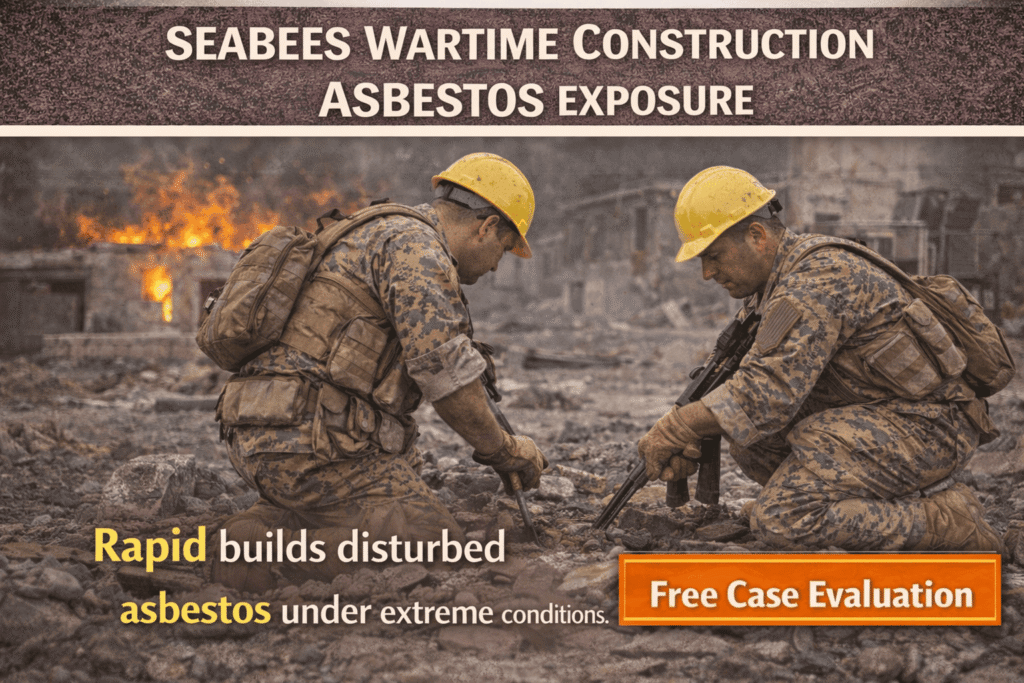
⚔️ Seabees Wartime Construction Mesothelioma Lawsuit
Rapid military construction during wartime disturbed asbestos under extreme and hazardous conditions.
During times of war, the U.S. Navy Seabees were tasked with building critical military infrastructure at unprecedented speed. From World War II through Korea, Vietnam, and later conflicts, Seabees constructed airfields, ports, bases, hospitals, power plants, and fortifications while under enemy threat and intense operational pressure.
Wartime conditions dramatically increased asbestos exposure. Speed took priority over safety, protective equipment was minimal or nonexistent, and asbestos-containing materials were cut, drilled, demolished, and repaired continuously. Many Seabees involved in wartime construction are now diagnosed decades later with mesothelioma and other asbestos-related diseases.
🧱 Why Asbestos Was Heavily Used During Wartime Construction
Asbestos was considered essential for rapid, durable, and fire-resistant construction during combat operations.
Wartime projects relied on asbestos for:
-
🔥 Fireproofing against explosions and fuel fires
-
❄️ Thermal insulation for power and heating systems
-
🧱 Structural durability in cement and panels
-
⚙️ Mechanical reliability in generators and boilers
-
🛡️ Protective barriers in bunkers and fortifications
Because materials needed to perform immediately, asbestos use was widespread and uncontrolled.
🚧 High-Risk Wartime Seabee Construction Duties
Combat-zone construction placed Seabees in constant contact with disturbed asbestos.
🏗️ Rapid Base and Facility Builds
Airstrips, command centers, and housing were built quickly using asbestos cement, insulation, and fireproofed steel.
✈️ Airfield and Runway Construction
Concrete panels, hangars, and control facilities incorporated asbestos materials cut and drilled on-site.
⚓ Port, Dock, and Harbor Construction
Fuel lines, steam pipes, and marine facilities used asbestos insulation exposed during installation and repair.
🚨 Emergency Repairs Under Fire
Bombing and combat damage required immediate repairs that shattered asbestos insulation and coatings.
🌍 Wartime Locations with Heavy Asbestos Exposure
Seabees encountered asbestos across multiple combat theaters.
🌴 World War II – Pacific & Europe
-
Island airfields and naval bases
-
Rapid wartime construction
-
Poor ventilation and dust conditions
🇰🇷 Korean War
-
Cold-weather insulation
-
Emergency power systems
-
Temporary structures
🇻🇳 Vietnam War
-
Heat-resistant asbestos materials
-
Constant repairs from combat damage
-
Long deployments
Repeated deployments multiplied cumulative exposure.
👷 How Wartime Conditions Increased Asbestos Exposure
Combat environments intensified exposure pathways:
-
🌬️ Inhalation of fibers from explosions and repairs
-
🧤 Contaminated uniforms worn continuously
-
🧰 Debris and rubble exposure during cleanup
-
🏠 Secondary exposure after returning home
Wartime urgency meant asbestos was disturbed without containment or respiratory protection.
🩺 Health Risks Linked to Wartime Asbestos Exposure
Asbestos fibers lodge permanently in lung or abdominal tissue.
⚠️ Common Asbestos-Related Diseases in Wartime Seabees
-
Mesothelioma (pleural and peritoneal)
-
Asbestos-related lung cancer
-
Asbestosis
-
Pleural plaques and thickening
Wartime exposure often involved high-intensity, repeated disturbance, increasing disease severity.
⏳ Long Latency Period of Wartime Asbestos Diseases
Asbestos illnesses typically appear long after combat service.
-
⏱️ Typical latency: 20–50 years
-
Symptoms often emerge decades after discharge
-
Diagnosis frequently occurs later in life
Because of this delay, legal claims usually begin at diagnosis, not exposure.
⚖️ Legal Options for Seabees Exposed During Wartime Construction
Seabees diagnosed with asbestos-related disease may qualify for multiple compensation options.
🧾 Available Compensation Paths
-
⚖️ Mesothelioma lawsuits against asbestos manufacturers
-
🏦 Asbestos trust fund claims
-
🎖️ VA disability compensation
-
👨👩👧 Wrongful death lawsuits for surviving families
Combat service does not limit legal rights.
🧑⚖️ How a Mesothelioma Lawyer Can Help Wartime Seabees
Wartime exposure cases are complex and documentation-heavy. An experienced lawyer can:
-
🔍 Identify asbestos products used in combat construction
-
📂 Reconstruct exposure using deployment and unit records
-
🏦 File claims with multiple asbestos trust funds
-
⚖️ File lawsuits in favorable U.S. jurisdictions
-
🎖️ Coordinate claims with VA benefits
Most cases are handled on a contingency basis, meaning no upfront cost.
⌛ Statute of Limitations for Wartime Asbestos Claims
Deadlines vary by state and usually begin:
-
At medical diagnosis, or
-
At death for wrongful death claims
Combat exposure does not shorten filing deadlines.
❓ Frequently Asked Questions (FAQs)
❓ Did wartime construction increase asbestos exposure?
Yes. Speed, damage, and lack of safety controls greatly increased exposure.
❓ Does combat service strengthen a claim?
Yes. Combat-zone exposure is well-recognized in asbestos litigation.
❓ Can VA benefits and lawsuits be combined?
Yes. These compensation paths are separate.
❓ What if records are incomplete?
Exposure can often be proven through unit history and job duties.
❓ Is it too late to file?
Often no. Most claims begin at diagnosis.
📞 Get Help for Seabees Exposed to Asbestos During Wartime Construction
If you or a loved one served as a Seabee in wartime construction and were diagnosed with mesothelioma or another asbestos-related disease, help is available now.
📌 You May Be Eligible For:
-
Significant financial compensation
-
Asbestos trust fund payments
-
VA disability or survivor benefits
-
Wrongful death compensation
📞 Call 800-291-0963 for a free, confidential case review
⏱️ No upfront costs • Nationwide representation • Seabee-focused claims
Acting now helps protect your rights and your family’s future.